By Way of the Cross
Jesus began to prophecy his trial and death months—if not years—before it happened. He told his disciples that he must go unto Jerusalem, and suffer many things of the elders and chief priests and scribes, and be killed, and be raised again on the third day. This was the sign of Jonah that he spoke about. He also told them, “The Son of Man shall be betrayed into the hands of men: And they shall kill him, and the third day he shall be raised again.”
When Jesus spoke about the good shepherd, he announced that he would bring his life back, like he did for Lazarus. “Therefore does my Father love me, because I lay down my life, that I might take it again. No man takes it from me, but I lay it down of myself. I have power to lay it down, and I have power to take it again. This commandment have I received of my Father. I am the good shepherd: the good shepherd gives his life for the sheep. I lay down my life for the sheep.”
Jesus also prophesied to his disciples the coming of the Son of Man. “Wherefore if they shall say unto you, Behold, he is in the desert; go not forth. Behold, he is in the secret chambers; believe it not. For as the lightning comes out of the east, and shines even unto the west; so shall be the coming of the Son of Man. For wheresoever the carcass is, there will the eagles be gathered together.” What Jesus meant is that the eagles would gather where the remnant of his teaching is found. “Thus the eagles gather,” says Lanello, “and where the eagles gather so shall the Body of Christ be.”
The eagle is also mentioned in Pistis Sophia, when Mary Magdalene shared her thoughts on the Psalm of David: Your vigor will renew itself like that of an eagle. Mary Magdalene said, “He thus mentioned like an eagle, “due to the eagle's abode being in the elevated region, similar to the Invisibles.” The Invisibles are the term Jesus and his disciples used to describe the ascended masters.
The eagle is unique in the nature kingdom for its ability to regenerate its body and prolong life, following immense pain. Their journey is an allegory for the resurrection, in the elemental-kingdom. Eagles renew themselves by breaking their old beaks against rock, which causes the beak to fracture and fall off. When a new beak has grown, the eagle uses it to pluck out feathers and talons, allowing for the growth of new ones. The entire process can take up to six months. Through patience and endurance, the eagle emerges with new beak, talons and feathers, which restores its ability to fly and to hunt.
Jesus continues: “Immediately after the tribulation of those days shall the sun be darkened, and the moon shall not give her light, and the stars shall fall from heaven, and the powers of the heavens shall be shaken. And then shall appear the sign of the Son of Man in heaven, and then shall all the tribes of the earth mourn, and they shall see the Son of Man coming in the clouds of heaven with power and great glory. And he shall send his angels with a great sound of a trumpet, and they shall gather together his elect from the four winds, from one end of heaven to the other.
“Now learn a parable of the fig tree; When its branch is yet tender, and puts forth leaves, you know that summer is nigh. So likewise, when you shall see all these things, know that it is near, even at the doors. Verily I say unto you, This generation shall not pass, till all these things be fulfilled.
“Heaven and earth shall pass away, but my words shall not pass away. Of that day and hour knows no man—no, not the angels of heaven—but my Father only. As the days of Noah were, so shall also be the coming of the Son of Man. For as in the days that were before the flood, they were eating and drinking, marrying and giving in marriage, until the day that Noah entered into the ark. And knew not until the flood came, and took them all away. So shall also the coming of the Son of Man be.”
“Then shall two be in the field; the one shall be taken, and the other left. Two women shall be grinding at the mill; the one shall be taken, and the other left. Watch therefore, for ye know not what hour your Lord does come. But know this, that if the man of the house had known when the thief would come, he would have watched, and would not have suffered his house to be broken up. Therefore be ye also ready. For in such an hour as you think not, the Son of Man comes.” For the Lord so comes as a thief in the night.
Now when the time of the Passover was approaching, Jesus and his disciples came nigh to Jerusalem and he sent two of his disciples to find a donkey to ride into Jerusalem. “Go your way into the village and you will find a colt tied, whereon never a man sat. Loose him, and bring him. And if any man say unto you, Why do you do this? say that the Lord has need of him, and straightway he will send him hither.”
So they went their way, and found the colt tied by the door. And one who stood there said to them, “What are you doing, loosing the colt? And they said unto them even as Jesus had commanded: and they let them go.”
Thus the words of the Prophet Zachariah would be fulfilled: “Rejoice greatly, O daughter of Zion. Shout, O daughter of Jerusalem. Behold, thy King cometh unto thee. He is just, and having salvation; lowly, and riding upon an ass, and upon a colt, the foal of an ass.”
The disciples brought the colt to Jesus. They cast their garments on the colt, and he sat upon it. Then many spread their garments in the way. Others cut down branches off the trees, and strawed them in the way. And they that went before, and they that followed, cried out: “Hosanna; Blessed is he that cometh in the name of the Lord. Blessed be the kingdom of our father David, that cometh in the name of the Lord. Hosanna in the highest!” Some of the Pharisees from among the multitude said to Jesus, “Master, rebuke thy disciples.” And Jesus answered and said unto them, “I tell you that, if these should hold their peace, the stones would immediately cry out.”
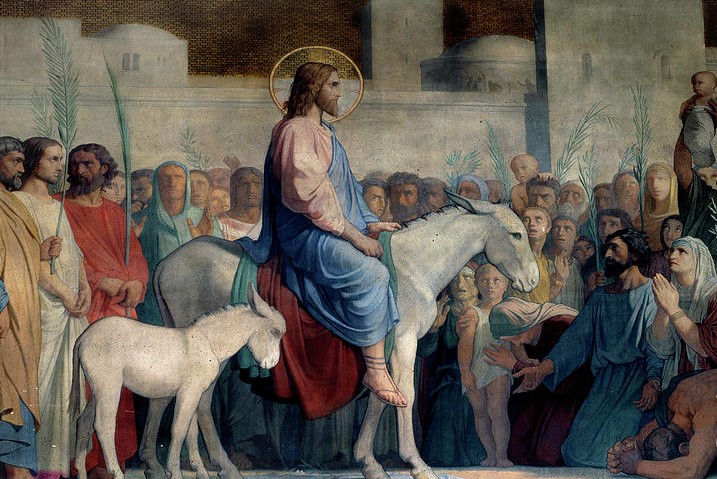
The Entrance of Christ into Jerusalem by Hypolithe Flandrin
Then, as Jesus neared Jerusalem, he began to weep. “O Jerusalem, Jerusalem, who kills the prophets and stones those sent to her, how often I have longed to gather your children together, as a hen gathers her chicks under her wings, but you were unwilling! Look, your house is left to you desolate. For I tell you that you will not see me again until you say, ‘Blessed is he who comes in the name of the Lord.’”
In a dictation through Mark Prophet, Mother Mary recounts Jesus' triumphal entry into Jerusalem. She said, “On that first Palm Sunday, as my beloved son rode upon the humble colt through the streets of Jerusalem in the midst of those “hosannas” and waving palms, his entire being radiated the feeling of deep humility and yet gracious dignity. He was, indeed, the true representation of the God-mastery of all life... to draw the attention of even the outer consciousness of the multitudes to his light.
“Our Jesus’ consciousness was that of complete oneness with his God and the radiation of that feeling from his very physical form was a magic quality which instantly lifted and raised the feelings of all the life he contacted, angelic, human and elemental as well. As he rode through the narrow streets of that ancient city in such peaceful God-control, no expression of studied pomp, pride or even self-satisfaction marred the natural beauty of his countenance which, as ever, remained fully composed, gentle and benign, in full command of the tremendous energies being released from those who thronged his way.
“For himself he accepted naught of the praise and adulation so released, but offered all to his beloved Father of Love. In all he did, Jesus obediently fulfilled his divine mission, even in the slightest detail. This triumphal entry into Jerusalem, City of Peace, was a part of that divine plan, revealing to all his unconquerable spirit as the living example of the all-powerful love of the Godhead—right here in this world of form. His example all men may follow—each one thus becoming his very own Christ in action.
“In the close connection with the beloved Jesus which was my honor and privilege—partly because I was his physical mother, I knew something of the tremendous strength, courage, power and many other God virtues which he had drawn from his source, through long hours of contemplation and application, to have made possible that day!
“The memories of that first Palm Sunday are as fresh and vibrant in my consciousness as though it had been yesterday. The mounting crescendoes of the voices of the people, harmoniously blending together in praise to God as the happy procession moved on, was thrilling indeed to me. It filled my soul, too, with deep and sincere gratitude—not only for his victory, but for the opportunity which was mine to be a part of that universal pageant of light.
“Beloved ones, you have heard it said that “a thing of beauty is a joy forever” and so it is! I say to you that everything of beauty endures forever—for all beauty expressed is God-in-action and can never cease to be! The outer physical forms in and from which that beauty manifests may disappear from the outer screen of life, but the etheric pattern, which is the divine idea and memory thereof, still abides in the akashic records.
“Let the radiant flame of my grace and peace anchor into your etheric bodies now—today—and awaken in you all the feelings of joy and praise you have ever known in past ages, when your accomplishments of light were very great. Those memories live in you, even though buried deeply in the folds of your etheric garment.”
The gospel story continues: And there were certain Greeks among them that had come to Jerusalem to worship at the feast of Passover: They went to Philip and said, “Sir, we would see Jesus.” Jesus answered them, saying, “The hour is come, that the Son of man should be glorified. Verily, verily, I say unto you, except a corn of wheat fall into the ground and die, it abides alone. But if it die, it brings forth much fruit. Now is my soul troubled and what shall I say? Father, save me from this hour: but for this cause came I unto this hour. Father, glorify thy name!”
Then came a voice from heaven, saying, “I have both glorified it, and will glorify it again.” The people that stood by heard the voice, and said that it thundered. Others said an angel spake to him.
This is the third time that a voice out of heaven speaks to Jesus, and others hear it. At his baptism, the voice said, “This is my beloved Son in whom I am well pleased.” During Jesus' transfiguration, the voice said, “This is my Son, whom I love. With him I am well pleased. Listen to him!” And now the voice said, “ I have both glorified my name, and will glorify it again.”
Jesus answered and said, “This voice came not because of me, but for your sake. Now is the judgment of this world. Now shall the prince of this world be cast out. And I, if I be lifted up from the earth, will draw all men unto me,” signifying what death he should die.
The people said, “We have heard out of the law that Christ abides for ever. How can you say, The Son of Man must be lifted up? Who is this Son of Man?” Jesus replied, “Yet a little while is the light with you. Walk while you have the light, lest darkness come upon you. For he that walks in darkness knows not whither he goes. While you have light, believe in the light, that you may be the children of light.” These things Jesus spoke and departed, and did hide himself from them.
The Gospel of Judas tells us: “The high priests were agitated, especially since Jesus had retired to a chamber for prayer. Some scribes lying in wait, intended to apprehend him during his devotions. Their apprehension stemmed from the public's reverence for Jesus—deeming him a prophet.”
Continuing with the Gospel of Matthew: Then Judas Iscariot went unto the chief priests and said unto them, “What will you give me, and I will deliver him unto you?” And they covenanted with him for thirty pieces of silver. And from that time he sought opportunity to betray him.
Now the first day of the feast of unleavened bread, the disciples came to Jesus saying, “Where would you like us to prepare and eat the Passover?” Jesus told them, “Go into the city to such a man, and say unto him, the Master says my time is at hand. I will keep the Passover at your house with my disciples. And the disciples did as Jesus had appointed them, and made ready the Passover.
In the evening, he sat down with the twelve, and as they were eating, he told them that one of them would betray him. They were exceeding sorrowful, and began every one to say, “Lord, is it I?” And he answered and said, “He that dips his hand with me in the dish, the same shall betray me.” Then Judas, who betrayed him said, “Master, is it I?” Jesus answered, “Thou has said. He it is, to whom I shall give a sop, when I have dipped it.” And when Jesus had dipped the sop, he gave it to Judas. After eating the sop, Satan entered into Judas and Jesus said, “What thou doest, do quickly.”
None of the other disciples understood why Jesus said this. Some thought that because Judas had the money bag, Jesus said “Buy those things that we have need for the feast; or that he should give something to the poor.” And Judas having eaten the sop went immediately out, and it was night. After he left, Jesus told the rest of his disciples, “Now is the Son of Man glorified, and God is glorified in him. If God be glorified in him, God shall also glorify the Son of Man in himself, and shall straightway glorify him.” Jesus was reaffirming that even in the initiation at hand, “I and my Father are One,” and that things would unfold swiftly.
Then, Jesus washed the feet of his disciples. And as they were eating, Jesus took bread, and blessed it, and brake it, and gave it to the disciples, and said, “Take, eat; this is my body.” And he took the cup, and gave thanks, and gave it to them, saying, “Drink ye all of it; For this is my blood of the new testament, which is shed for many for the remission of sins. But I say unto you, I will not drink henceforth of this fruit of the vine, until that day when I drink it new with you in my Father’s kingdom.” And when they had sung an hymn, they went out into the mount of Olives.
In the dictation, “I Have Desired to Be Remembered by You,” the master Jesus spoke of the last supper as his communion with Maitreya. This denotes the workings of the Brotherhood East and West, and the oneness of the body of God, on earth as in heaven. “As you know, at the Last Supper, prior to my crucifixion, I also took bread and gave thanks to my heavenly Father and to my Guru, Lord Maitreya, for the initiation of the crucifixion that they would shortly set before me. Having thus prayed, I did break a loaf of bread, representing the whole loaf of my body, and I said: “Take, eat: this is my body, which is broken for you. This do in remembrance of me.”
“And when the disciples and I had supped, I took the cup and again gave thanks to my heavenly Father and to my Guru, Lord Maitreya, and gave it to the twelve. Then I commanded them to drink the full cup of my sorrows and the full cup of my joy, saying: “Drink ye all of it. For this is my blood of the new testament, which is shed for many for the remission of sins. This do ye, as often as ye drink it, in remembrance of me.”
“By this twofold ritual, I inaugurated the sacrament of Holy Communion. And I commanded the twelve and all who would receive me through their witness to institute this sacrament unto the fulfillment of the age of Pisces and the fullness of their Christhood....In my concluding prayer at the Last Supper, I called to Sanat Kumara, Gautama Buddha and Lord Maitreya for the blessing of my disciples and the other seventy, of all who had been called and of all who would answer the call. It was a passing of the torch, the transfer of a mantle, if you will.”
Then, Jesus washed the disciples' feet and the master explained why. “Knowing that the Father had given all things into my hands and that I was come from God and would go to God –even as you have come from God and will go to God—I rose from supper and laid aside my garments and took a towel and wrapped it around myself. Then I poured water into a basin and washed my disciples’ feet and dried them with the towel.
“But when I came to Simon Peter he said, “Lord, are you going to wash my feet?” And I said to him, “You do not understand what I am doing and why I am doing it, but one day you will know what I have done for you and you will rejoice in me.”
“But the impetuous Peter said, “You will never wash my feet!” Whereupon I answered, “If you do not allow me to wash your feet, you will have no part with me in the resurrection.”
“For, as I further explained to him, the ritual of the Master washing the disciple’s feet was an ancient custom. In so doing, the Master was initiating the disciple to come up higher on the initiatic ladder. It signified that the Master had washed his disciple’s understanding.
“In this case, I, as their Master, had come to do just that and more: I had come to take upon myself the burden and the yoke of a portion of each disciple’s karma.
“Now Peter understood and he said to me, “Lord, not only my feet but also my hands and my head.”And so I completed the ritual. And Peter and the rest recognized the empowerment that I had conveyed to them in the ritual of the washing of their feet. This empowerment would be with them long after I had departed from Palestine, even unto the hour of their ascension.
"In my concluding prayer at the Last Supper, I called to Sanat Kumara, Gautama Buddha and Lord Maitreya for the blessing of my disciples and the other seventy, of all who had been called and of all who would answer the call. It was a passing of the torch, the transfer of a mantle, if you will.
Continuing with the Gospel of Matthew. Then Jesus said to them, “All of you shall be offended because of me this night. For it is written, I will smite the shepherd, and the sheep of the flock shall be scattered abroad. But after I am risen again, I will go before you into Galilee.”
Peter answered, “Though all men shall be offended because of thee, yet will I never be offended!” Jesus said to him, “Verily I say to you, that this night, before the cock crows, you shall deny me thrice.” Peter said to him, “Though I should die with thee, yet will I not deny thee.” All the disciples said likewise.
Then Jesus went with them to a place called Gethsemane, and said to the disciples, “Sit ye here, while I go and pray yonder.”
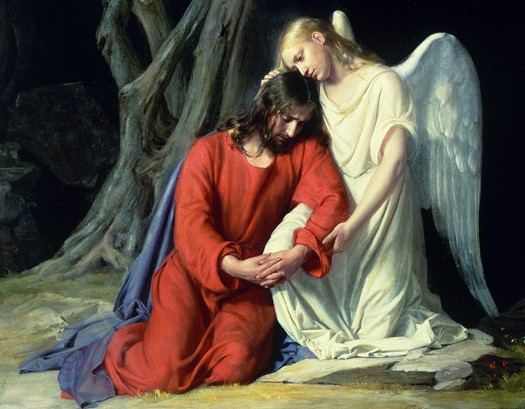
In Gethsemane by Carl Bloch
And Jesus took with him Peter, James and John, and began to be sorrowful and very heavy. He said, “My soul is exceedingly sorrowful, even unto death. Tarry here, and watch with me.” Then he went a little further, and fell on his face and prayed, saying, “O my Father, if it be possible, let this cup pass from me. Nevertheless not my will but thine be done.” Then Jesus went to the disciples, and found them asleep, and said to Peter, “What? Could you not watch with me one hour? Watch and pray, that you enter not into temptation. The spirit indeed is willing, but the flesh is weak.”
Jesus described this initiation in another dictation. “Did not doubt assail me in the Garden of Gethsemane?” he said. “Did not all the hordes of the planetary momentum of death assail me as I myself would face the hour of apparent death? Beloved hearts of light, they did. And I will tell you that our Father has provided the solution to this entire momentum of death and doubt and fear. It is the love, the very love of the will of God.”
Jesus went away again the second time and prayed, saying, “O my Father, if this cup may not pass away from me, except I drink it, thy will be done.” And he came and found them asleep again, for their eyes were heavy. And he left them, and went away again, and prayed the third time, saying the same words. Then he went to his disciples and said to them, “Sleep on now, and take your rest: behold, the hour is at hand, and the Son of Man is betrayed into the hands of sinners.”
Then he said, “Rise, let us be going. Behold, he is at hand that does betray me.” And while he was speaking, Judas came with a great multitude from the chief priests and elders of the people, with swords and staves and lanterns and torches and weapons. Jesus, knowing all things that should come upon him, went forth and said unto them, “Whom seek ye?” They answered, “Jesus of Nazareth.” Jesus said to them, “I AM He”—and as soon as he had said this, they went backward, and fell to the ground, because there was so much power in his words.
Judas had given them a sign, “Whomsoever I kiss is he. Hold him fast.” And he went up to Jesus and said, “Hail Master,” and kissed him. Jesus said unto him, “Friend, wherefore art thou come?” Then they came and laid hands on Jesus. And, behold, Peter stretched out his hand, and drew his sword, and struck Malchus, a servant of the high priest, and smote off his ear. Jesus said, “Put thy sword into the sheath: the cup which my Father has given me, shall I not drink it?Thinkest thou that I cannot now pray to my Father, and he shall presently give me more than twelve legions of angels? But how then shall the scriptures be fulfilled, that thus it must be?”
We witness again and again Jesus' deepest commitment and love to fulfilling the scriptures.
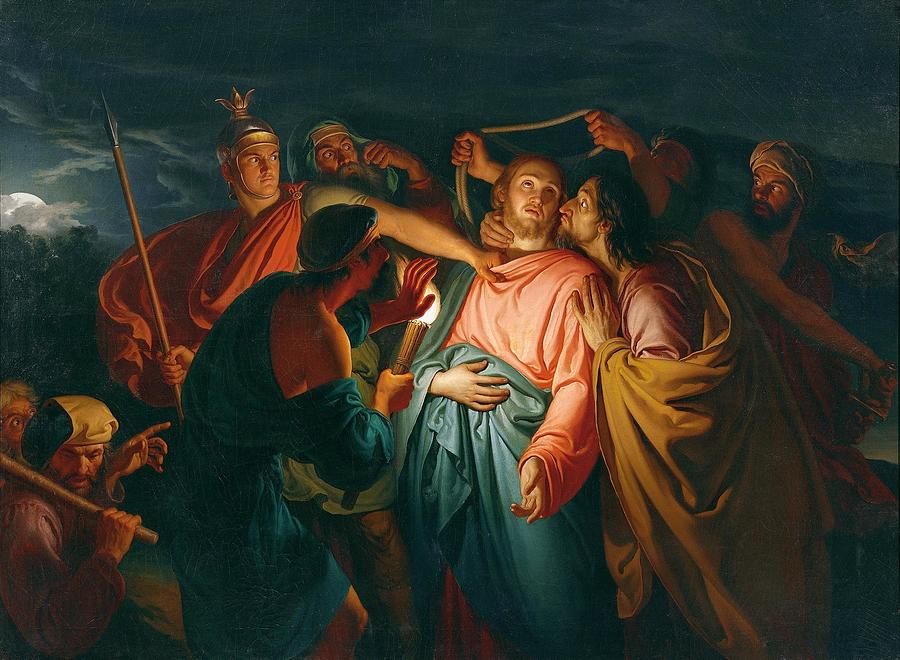
The Judas Kiss by Giuseppe Diotti
Jesus said to the multitudes, “Are ye come out as against a thief with swords and staves to take me? I sat daily with you teaching in the temple, and ye laid no hold on me. I have told you that I am He. If therefore ye seek me, let these go their way,” he said, speaking of the disciples, and thereby fulfilling his promise to the Father, “Of them which thou gavest me, have I lost none.”
Then all the disciples forsook him, and fled, safe one.
Then the band and the captain and officers of the Jews took Jesus, and bound him, and led him away to Annas first, for he was father in law to Caiaphas, who was the high priest that same year. Annas questioned Jesus about his disciples, and his doctrine. Jesus answered, “I spake openly to the world. I taught in the synagogue, and in the temple, where the Jews always resort, and in secret I have said nothing. Behold, they know what I said.” And when he had thus spoken, one of the officers which stood by, struck Jesus with the palm of his hand, saying, “Is this how you answer the high priest?” Jesus said to him, “If I have spoken evil, bear witness of the evil. But if I spoke well, why do you smite me?”
Now Caiaphas had counseled the Jews that it was expedient for one man to die for the people. So Annas bound Jesus and sent him to the Hall of Judgment to be tried before Caiaphas, where the scribes and the elders were assembled.
The fallen ones through Annas and Caiphus were taking the opportunity to try Christ in their earthly Judgment Hall, as a satanic inversion and retaliation against God for the true Judgment Hall that is the Court of the Sacred Fire on the God Star Sirius. Here souls of great darkness are taken to the second death at God's appointed time, and for their sin against the Holy Spirit incarnate in Jesus and all of God's children.
Jesus reminded students of the Summit Lighthouse to be wise as serpents and harmless as doves. “Do not whitewash the deeds of the seed of the Wicked One. Do not sympathize with the sorrows of Satan or his cohorts. But meditate upon the wondrous Love of God and contemplate his Wisdom. Go to the altar and let God tell you, through your Mighty I AM Presence, what is Truth, what is Error, what is Real, what is Unreal.
“When I sent the other seventy disciples two by two before me to prepare the way for my coming in every city where I would go, they returned with joy, for the devils were subject unto them in my name. For my presence was both with them and in them.
“Then I told them that I had beheld Satan as lightning fall from heaven. At that point I empowered them in my name to tread on “serpents” and “scorpions” and to neutralize the power of the enemy, and I promised them that nothing would by any means hurt them. Finally, I told them to rejoice not that the spirits were subject unto them but that their names were written in heaven.”
The gospels tell us Peter and another disciple followed Jesus to the palace. I believe that disciple was John the Beloved, because John was the only disciple who had the courage to be at the foot of the cross. This disciple who went in with Jesus is only mentioned in the Gospel of John, and John, out of humility, would speak of himself in the third person, as “the disciple whom Jesus loved;” and in this instance, as “the disciple which was known to the high priest.”
Peter followed from afar to the high priest’s palace, and went in to the courtyard. The other disciple, which was known unto the high priest, followed Jesus inside but was let out. Then the damsel that kept the door said to Peter, “Are you not also one of this man’s disciples?” And Peter replied, “I know not what you say.” Then he stood with the servants and officers who had made a fire of coals, for it was cold, and they warmed themselves.
When Peter went under the porch, another maid saw him and said, “This fellow was also with Jesus of Nazareth.” Again Peter swore, “I do not know the man.” After a while, one of the servants of the high priest, who was kin to the one whose ear Peter had cut off, said, “Did not I see you in the garden with him? Peter denied again, and immediately the cock crowed and Peter remembered the words of Jesus. Then he went out and wept bitterly, for like Saint Paul later wrote, “The good that I would I do not. But the evil which I would not, that I do.”
Now the chief priests and elders, and all the council sought false witnesses to incriminate Jesus and put him to death. Though many false witnesses came, they found no evidence. At last two false witnesses said, “This fellow said, I am able to destroy the temple of God, and to build it in three days.”
The high priest arose, and said to Jesus, “Do you answer nothing?” Still Jesus held his peace, so the high priest said, “I adjure you by the living God, tell us whether you are the Christ, the Son of God.” And Jesus answered, “You have said. Nevertheless I say unto you, hereafter shall you see the Son of Man sitting on the right hand of power, and coming in the clouds of heaven.”
Then the high priest rent his clothes, saying, “He has spoken blasphemy; what further need have we of witnesses? Behold, now you have heard his blasphemy. What do you think?” They answered and said, “He is guilty of death.” Then they spit in his face, and buffeted him; and others smote him with the palms of their hands, saying, “Prophesy unto us, thou Christ, who is he that smote thee?” And these same ones who accused Christ of blaspheming were blaspheming against the Holy Spirit, as Jesus warned.
When the morning had come, all the chief priests and elders of the people took counsel against Jesus to put him to death. And when they had bound him, they led him away, and delivered him to Pontius Pilate, the Roman governor.
Pilate asked, “What accusation do you bring against this man? The mob became the more fierce, saying, “He stirs up the people, teaching throughout all Jewry, from Galilee to this place.” When Pilate heard of Galilee, he asked whether Jesus was Galilæan. As soon as he knew Jesus belonged to Herod’s jurisdiction, he sent him to Herod, who happened to be in Jerusalem at the time. That day, uniting against the Christ, Pilate and Herod became friends; whereas before, they were at enmity with each other. When Herod first saw Jesus, he was exceedingly glad because he had desired to see Jesus for a long time. He had heard many things of Jesus and hoped to see a miracle. So he questioned him with many words; but Jesus answered nothing. Meanwhile, the chief priests and scribes vehemently accused him.
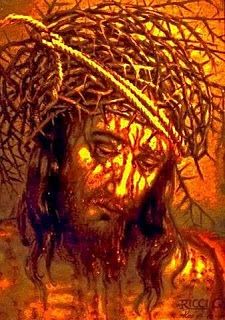
Then, Herod sent Jesus back with his soldiers to Pilate, and dressed him in a gorgeous purple-scarlet robe to mock him. The soldiers plaited a crown of thorns and put it on his head, and placed a reed in his right hand, and bent the knee before him, mocking, “Hail, King of the Jews!” And they spit upon him, and took the reed, and smote him on the head. The Gospel of Peter tells us that some who scourged him, said, “With such honor let us honor the Son of God.”
According to experts on the Shroud of Turin, the burial cloth in which Jesus was wrapped, the crown of thorns was not a simple wreath. It was like a helmet made of very sharp and strong Jerusalem thorns, that punctured Jesus' head in many places. The photographic image that appeared upon the shroud from the burst of resurrection flame reveals that Jesus had more than fifty head wounds from this crown of thorns.
Meanwhile Judas, who betrayed Jesus thinking Jesus would save himself and summon the powers of heaven to defeat the powers of this world, saw that Jesus was condemned. He repented and returned the thirty pieces of silver to the chief priests and elders saying, “I have sinned by betraying innocent blood.” “What is that to us?” they said. So Judas left the pieces of silver in the temple, and went and hung himself.
The chief priests then took the silver pieces and said, “It is not lawful to put them in the treasury, because this is the price of blood. So they used the silver pieces to buy the “potter’s field,” where potters would find clay to make their pottery.
Jeremiah and Isaiah both spoke of God as the master potter. Isaiah said, “But now Lord, you are our Father. We are the clay, and you;our potter. And we are all the work of your hand. Jeremiah said, O house of Israel, cannot I do with you as this potter? saith the Lord. Behold, as the clay is in the potter's hand, so are ye in mine hand, O house of Israel.”
The chief priests decided the field would be used to bury Gentiles, and the field to this day is called the field of blood.
When Pilate entered into the judgment hall again and sat down on the judgment seat, his wife sent a message to him saying, “Have nothing to do with that just man: for I have suffered many things this day in a dream because of him.” Pilate asked Jesus, “Art thou the King of the Jews?” Jesus answered, “Do you say this of yourself, or did others tell you this about me?
“Am I a Jew?” asked Pilate. “Thine own nation and chief priests have delivered you unto me. What have you done?” Jesus answered, “My kingdom is not of this world. If my kingdom were of this world, then would my servants fight, that I should not be delivered to the Jews. But now is my kingdom not from hence.”
Pilate then said to Jesus, “Are you a king then?” Jesus answered, “You say I am a king. To this end I was born, and for this cause came I into the world, that I should bear witness unto the truth. Every one that is of the truth hears my voice.” “What is truth?” asked Pilate with jadedness.
When we observe all of the manipulations and treacheries of this world, with wheels within wheels of illusion, we must stay tethered to God Reality by holding on to the hem and the hand and Will of the Master, together with our own Christ Self and the great hosts of ascended masters. This secret was known as “tikkun,” to the ancient Kabbalists. It is the practice of clinging to God.
Pilate called together the chief priests and the rulers and the people and said unto them, “You have brought this man unto me as one who deceives the people. Behold, I have examined him before you and have found no fault in him. Neither has Herod found anything worthy of death. I will therefore chastise him, and release him.”
They answered, “If he were not a malefactor, we would not have delivered him up to you.” Pilate said, “Then you take him and judge him according to your law.” The Jewish authorities replied, “It is not lawful for us to put any man to death.”
Pilate took Jesus and scourged him, and went forth again and said, “Behold, I bring him forth, that you may know that I find no fault in him.” Then came Jesus forth, wearing the crown of thorns, and the purple-scarlet robe. And Pilate said unto them, “Behold the man!”
When the chief priests and officers saw him, they cried out again, “Crucify him, crucify him.” Then Pilate said unto them, “Take him, and crucify him: for I find no fault in him.”
The Jews answered, “We have a law, and by our law he ought to die, because he made himself the Son of God.” When Pilate heard this, he was that much more afraid of making a mistake, so he went again into the judgment hall, and said to Jesus, “Who are you?” But Jesus gave him no answer.
Pilate said to them, “I find in him no fault at all. But you have a custom, that I should release to you a prisoner at Passover. Would you like me to release to you the King of the Jews? Which one of the two shall I release?” Pilate said, speaking also of the robber. “Barabbas,” they said. “What shall I do then with Jesus who is called Christ?” asked Pilate. “Let him be crucified,” they all answered. Pilate asked why. “What evil has he done?” But they cried out all the more, “Let him be crucified.”
Then Pilate said to Jesus, “Won't you speak to me? Don't you know that I have the power to crucify you and the power to release you?” Jesus answered, “You could have no power at all against me, except it were given from above. Therefore he that delivered me to you has the greater sin.”
Pilate sought to release Jesus again, but the Jewish authorities played a political card. They knew Pilate must report to Caesar, and so they bribed him with a veiled threat. “If you let this man go, you are not Cæsar’s friend. Whosoever makes himself a king speaks against Cæsar.” So Pilate brought Jesus forth again, thinking they would be satisfied from all the suffering he had already received, and move on to their Passover celebrations. Sitting in the judgment seat called Gabbatha in Hebrew, he said to them, “Behold your King!” Still, they cried out, “Away with him, away with him, crucify him.” Pilate replied, “Shall I crucify your King?” And the chief priests answered, “We have no king but Cæsar.”
The Gospel of Peter tells us that even the Roman centurions were afraid of the Jews. When Pilate saw that he could not prevail and that the Jews would likely start a riot under his watch, he took water and washed his hands before them, saying, “I am innocent of the blood of this just man. You see to it.” The people replied, “His blood be on us, and on our children.” The Gospel of Peter reports that Pilate said: “I am clean of the blood of the Son of God for it is better for us to owe the debt of the greatest sin in the sight of God, than to fall into the hands of the Jewish people and be stoned.”
Then Pilate released Barabbas and the soldiers put Jesus' raiment back on him, and led him away to be crucified. The Gospel of Peter also tells us that the people were pushing Jesus, saying, “Let us drag along the Son of God now that we have power over him.”
Joseph of Arimathea, who was a friend of both Pilate and Jesus, had been standing there and had not consented to their deed. Knowing they were about to crucify him, he came before Pilate and requested Jesus' body for burial. Pilate sent a request to Herod, and Herod said, “Brother Pilate, even if no one had requested him, we would have buried him, since indeed Sabbath is dawning. For in the Law it has been written: The sun is not to set on one put to death.”
Elizabeth Clare Prophet gave an important lecture on the crucifixion. She explained that the same multitudes who cheered Jesus in his triumphal entry into Jerusalem were the ones who, two days later, cried out, “Crucify him!” She said, “It was the chief priests—who finally had become the fallen angels in embodiment, edging themselves in positions of power among the Jews—that crucified Christ. They did not crucify Jesus, they crucified the Christ. The same multitudes who proclaimed him on Palm Sunday—who received him with palms and laid their cloaks beneath his feet that he might pass, gave glory and praise to him—now, under the magnetism and the influence of these fallen angels, could cry out for Barabbas to be freed and demand that that same one be crucified. This shows a stronger mind, a stronger will, a stronger power than the people had.
“On the one hand, Jesus had the great power to heal them, to teach them. And when they were in the circle of the Good Shepherd, they were able to endure in his light. But when they came under the dark auras of the fallen ones, they immediately, almost like chameleons, took upon themselves their auras and were poisoned by their lies and accusations.
“Pilate himself was not fooled, for he was one also. He had the knowledge of heaven and earth. He was a fallen angel who could have gained himself a great good karma. He could have spared Jesus in defiance of the people and the priests—but he was a politician. He was concerned about the opinions of the people especially. And so he did the will of the people but knew full well that it was because of the envy of the high priest and the Pharisees, their envy of Jesus’ power, that they desired to put him to death.
“But more than this, they knew that the Christ in him had the power to judge them before Almighty God. And it was for this power of judgment that the hatred of the chief priests was upon Jesus; for no one had ever dared challenge their hierarchy, no one had ever dared accuse them, no one had ever called them sons of the devil and denied that they were sons of Abraham—no one but Jesus.
“He said it to them publicly. He challenged their entire position, and therefore they feared greatly—and they feared the people also. They would not go against the will of the people. They, therefore, had first to brainwash the people against him with their lies, their accusations, their disinformation.” The Gospel of Matthew confirms this, and describes that Pilate knew “that for envy they had delivered him.”
Veil of Veronica
Now we enter the fourteen stations of the cross. The ascended masters place the fourteen stations of the cross on the twelve lines of the cosmic clock, and describe the human perversions of each line. The last two stations represent the figure-eight flow between Alpha and Omega, on the twelve and six o'clock points. We can understand the fourteen stations of the cross as a mystical illustration of Jesus carrying the sins of the world on all lines of the clock, and transmuting the negative attributes of each human misqualification.
Station 1: Jesus is condemned to death
12 o'clock line. Capricorn criticism, condemnation, and judgment
Station 2: Jesus is made to bear his cross
1 o'clock line. Aquarius hate and hate creation, mild dislike, irritation
Station 3: Jesus falls the first time
2 o'clock line. Pisces fear, doubt, human questioning, records of death, anxiety and human reasoning.
Station 4: Jesus meets his afflicted mother
3 o'clock line. Aries pride of the mind, ego, arrogance, conceit and deceit
Station 5: Simon the Cyrenian helps Jesus bear his cross
4 o'clock line. Taurus disobedience, stubbornness, and defiance of God's law
Station 6: Veronica wipes the face of Jesus
5 o'clock line. Gemini envy, jealousy, and ignorance
Station 7: Jesus falls the second time
6 o'clock line. Cancer indecision, self-pity, and self-justification.
Station 8: Jesus consoles the holy women
7 o'clock line. Leo ingratitude, absence of grace, absence of appreciation of the flame of God.
Station 9: Jesus falls the third time
8 o'clock line. Virgo injustice, sense of injustice, and the defilement of God-justice
Station 10: Jesus is stripped of his garments
9 o'clock line. Libra unreality, treachery and intrigue
Station 11: Jesus is nailed to the cross
10 o'clock line. Scorpio selfishness, self-love, lust, self-concern, spiritual blindness
Station 12: Jesus dies on the cross
11 o'clock line. Sagittarius resentment, revenge, and retaliation
Station 13: Jesus is taken down from the cross
12 o'clock line. Capricorn opposition to the figure-eight flow of energies from Alpha to Omega in the white fire core of being
Station 14: Jesus is laid in the sepulcher
6 o'clock line. Cancer opposition to the figure-eight flow of energies from Omega back to Alpha in the white fire core of being
And as they led him away, they found a Cyrenian coming out of the country named Simon, and made him carry the cross for Jesus. Elizabeth Clare Prophet taught about this: “Thus, the Christ is given the help of Simon the Cyrenian; and therefore, we realize that Jesus accepts helpers in the bearing of the burden of the cross of world karma. We may bear one another’s burden,” she adds, “but at the place of the fastening of the heart to that mighty cross, we go alone.”
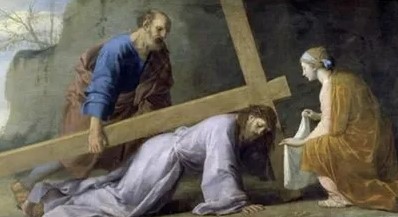
Jesus Carrying his Cross Eustache Le Sueur
The gospels says there followed him a great company —including Mother Mary and Mary Magdalene, and Mary the mother of James and Joses, and the mother of Zebedee’s children—as well as many other women who bewailed and lamented Jesus. And Jesus turned to them and said, “Daughters of Jerusalem, weep not for me, but weep for yourselves, and for your children. For, behold, the days are coming, when they shall say, Blessed are the barren, and the wombs that never bore, and the breasts which never gave suck. Then shall they begin to say to the mountains, Fall on us; and to the hills, Cover us. For if they do these things to a green tree, what shall be done to the dry?” Jesus was the green tree full of life.
There was also a woman who, according to tradition, wiped Jesus’ face with a cloth as he carried the cross to Calvary. The cloth is a catholic relic that is said to bear the true image of Christ’s face and has been safeguarded in the Vatican Basilica.
They arrived at Golgotha, the “place of a skull,” which was near the city, so many people passed by. Pilate wrote a title, and put it on the cross: “Jesus of Nazareth the King of the Jews.” It was written in Hebrew, and Greek, and Latin. The Jewish chief priests said to Pilate, “Write not, The King of the Jews—only that he said, I am King of the Jews.” They did not want a statement of fact, but Pilate refused to change it. “What I have written I have written,” he answered.
Two other malefactors were put to death alongside Jesus, one on the right hand, and the other on the left. Jesus said, “Father, forgive them; for they know not what they do.” Then the soldiers, having crucified Jesus, took his garments, and made four parts. They gave each soldier a part. Now his coat was without seam, woven from the top down through, so the soldiers said among themselves, “Let us not rend it, but cast lots for it, whose it shall be.”
This fulfilled the scripture from the Book of Psalms: “They parted my raiment among them, and for my vesture they did cast lots.” All of these actions reflected the desire of the fallen ones to steal Jesus' light by appropriating his spiritual mantles. The seamless coat also has a spiritual significance. The ascended masters speak of the seamless garment, which is the vehicle by which the soul is transported into the heaven planes, and that Jesus called the wedding garment.
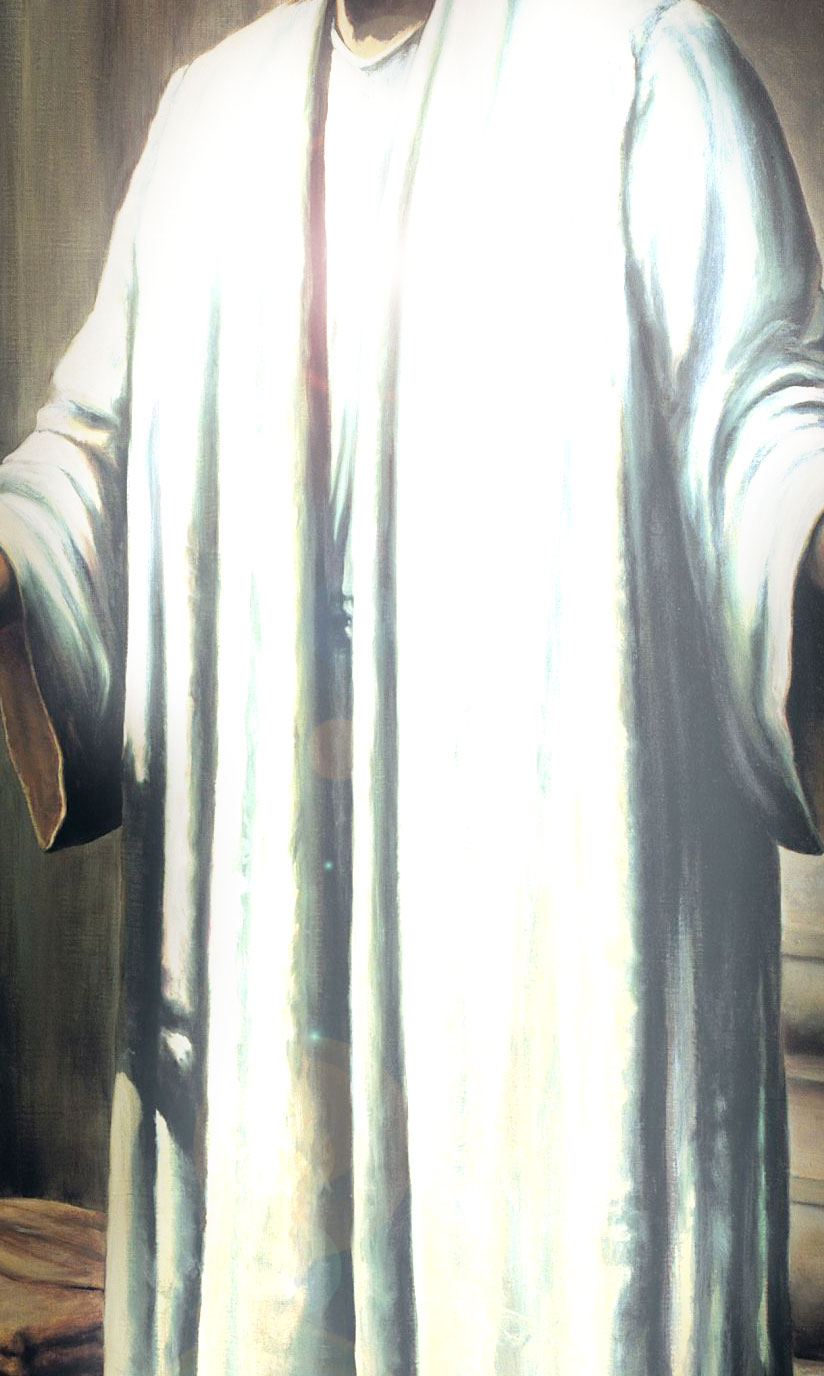
The Seamless Garment
Two ascended masters, who stood by the tomb in white apparel, gave a dictation through the Summit Lighthouse and said:“The very threads themselves represent the consciousness, the thoughts, the feelings. Thoughts are the warp, feelings are the woof, and the fire of the etheric body is the smoothness of the cloth that is to drape as a forcefield of auric protection around the physical body and all of the bodies.”
Jesus told students in a dictation, “Mend the holes in your seamless garment. Go back to the fragmented parts. All these you must retrieve if you would weave the deathless solar body. If you have holes in your garment, you must sew them up. You must seal your garment until the soul is satisfied and filled with light and filled again and again.”
The master Saint Germain also spoke about the seamless garment: “It is quite natural to draw light from within your heart and send it out into the world. This is the virtue that creates the seamless garment. Do you realize that your tube of light is the seamless garment of the Christ? Do you realize when you call forth from God the perfection of his light-radiance to surround you that you are weaving the seamless garment around yourself?”
Those who passed by Jesus reviled him, wagging their heads and saying, “Thou who destroys the temple, and builds it in three days, save thyself. If thou be the Son of God, come down from the cross.” Likewise the chief priests mocked him with the scribes and elders: “He saved others. Himself he cannot save! If he be the King of Israel, let him now come down from the cross, and we will believe him. He trusted in God. Let God deliver him now if he will have him. For he said, I am the Son of God.”
The soldiers also mocked him, and took a sponge filled with vinegar and gall, a bitter potion made to dull the pain. They put it on a hyssop reed and gave him to drink, saying: “If thou be the king of the Jews, save thyself.” When he had tasted it, he would not drink. The ascended master Sanat Kumara said in a dictation, “He who hung on the cross refused to drink the vinegar mingled with gall, because he rejected this mockery of his crucifixion by Serpent’s seed.”
Prophet writes, “It is very interesting to see that when the chips are down, when the Son of God is so belittled, all of those who dared not speak against him when he was in the temple will come to wag their heads and to berail him, especially when they can group themselves in numbers. For, in actuality, they always fear the Anointed One but somehow are encouraged in their numbers to get back at him.
One of the malefactors who was crucified alongside him said, “If thou be Christ, save thyself and us.” But the other rebuked him, saying, “Do you not fear God, seeing you are in the same condemnation? We are condemned justly, and receive the just recompense for our deeds. But this man has done nothing amiss.” Then he said to Jesus, “Lord, remember me when you come into your kingdom.” Jesus replied, “Verily I say to thee, today you shall be with me in paradise.”
Now stood by the cross Mother Mary, and his mother’s sister—Mary the wife of Cleophas—and Mary Magdalene. When Jesus saw his mother, and the disciple standing by whom he loved, he said to his mother, “Woman, behold thy son!” Then he said to the disciple, “Behold thy mother!” And from that hour that disciple, John the Beloved, took her into his own home.
John witnessed that after this, Jesus—knowing that all things were accomplished that the scripture might be fulfilled—said, “I thirst.” There was set a vessel full of vinegar: and they filled a sponge with it and put it on hyssop to his mouth. When Jesus received the vinegar, he said, “It is finished,” bowed his head, and gave up the ghost.
The other gospels add to this account, that from the sixth hour to the ninth hour, there was darkness over all the land, and at about the ninth hour, Jesus cried out with a loud voice, “Eloi, Eloi, lama sabachthani?” “My God, my God, why hast thou forsaken me?” Some who heard it said, “This man calls for Elias (Elijah). Let us see whether Elias will come to save him. Then Jesus cried with a loud voice, “Father, into thy hands I commend my spirit.” And having thus said, he gave up the ghost.
The Gospel of Peter says that a soldier, who was irritated by Jesus, ordered there be no leg-breaking, so that he might die tormented, but instead, Jesus was silent as if having no pain. The teachings from the Bridge to Freedom also share that perspective. In Schroeder's book, we read, “At Luxor it was comparatively easy for the highly-trained initiate to withdraw the senses from contact with the world around him and suspend the breath, so that, to the outer sense the body was dead.
“However, to perform this act consciously, amid hundreds of vicious consciousnesses, is much more difficult. Yet, in order to satisfy the outer consciousness, it was necessary for mankind itself to actually perform and execute the death sentence. Otherwise, mankind would never have believed that the resurrection was authentic. Mary said that neither she nor Jesus relished the necessity of having to pass through this experience.
“When Jesus asked that the “cup” be taken from him, it was because no one knew for certain whether or not the public demonstration would be successful. Through such a public experience, all of the astral and psychic viciousness that had accumulated since the “fall of man” was directed through those embodied individuals who allowed themselves to be used as pawns or shells of that force.
“Standing in the wind on Calvary’s hilltop, looking at the greed in the consciousness of those who loved and enjoyed the spectacle, Mary, with every fiber and cell of her being, held to the perfect concept of the resurrected, risen, breathing Christ. She called to Lord Maitreya, to Helios and Vesta, to Gabriel and to everyone who had given her assistance before. Mary sensed the response from the heart of the Sun; she saw the Presence of Vesta; she saw above Jesus the luminous, shining Presence of Lord Maitreya, and the felt the nearness of Gabriel.
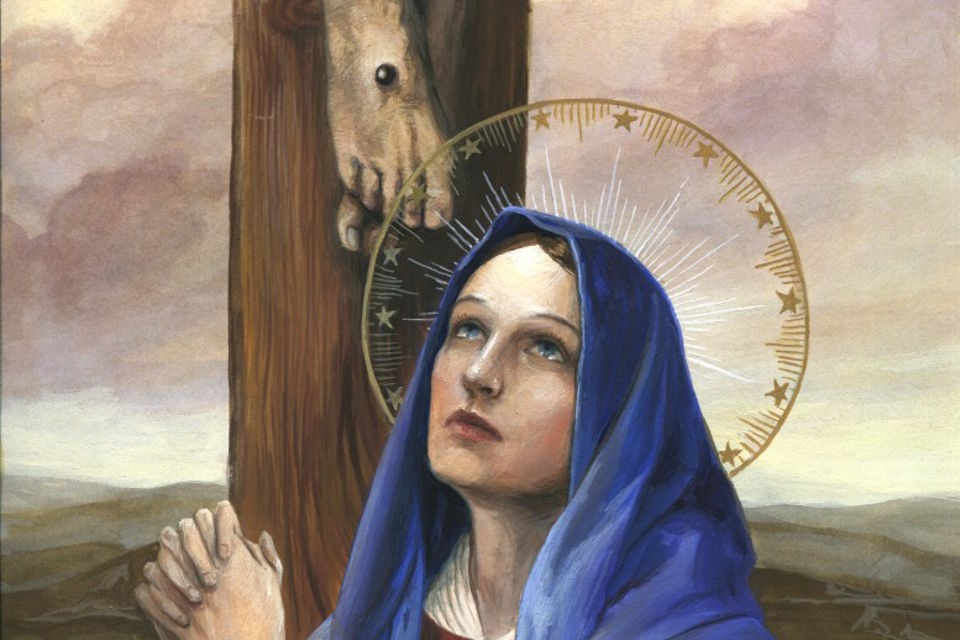
“Mary was able to hold her attention upon what she called the “immaculate concept” of Jesus, knowing that neither the spear nor the crown of thorns, nor the cross, nor the nails could hurt him. She stood and upheld the focus of the Resurrection Flame upon her son, and concentrated her energies upon the victorious, happy pattern of her life experiences. As always, Mary was able to see Jesus' Holy Christ Self (the Master explained elsewhere that the Christ Self abides above the physical vehicle).
“For three long hours Jesus' body hung between that of two thieves on the cross. John assisted Mary, holding to that Perfect Concept of man as co-creator with God, so that Jesus might pass through that initiation. Mary and John understood how to disconnect, through Light and love, the gravity pull of the physical body. This they applied as the cross was raised, thus preventing the tearing of his body.
“Continuing with this account, Jesus' last words were not “My God, my God, why hast thou forsaken me?” but, “Father, how thou hast glorified me. Into thy hands I command my spirit.” Then the words “It is finished,” were heard coming from the direction of the cross.
“Jesus did experience pain from the physical abuse inflicted upon him prior to the crucifixion. But he did not suffer while being on the cross, because he was master of the situation, and had withdrawn from the body sufficiently so that he did not feel pain.” Elisabeth Clare Prophet stated that nonetheless, “Jesus desired to experience with his full faculties all of the crucifixion. He did not desire to be drugged and therefore be deprived of the moment of transmutation of pain. Ultimate pain transmuted becomes the ultimate bliss of the Son of God.”
The Gospel of Peter recorded that even though the crucifixion of Jesus happened during the day, darkness held fast all Judea, and many went around with lamps, thinking that it was night, and even fell. He explained that the Jews were distressed and anxious lest the sun set while Jesus was still living, for the Law was written: “Let not the sun set on one put to death.”
The bodies were not to remain on the cross for the Sabbath day, so they beseeched Pilate that their legs might be broken, to expedite death by asphyxiation. The soldiers broke the legs of the two malefactors, but when they came to Jesus, they saw that he was dead already, so they did not break his legs. Instead, one of the soldiers pierced his side with a spear that became a sacred relic, the “spear of of Longinus,” or “holy spear.” Blood and water flowed from Jesus' side, fulfilling the prophecy found in Psalms, “A bone of him shall not be broken,” and the prophecy of the prophet Zecharias, “They shall look on him whom they pierced.”
The Gospel of Matthew clarifies that there was darkness all over the earth from the sixth hour to the ninth hour. Prophet explained that the sixth hour is the point of the soul’s identification with the Mother flame. It is the counterpart of the Father. And the ninth hour is the hour when Jesus experienced the dark night of the Spirit, and the snapping of the crystal cord, which is the cause for physical death.
She said, “Now Jesus knew that this initiation would be upon him. He knew exactly what was to take place. Six hours on the cross of an excruciating death—yet he came to the moment of the blackout, the snapping of the cord, and it was so sudden and so painful to sense the loss of the direct tie to the Father, the I AM Presence, to the Guru Maitreya, that he cried out in response, “My God, my God, why hast thou forsaken me?”
She further explained: “Part of the initiation of the crucifixion is bearing the momentum of planetary darkness. This is the darkness that Jesus had to bear which surrounded the cross while he was totally cut off from his Presence, relying solely on the memory of what it was like to feel his Presence and to be with God. There comes a time when we all have to stand on our own light, what we have invoked. That is all we have and we are given no more. We have to go by that momentum until the hour of the dark night of the Spirit and the crucifixion has passed. And on the basis of the light we have gleaned, we see the unreality of death.
“This initiation takes place for many people after they pass on, at the etheric temple of Luxor in Egypt. It is also given in one of the chambers of the Great Pyramid, which is used at the etheric level for this test of laying down the body, to see if man is attached to his body or if he knows that he is real in God. Just believing it is not enough. For in the hour of the dark night, all the momentums of the subconsciousness, which we call the electronic belt, rise up to challenge the light within man.
“This is the beast that ascends out of the bottomless pit to challenge the Christ consciousness that bears witness to the truth. And that beast, which is our own human creation from all of our past embodiments, has to be slain by the two-edged sword, the power of the spoken Word that comes forth from the throat chakra. It comes forth to challenge all misqualified energy in all planes of one’s consciousness.
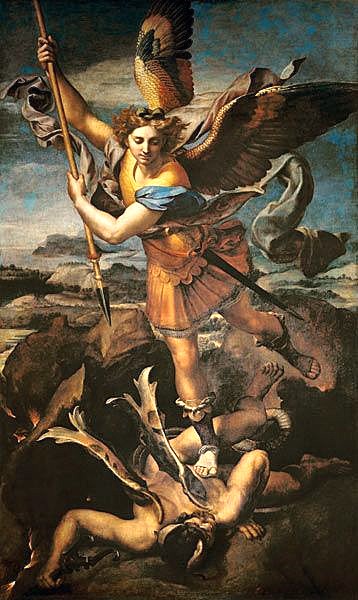
Archangel Michael by Raphael
“This combined momentum of energy is called the dweller-on-the-threshold. We all have to meet that dweller sooner or later, and we have to slay the beast. This is why some of the saints, like Saint George, are pictured as slaying the dragon. It is his own dweller-on-the-threshold, but it is more than his own. It is also the dweller-on-the-threshold of the entire planetary body.”
The Gospel of Mathew tells us that when Jesus gave up the ghost, the veil of the temple was rent in twain from top to bottom. Matthew says the earth quaked, and the rocks broke, and the graves were opened, and many bodies of saints arose, and went into the holy city, and appeared to many.
Prophet explained that the moment their murderous intent became physical and Jesus gave up the ghost, the veil in the temple was rent revealing the Holy of Holies as the place where the Lord Christ himself officiates as the High Priest in the temple of man. “The crucifixion of Christ,” she said, “is for the judgment of all those who occupy the position of the authority of Christ and yet exercise it not as the Christ but as the Antichrist. The meaning of the crucifixion is the revelation that Christ is every man’s Real Self and that if that Real Self is to be, and be the one with whom the soul unites, that one must pass through this hour of the crucifixion.”
She said their intent was, and is always, to kill the Christ and not the man, and to crucify the integrated personality in God. This is why we call in Archangel Michael's Rosary for Armageddon, for the judgment of “the entire crowd of fallen ones who plotted the betrayal and judgment, the trial and crucifixion of Jesus Christ and have continued to plot against the servant sons and daughters of God in this and every age.” The crucifixion continues in the world each day, and with every child who is abused, trafficked, starved, harvested, raped, aborted and killed.
These very same fallen angels had denied Christ before God in heaven and were cast down to earth by Archangel Michael, or had left the exalted spheres of the heaven world to fulfill their lust to come after the daughters of men, as recorded in the Book of Enoch. “One way or the other,” Prophet said, “they were put out of heaven because they desired not and loved not the pure Person of the living Christ.”
Prophet explained that by denying the Christ in the heavens, they also denied the Christ in themselves. They lost the first estate of their offices in the angelic hierarchy, and descended to earth to become princes and kings, high priests and chiefs, lawyers and judges. They usurped the authority of Christ on earth and moved in on younger souls ill-prepared to deal with those who had existed in heaven for thousands of years, amassing the power of God, before they betrayed God. This is why the Psalmist wrote: “Nevertheless you will die like men; And you will fall like any one of the princes.”
Why did they hate Jesus so? “Only because he would not share his light with them,” said Prophet. “He would not give the light of the Christ to those who had not lawfully earned it by discipleship,. He would not give it to those who had not a chalice reflecting their loyalty to the Godhead—their loyalty to the Father and to the Son, to the heavenly hierarchy, to the Elohim, and to the mighty archangels.”
The gospel story continues. Now when the centurion, and those who were watching Jesus experienced the earthquake, they feared greatly and said, “Certainly this was a righteous man. Truly this was the Son of God.” And they smote their breasts and went home. The Gospel of Peter describes that when they drew the nails from the hands of Jesus and placed him on the earth, all the earth was shaken, and a great fear came about. The Jews and the elders and the priests, knowing how much wrong they had done, began to beat themselves, saying: “Woe to our sins. The judgment has approached and the end of Jerusalem.”
Peter also describes what he and the disciples were experiencing away from the cross. “But I, with the companions, was sorrowful; having been wounded in spirit. We were in hiding, for we were sought after by them as wrongdoers, and as wishing to set fire to the sanctuary. In addition to all these things we were fasting; and we were sitting mourning and weeping night and day until the Sabbath. Then the sun shone, and it was found to be the ninth hour.” This brings us back to how Jesus told John's disciples that his disciples would fast when the bridegroom was no longer with them.
In a dictation through the Summit Lighthouse, the master Serapis Bey spoke how we must all take Jesus down from the cross and focus on the resurrection—the victory over death and hell—rather than on the crucifix He said: “The living Christ Jesus is taken down from the cross. Unto the messengers and unto the disciples who have been crucified lifetime after lifetime in a mockery of the real inner temple initiation of the fastening of the soul to the cross of God, I say: This day thou art free to enter into the very tabernacle of God and into the temple of Luxor to undergo the initiations of Almighty God and the Father and the Son, before whom I humbly receive you to initiate your souls. No longer may the fallen ones in despite turn the crucifixion as a divine initiation, to the mockery of souls, to the desecration of God incarnate.”
We find several accounts as to what happened next to Jesus' body. The Gospel of Matthew tells us Pilate commanded Jesus' body be delivered to Joseph of Arimathæa. Joseph took the body, and wrapped it in a clean linen cloth, and laid it in his own new tomb, which he had hewn out in the rock. Then he rolled a great stone to the door of the sepulcher, and departed. The Gospel of Peter tells us “Having taken the Lord, Joseph washed and tied him with a linen cloth and brought him into his own sepulcher, called the Garden of Joseph.”
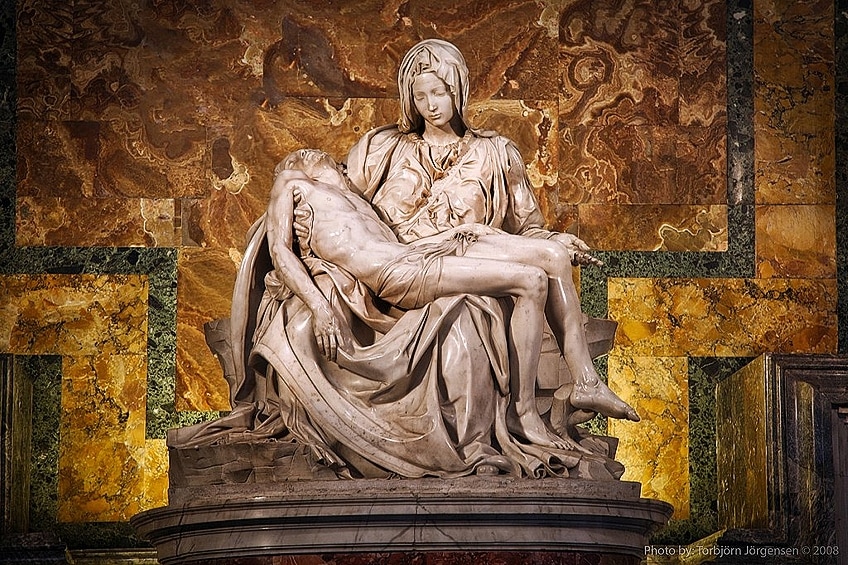
La Pieta by Michaelangelo
The Gospel of John tells us there came also Nicodemus, with a hundred pound mixture of myrrh and aloes. Then they took the body of Jesus, and wound it in linen clothes with the spices, as is the manner of the Jews to bury.
The Gospel of Matthew also says that the women, which came with Jesus from Galilee, followed and beheld the sepulcher, and how his body was laid. Mary Magdalene, and the other Mary, were sitting over against the sepulcher, and returned and prepared spices and ointments, and rested the Sabbath day according to the commandment.
Teachings from the Bridge to Freedom tell us that the gifts of frankincense and myrrh, that the Three Wise Men brought to Jesus at his birth, had been kept carefully by Mary, and were used by Martha and the “other Mary” in anointing the body of Jesus, and wrapping it in the linen furnished by Mary.
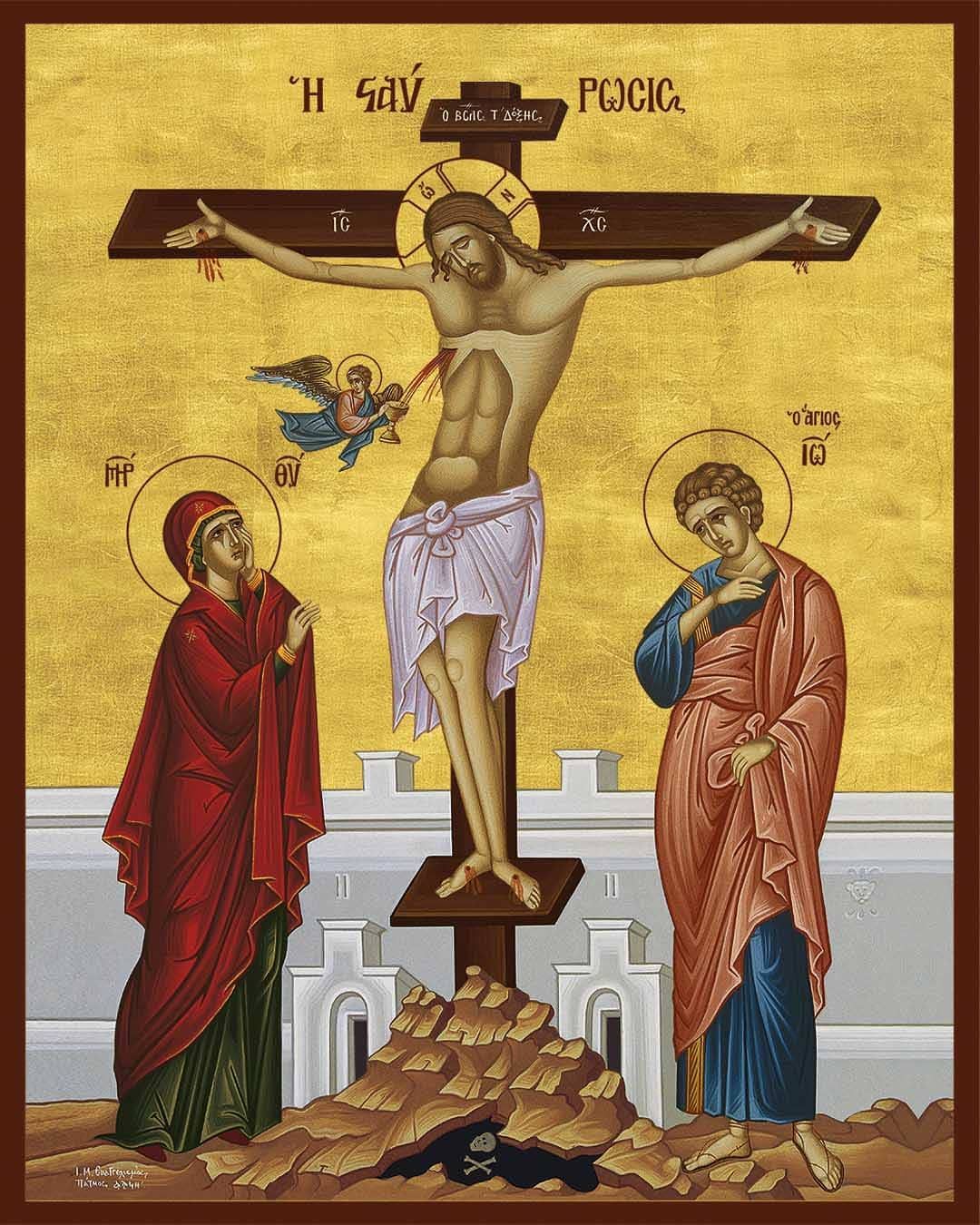
Elizabeth Clare Prophet gave more teaching on the initiation of the crucifixion: “Thus, in the hours of this proving of the Word and reproving the fallen ones, we see from 9:00 p.m. Friday until dawn Sunday— the Son of God is fulfilling the twofold mission—the judgment of the fallen ones and the resurrection of his own body temple.”
“The soul of Jesus, working with the externalized light of all incarnations of his attainment, must draw forth from the Godhead and renew the action of the threefold flame and the pulsation of his heart. Not only must he accomplish this, but by the same momentum of his attainment he must descend in his finer body—the soul in the etheric body, the soul clothed upon with the full Christ consciousness that he was—and go and speak to the most rebellious angels in the very depths of hell, to rebuke them for their evil deeds against the Most High God, to preach to them repentance, remission of sin, and to cause them to bend the knee and once again confess the living Christ. And he presented that Christ to them himself.”
“Thus he relied utterly upon his disciples to care for the body while he worked intensely out of the body. We are reminded of the disciples of the masters of the Far East who tend the master’s body while he is in Samadhi, in other octaves working the works of God.”
Now the next day, the chief priests and Pharisees came to Pilate saying, “Sir, we remember that that deceiver said, while he was yet alive—after three days I will rise again. Command therefore, that the sepulcher be made sure until the third day, lest his disciples come by night, and steal him away, and say unto the people, He is risen from the dead. So the last error shall be worse than the first.”
The Gospel of Peter tell us Pilate gave them Petronius the centurion and his soldiers to safeguard the sepulcher. Together with the soldiers, the elders and scribes came to the burial place and rolled a large stone. All who were there placed it against the door of the burial place, and marked it with seven wax seals. Then, they pitched a tent there to safeguard it.
Elizabeth Clare Prophet describes the inner workings of the crucifixion. She says, “Now the Christ moves from being the Mother, caring for all, to being the judge which discriminates light and darkness, binds the seed of the wicked and casts them out.
“This is always the office of the Christ in us. And this Christ performs that work even independently of our outer minds. But the more we are aligned with that Christ, the more we make our oneness secure, the more we are locked in the divine embrace of the Beloved, the more there comes the physical anchoring of the judgment and therefore the physical rage of the fallen ones who, because of their envy and their hatred, must find some way to get even. Therefore, they view the crucifixion from their level. And their level is the hatred, the absolute hatred of the absolute Son of God.
“But the Father and the Son look upon the crucifixion from another level entirely. It is the Son’s initiation to define the absolute union of that which has descended from above with the above. It is that moment when the soul is fastened to the cross and, through the experience of taking unto itself world karma, there is a fusing of that soul with Christ. And never, never again are they twain—never the inner and the outer temple—for the soul has merged with the High Priest who is Christ the Lord.
“So we realize that if we lived in a world in a context where there were no evil, we should still pass through the initiation of the crucifixion as the highest love, as the marriage of the soul with Christ—with the attendant bearing of a burden whereby we should experience the immensity of the darkness in the matter universe and the immensity of the Light in the Spirit.”
The Angel of the Cosmic Cross of White Fire described, “Therefore is the Light of God within your heart, the mighty threefold flame, the sufficiency unto eternal life. Therefore, beloved ones, ere the fullness of your individual initiation of the crucifixion come ye must garner in the heart the fullness of the Godhead, the fullness of the Word, that in the hour of the cry “My God, my God, why hast thou forsaken me?”—in the hour when you are required to sustain through the mighty threefold flame of Life the entire momentum of the Godhead—you will not be found wanting. And life, eternal life, shall swallow up death in the victory of the resurrection spiral.”