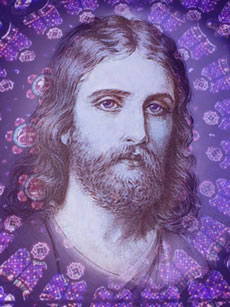
A Little Child
Shall Lead Them
We pick up our story with Mary, Joseph and Jesus returning to the Holy Land. The Gospel of Matthew speaks of Joseph having a dream where an angel tells him Herod is dead and that he can return to Nazareth. The Gospel of Luke doesn't mention the flight to Egypt and only gives a very general statement about Jesus' childhood: “And the child grew, and waxed strong in spirit, filled with wisdom: and the grace of God was upon him.”
For more information about Jesus' childhood, we must look elsewhere. The First Gospel of the Infancy of Jesus Christ, The Infancy Gospel of Thomas and the teachings of the ascended masters give us vivid and beautiful details about Jesus' childhood, before his discourse in the Jerusalem Temple at age twelve, that we can also read about in the Gospel of Luke.
Both apocryphal infancy gospels speak of many miracles wrought by the child Jesus among Judean playmates and peers. Though it is possible that some of the events described may have been embellished or modified to inspire faith and admiration, what we can take away from these accounts is the undeniable miracle action of the divinity of Christ dwelling bodily in child Jesus. The First Gospel of the Infancy of Jesus Christ describes miracles when very sick children, even on the verge of death, were healed after being sprinkled with the water that child Jesus had bathed in. “Then she took a little of that water, as Saint Mary had commanded, and sprinkled it upon her son, who being wearied with his violent pains, had fallen asleep; and after he had slept a little, awakened perfectly well and recovered.”
Another child named Caleb was healed of a deadly condition when his mother made a coat for him from a cloth that child Jesus had worn. A woman who was the mother's rival then threw Caleb into a hot oven, seeking revenge, and after that in a deep well. In both cases, Caleb remained unharmed, as he wore the coat made from Jesus' clothing. The mother reported to Mary what had happened. Not long after, her karma returned to her. Her foot got tangled in a rope as she went to draw water and she fell into the well and died.
We read about
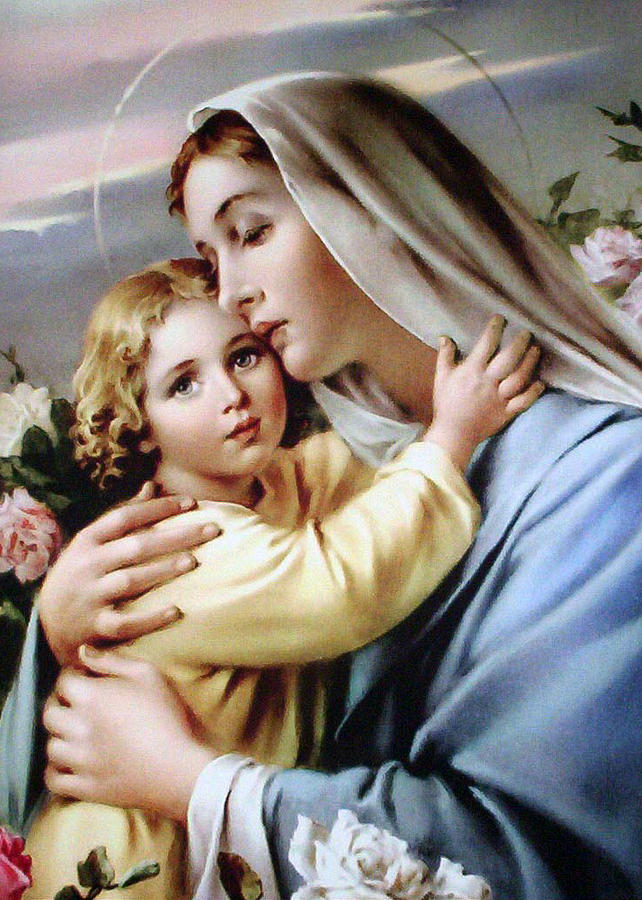
a possessed girl afflicted by Satan, who appeared to her in
the shape of a dragon. Mary gave her one of Jesus' swaddling
cloths. “As soon as the dragon saw the swaddling cloth
of the Lord Jesus, fire went forth and was scattered upon his
head and eyes, so that he cried out in a loud voice, 'What have
I to do with thee, Jesus, thou son of Mary. Whither shall I
flee from thee?'” The girl was delivered from her trouble
and sang praises and thanks to God.
Three childhood miracles involved children who later became disciples of Jesus. Bartholomew as a child fell very ill, and lay at the point of death. His Mother went to see Mary. “O my Lady, help and relieve me; for I had two sons, the one I have just now buried, the other I see is just at the point of death. Behold how I earnestly seek favor from God and pray to him.” Mary told Bartholomew's mother to place him in Jesus' bed, and to cover him with Jesus' clothes. “At the moment when his eyes were just closed by death; as soon as ever, the smell of the garments of the Lord Jesus Christ reached the boy. His eyes were opened and calling with a loud voice to his mother, he asked for bread.”
The gospel speaks of child Judas being possessed by Satan and biting people, and also himself. His mother took him to Mary, while Jesus was outside playing. Judas sat next to Jesus and under Satan's influence, tried to bite Jesus and then struck him, to where Jesus cried out. In that moment, the gospel says Satan went out of Judas like a mad dog.
Some of the infancy gospel stories describe the child Jesus as being an affront to people because of his spiritual gifts, and having to learn to manage his spiritual powers. Other stories describe how through the law of karma, those who wished harm upon him were immediately harmed in return. And some relate to him drawing upon his powers to heal, resurrect the dead and right wrongs. In contrast to these descriptions of divine retribution, I would like to interject teachings from two Summit Lighthouse dictations by Jesus, that describe his sweet temperament:
“When I was a small boy playing and working in the carpenter shop at Nazareth, like many of the children in the neighborhood, I developed a real affection for the tools and equipment we used. I learned to take sweet delight in fashioning various objects suitable as gifts or household articles for the use of my dear mother or others in the spiritual community. By applying myself to carving wood or constructing purposeful items, I became quite skillful in the trade. Beloved Mary often said I remained tiny for so short a time and so quickly stood ready for my mission that she could scarce realize it when I first begun my earthly ministry! The years were so short to all of us and there seemed so little to fan the flame of what was to become Christianity or another divine impulse to lead men heavenward.”
Two apocryphal stories relate to Saint Joseph, who told us as the ascended master Saint Germain: “I guided his hands in framing his first works of art.” Mother Mary also tells us, “In reviewing the scenes of Jesus’ childhood, I see again his first tiny steps, his use of Joseph’s carpenter tools as a boy, his subsequent role as World Saviour where as a “world carpenter,” he sought to frame and fashion a universal temple of receptive consciousness in mankind, so all could be receptive to God’s message of love even if they would not receive him.”
The First Gospel of the Infancy of Jesus Christ tells us Joseph took Jesus wherever he went—whether he was called to make gates or milk pails or boxes. “And when Joseph needed the wood wider or longer or shorter, Jesus would stretch his hands towards it and it would be so.” One day, the King of Jerusalem sent for Joseph to make a throne of carved wood with figures, like Solomon's throne, and Joseph took two years to finish it. As he was about to set it in place, he realized that it lacked in the appointed measure, and the king was wroth. Then, Jesus miraculously helped him adjust the throne's dimensions.
The Infancy Gospel of Thomas tells us about a rich man who ordered a couch from Joseph. One of the cross pieces was too short, so Jesus said to his father: “Put down the two pieces of wood and make them even in the middle.”Then Jesus took the shorter piece of wood and stretched it, making it equal to the other. The gospel says Joseph kissed him and exclaimed, “Blessed am I, because God has given me this child.”
Nevertheless,
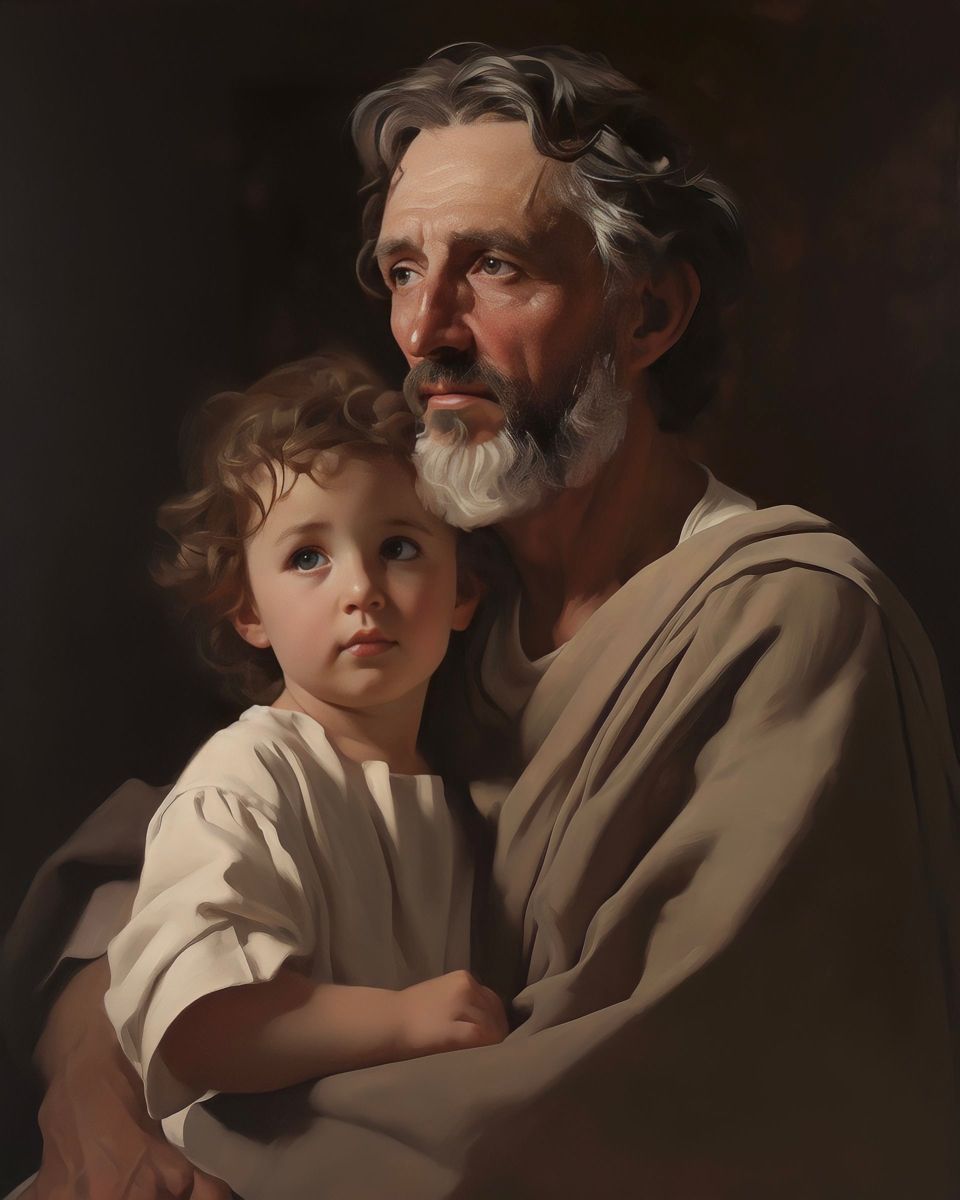
the ascended master Saint Germain told us in Summit Lighthouse
dictation that when he was Joseph, he had to discipline child
Jesus at times: “I did not spare the rod with my son Jesus
and therefore he grew up the disciplined one. Whether you think
you have an avatar or not, recognize that the four lower bodies
must be disciplined and the soul itself.”
We also find “surprising miracle” stories of Jesus in the infancy gospels, like Jesus one day going into a dye shop and throwing all the clothes into the furnace. The owner of the shop was most upset and Jesus replied, “I will change every color to what color thou desirest,” and proceeded to do so. On another occasion, Mary asked Jesus to go to the well to fetch water, but the pitcher broke. So Jesus gathered up the water and put it in his cloak, and brought it back to his mother without spilling it. Mary was astonished by this wonderful happening and kissed him, and held it in her memory.
There is also a story in the Gospel of Pseudo-Matthew about Jesus as a sower. “Again, on a certain day, he went forth into the field, and took a little wheat from his mother's barn, and sowed it himself. And it sprang up, and grew, and multiplied exceedingly. And at last it came to pass that he himself reaped it, and gathered as the produce of it three kors, and gave it to his numerous acquaintances.” Three kors would be the equivalent of almost nineteen bushels!
Jesus spoke of his communion with all life as a little child. He said in a Summit Lighthouse dictation, “The point I would make is that no matter how engrossed I was in the action of mind and hands, how delighted my eye with the creation unfolding before me, I was always able to listen and to hear the hum of the universe and my heavenly Father’s heartbeat, to feel the waves of his love sweeping into my being and then flooding back on the return current like the ebb and flow of the tide.
“Much later, when the woman who needed healing and had searched everywhere for it without success touched the outer hem of my garment, my childhood meditation stood me in good stead; for I felt the instantaneous response to this pull on my life in the surge of God’s consciousness which, like a charge of electricity, flowed from the heart center of my being into hers to give her immediate relief and complete healing.”
Some stories in the Gospel of Pseudo-Matthew seem exaggerated, and may well have been. The first involves shape shifting. Here, Jesus goes to meet some boys to play with them, and they run away to play hide and seek. When Jesus finds them, they have turned into kids (baby goats) and are hiding in the furnace of a woman's house. Jesus calls out to them, “Come out hither, O ye kids, to your shepherd!” The story says the kids leaped about him and frightened the women, who beseeched him, as the Good Shepherd, to turn them back into human form—so he did! In another story, the boy Jesus ranks the boys as if he had been king, and they spread their garments on the ground for him to sit on, and placed a crown of flowers upon his head, and stood at this right and left as guards of the king.
Now we read stories of the difficulties the child Jesus had with some of his peers, who could not appreciate his spiritual gifts. The first story is both in the The First Gospel of the Infancy of Jesus Christ and The Infancy Gospel of Thomas.
In the first instance, Jesus is playing with other children and they are making animal figures out of clay. Jesus could make them walk, and then return to clay form. “He had also made the figures of birds and sparrows, which, when he commanded to fly, did fly, and when he commanded to stand still, did stand still, and if he gave them meat and drink, they did eat and drink. When at length, the boys went away and related these things to their parents, their fathers said to them, Take heed children, for the future of his company, for he is a sorcerer; shun and avoid him, and from henceforth never play with him.” Reading this reminded me of the words of Handel's Messiah, that Mother Mary inspired: “He was despised and rejected of men.”
One story speaks of a Sabbath day, when the son of a Jew named Hanani saw Jesus making clay figures on the Sabbath and ran to destroy Jesus' fish pools. As he ran up to the pools, the water vanished and Jesus said, “In like manner as this water has vanished, so shall thy life vanish”—and the boy died. Another story mentions the son of Annas the scribe, standing there with Joseph, and taking a willow branch to let out the waters which Jesus had collected. Jesus was angry and said, “O wicked, impious and foolish! What harm did the pools and the waters do to thee? Behold, even now thou shalt be dried up like a tree, and thou shalt not bring forth either leaves, or root, or fruit.” And the boy immediately aged and was all dried up. So the villagers took him to Joseph and reproached him for having such a child: “Since thou hast such a child, it is impossible for thee to live with us in the village; or else teach him to bless, and not curse, for he is killing our children.”
The Gospel of Pseudo-Matthew concludes the story with Jesus referring to his Father in heaven and to the karma of those who are evil: “And Joseph came up to Jesus, and admonished him, saying, 'Why doest thou such things? For already many are in grief and against thee, and hate us on thy account, and we endure the reproaches of men because of thee.' And Jesus answered and said unto Joseph, 'No one is a wise son but he whom his Father hath taught, according to the knowledge of this time; and a Father's curse can hurt none but evil-doers.' Then they came again together against Jesus, and accused him to Joseph. When Joseph saw this, he was in great terror, fearing the violence and uproar of the people of Israel. At the same hour, Jesus seized the dead boy by the ear, and lifted him up from the earth in the sight of all. And they saw Jesus speaking to him like a father to his son. And his spirit came back to him, and he revived. And all of them wondered.”
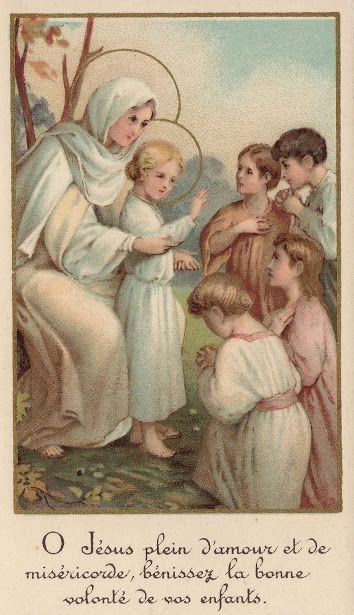
There was also a time when Jesus was coming home in the evening, and a boy ran so hard into him that he threw Jesus down. Jesus said, “As thou hast thrown me down, so shalt thou fall, nor ever rise,” and the boy also fell down and died. The Infancy Gospel of Thomas gives us more information. It tells us that when the boy struck Jesus on the shoulder, Jesus said to him; “Thou shalt not go back the way thou camest.” And immediately, he fell down dead. The Gospel of Pseudo-Matthew relates that later Jesus, at Joseph's remonstrance, revived the dead boy.
Again Joseph called Jesus, and admonished him saying, “Why doest thou such things, and these people suffer and hate us and persecute us?” And Jesus said, “I know that these words are not thine own. Nevertheless, for thy sake I will be silent, but they shall bear their punishment.” And straightway, those who accused him were struck blind.
Some may not believe Jesus would have behaved in what appeared to be such an impetuous or wrathful fashion. I tend to believe he may have, for several reasons. We know from the teachings of the ascended masters that Jesus was born in spring, in the sign of Aries. This sun sign is known for a fiery spirit marked by an often impulsive, boisterous and sometimes reckless planetary influence. Jesus would have had to, like everyone else, learn to manage the challenging aspects of his astrology.
We can find clues to Jesus' fiery personality in the biblical story where he braids a whip and then casts the merchants out of the temple, as well as when he curses the barren fig tree which had no fruit when he was hungry, and also when he rebukes Peter, “Get thee behind me Satan!” We find it in his dealings with the Pharisees. The Gospel of Thomas actually quotes Jesus saying, “Damn the Pharisees! They are like a dog sleeping in the cattle manger: the dog neither eats nor lets the cattle eat.”
And in Pistis Sophia, Mary Magdalene approaches Jesus deferentially several times, saying; “My Lord, I beseech you to have patience with me and not be displeased if I seek to inquire about all matters with precision and certainty. And I implore you to bear with my questions and not be angered. Please have mercy upon us and share your wisdom, revealing all that we wish to inquire of you.” Jesus answers the disciples and holy women lovingly and graciously in Pistis Sophia every time, but he did not spare the fire of divine wrath from coming through his being at other times recorded in the Bible.
The bottom line is that Jesus was not a pushover. He called a spade a spade, and trained his disciples to do likewise: “If anyone will not welcome you or listen to you,” he said, “when you leave, shake the dust off your feet as a testimony against them.” This leads me to conclude that Jesus as a child, had to learn to manage any residual belligerent energies and measure his feisty Aries response to personal affronts. He had to learn, as a human being, to sacrifice his pride like we must all do to follow in his footsteps, taking up the cross of our karma. This also makes the selfless giving of his life for our sake—and all the suffering he allowed himself to endure prior—that much more remarkable and touching.
There is an even deeper explanation, The Piscean master, even as a child, was allowing in some cases the personal karma of individuals to return instantly upon them, fulfilling his statement, “For judgment I AM come.” The same was true for Elisha, who we know from the teachings of the ascended masters, was the most recent past life of Jesus. Elisha, having received the double portion of Elijah's mantle, could precipitate food and raise the dead. Nevertheless, he allowed the karma to fall upon those who harmed him, just like child Jesus. In 2 Kings we read about Elisha's retribution:“Then he went up from there to Bethel; and as he was going up by the way, young lads came out from the city and mocked him and said to him, 'Go up, you baldhead; go up, you baldhead!' When he looked behind him and saw them, he cursed them in the name of the Lord. Then two female bears came out of the woods and tore up forty-two lads of their number. And he went from there to Mount Carmel, and from there he returned to Samaria.”
Another story from The Gospel of Pseudo-Matthew reminds of the story of Elisha, who, having received the mantle of Elijah, smote the waters. From 2 Kings: “Elisha then picked up Elijah’s cloak that had fallen from him and went back and stood on the bank of the Jordan. He took the cloak that had fallen from Elijah and struck the water with it. 'Where now is the Lord, the God of Elijah?' he asked. When he struck the water, it divided to the right and to the left, and he crossed over.”
The Gospel of Pseudo-Matthew relays: “There is a road going out of Jericho and leading to the river Jordan, to the place where the children of Israel crossed: and there the ark of the covenant is said to have rested. And Jesus was eight years old, and he went out of Jericho, and went towards the Jordan. And there was beside the road, near the bank of the Jordan, a cave where a lioness was nursing her cubs; and no one was safe to walk that way.
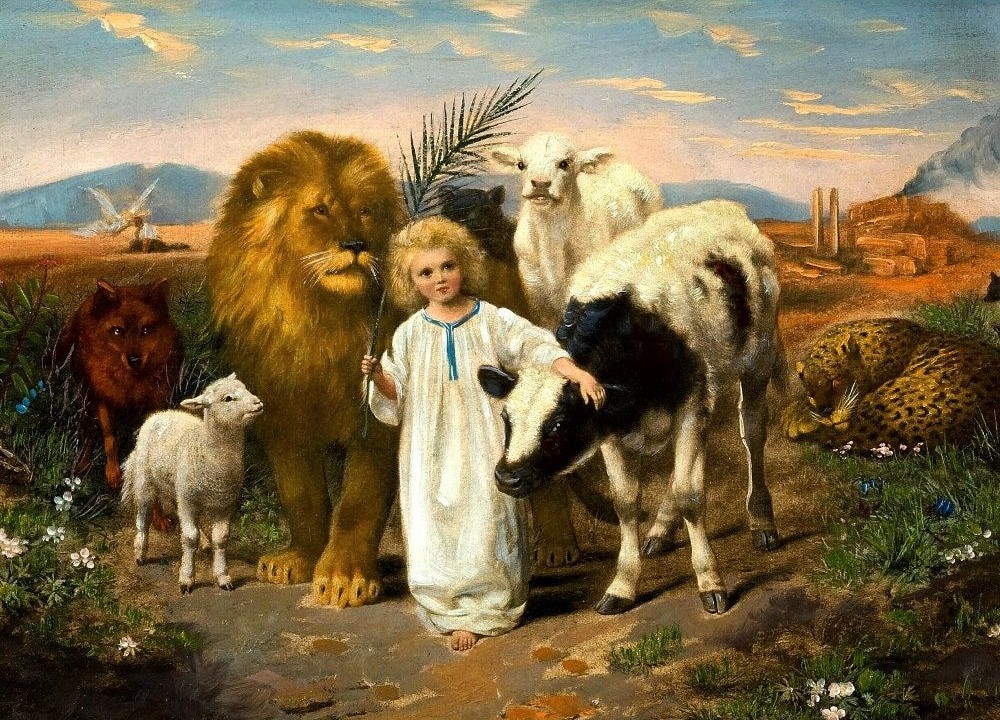
Peace by William Strutt
“Jesus then, coming from Jericho, and knowing that in that cave the lioness had brought forth her young, went into it in the sight of all. And when the lions saw Jesus, they ran to meet him, and adored him. And Jesus was sitting in the cavern, and the lion's cubs ran hither and thither round his feet, fawning upon him and sporting. And the older lions, with their heads bowed down, stood at a distance, and adored him and fawned upon him with their tails.
“Then the people who were standing afar off, not seeing Jesus, said: 'Unless he or his parents had committed grievous sins, he would not of his own accord have offered himself up to the lions.' And when the people were thus reflecting within themselves, and were lying under great sorrow, behold, on a sudden, in the sight of the people, Jesus came out of the cave, and the lions went before him, and the lion's cubs played with each other before his feet. And the parents of Jesus stood afar off, with their heads bowed down, and watched; likewise also the people stood at a distance, on account of the lions; for they did not dare to come close to them. Then Jesus began to say to the people: 'How much better are the beasts than you, seeing that they recognize their Lord, and glorify him; while you men, who have been made after the image and likeness of God, do not know him! Beasts know me, and are tame; men see me, and do not acknowledge me.'
After these things Jesus crossed the Jordan, in the sight of them all with the lions; and the water of the Jordan was divided on the right hand and on the left. Then he said to the lions, in the hearing of all: 'Go in peace, and hurt no one; but neither let man injure you, until you return to the place whence you have come forth.' And they, bidding him farewell, not only with their gestures but with their voices, went to their own place. But Jesus returned to his mother.”
Both the traditional gospels and the apocryphal gospels tell us Jesus had brother and sisters. The Gospel of Pseudo-Matthew claims James was Joseph's first-born child. I believe this is because Jesus was considered to be fathered by God, and that this had nothing to do with a former marriage by Joseph, as some scholars have claimed.
According to The Gospel of Pseudo-Matthew and the Gospel of Mark, Jesus' brothers were James, Joses, Jude and Simon, and he had at least two sisters. The gospels indicate that his siblings did not believe in, or appreciate his mission, until the conversion of James, when Jesus first appeared to him after the resurrection. This explains the statement recorded in the Bible that Jesus made, when he was told that his Mother and brothers and sisters were waiting for him: “For whosoever shall do the will of my Father which is in heaven, the same is my brother, and sister, and mother.”
Similarly to the life of Elisha, the infancy gospel stories speak of healing miracles performed by child Jesus. In one account, Joseph sent Jesus and James to gather wood and a viper bit James. Jesus blew on his brother's skin and the bite was instantly healed. In another story, the gospel speaks of a boy who put his hand in a partridge nest and was bit by a snake. Jesus called out to the serpent and said. “Go and suck out all of the poison which thou hast infused into that boy.” So the serpent crept to the boy, and took away all its poison again. Then the Lord Jesus cursed the serpent so that it immediately burst asunder and died. And he touched the boy with his hand to restore him to his former health. The boy began to cry, and Jesus said, “Cease crying, for hereafter thou shalt be my disciple.” This story specifies that the boy was Simon the Canaanite who is also mentioned in the Gospel of Matthew.
On a certain day, we read, the Lord Jesus was with some boys playing on the housetop, and one boy fell to his death. The boy's relatives accused Jesus of throwing him down. Jesus denied it, but they insisted. So Jesus said, “ Do not charge me with a crime of which you are not able to convict me, but let us go ask the boy himself, who will bring the truth to light.” Then, Jesus stood over the head of the dead boy and said, “Zeinunus, Zeinunus, who threw thee down from the housetop. And Zainunus (or Zeno) replied that Jesus had not. “Certainly not, my Lord,” says The Infancy Gospel of Thomas. “Thou didst not throw me down but has raised me up.” All were struck with astonishment. And the parents glorified God on account of the miracle, and adored Jesus.
A few days later, says the Infancy Gospel of Thomas, a young man was splitting wood when the axe came down and cut his foot in two, and he died from the loss of blood. And the child Jesus ran through the crowd and laid hand on the wounded foot, and the man was cured immediately. “Rise up now,” Jesus told the young man. “Split the wood and remember me.” And the crowd adored child Jesus and said, “Truly the Spirit of God dwells in this child.”
After this, the infant of one of Joseph's neighbors fell sick and died. Child Jesus heard the mother's weeping and all the commotion and ran to the infant and touched his breast: “I say to thee, child, be not dead but live and be with thy mother.” And directly, the child looked up and laughed, and Jesus told the mother: “Take it, give it milk and remember me.” Seeing this, the crowd acclaimed, “Truly this child was God or an angel of God. For every word of his is a certain fact.” The Infancy Gospel of Thomas says that after performing this miracle, the child Jesus went outside to play with the other children.
There was a time when Jesus went up to a house that was being built. There was a great commotion because a man was lying dead. Child Jesus took him by the hand and said, “Man, I say to thee, arise, and go on with thy work.” And directly, he rose up and adored him. And seeing this, the crowd witnessed, “This child is from heaven, for he has saved many souls from death.”
All three infancy gospels relate several stories about Jesus and his educators. The Infancy Gospel of Thomas tells us Jesus' first teacher was Zacchaeus. Zacchaeus said to Joseph, “Come, give him to me, brother, so that he may be taught letters, and so that he may know all knowledge, and learn to love those his own age, and honor old age and respect elders, so that he may acquire a yearning for children, teaching them in return.” Joseph replied, “And who can control this child and teach him? Don’t think of him as a small person, brother.”
Joseph took Jesus by the hand and led him into the school. Zacchaeus wrote the alphabet for him and began to teach him, but the child didn’t answer him. The gospels say Zacchaeus became irritated and struck Jesus, and Jesus said to him, “I want to teach you rather than be taught by you, since I know the letters you’re teaching more accurately.” Jesus proceeded to say all the letters very skillfully, from the alpha to the omega. Then, looking at his teacher, he said, “If you don’t know the nature of the alpha, how can you teach another the beta? Hypocrite! If you know, first teach me the alpha, and then I will trust you to speak of the beta.”
Then he began to teach the teacher about the first element. “Listen, Teacher, and understand the arrangement of the first element. “Now, notice how it has sharp lines and a middle stroke, which you see pointing, standing with legs apart, coming together, going out, dragging behind, lifting up, dancing around, in triple rhythm, two-cornered, of the same form, of the same thickness, of the same family, raised, balanced, isometric, of equal proportions. These are the lines of the alpha.” The gospel says Zaccheus lamented at his own ignorance and at his pupil's ability, and asked Joseph to take him back.
Joseph brought Jesus to another teacher, and Jesus said, “First you tell me what the beta is, and I’ll tell you what the alpha is.” The teacher became irritated and struck him, and Jesus cursed him, and the teacher fell and died.
After some days, another teacher said to Joseph that he would teach Jesus, and this time, the child went gladly. And entering the school, Jesus found a book lying on the lectern. The story goes that instead of reading, Jesus opened his mouth and uttered words so impressive that the teacher encouraged him to say more. He then told Joseph, “ I indeed took your child as a disciple, but he’s full of much grace and wisdom. Therefore, brother, lead him away with salvation into your house.”
The Gospel of Pseudo-Matthew adds to this narrative: “He spoke in the Spirit of the living God, as if a stream of water were gushing forth from a living fountain, and the fountain remained always full. And with such power he taught the people the great things of the living God, that the master himself fell to the ground and adored him. And the heart of the people who sat and heard him saying such things was turned into astonishment. And when Joseph heard of this, he came running to Jesus, fearing that the master himself was dead. And when the master saw him, he said to him: 'Thou hast given me not a scholar, but a master; and who can withstand his words.'” Then Jesus said to the teacher, “Since you spoke correctly and testified correctly, the one struck down will also be saved because of you.” And Joseph brought Jesus back to Mary.
The First Gospel of the Infancy of Jesus Christ further elaborates, “The Lord Jesus explained to him the meaning of the letters Aleph and Beth. Also which were the straight figures of the letters, which the oblique, and what letters had double figures; which had points, and which had none; why one letter went before another. And many other things he began to tell him, and explain, of which the master himself had never heard, nor read in any book. The Lord Jesus further said to the master, 'Take notice how I say to thee.' Then he began clearly and distinctly to say Aleph, Beth, Gimel, Daleth, and so on to the end of the alphabet. At this the master was so surprised, that he said, 'I believe this boy was born before Noah.' And turning to Joseph, he said, 'Thou hast brought a boy to me to be taught, who is more learned than any master.' He said also unto Saint Mary, 'This your son has no need of any learning.'”
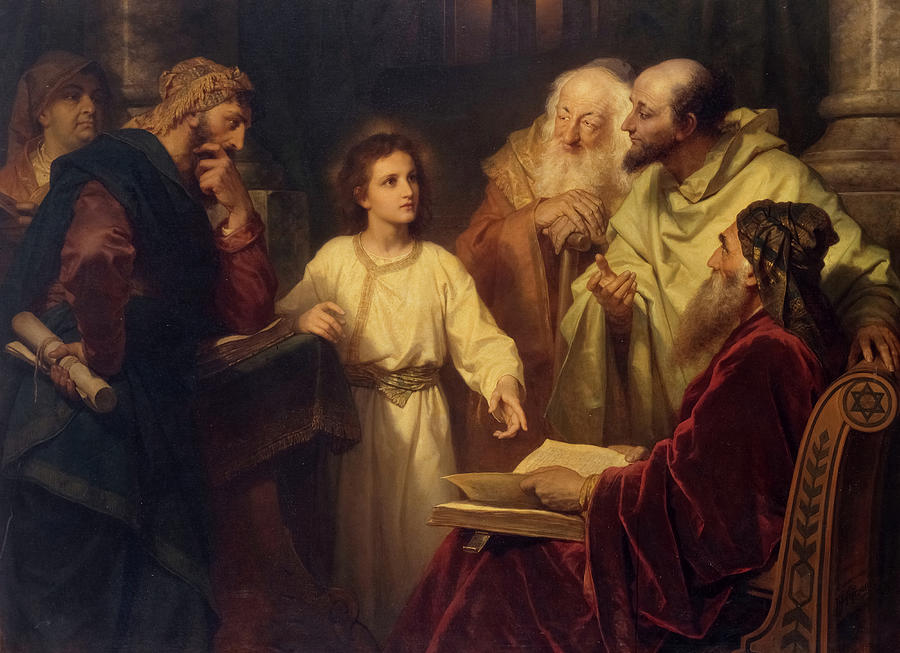
Jesus in the Temple by Heinrich Hofmann
The apocryphal infancy gospels conclude with the story of Jesus in the temple that we find in the Gospel of Luke: “Now his parents went to Jerusalem every year at the feast of the Passover. And when he was twelve years old, they went up to Jerusalem after the custom of the feast. And when they had fulfilled the days, as they returned, the child Jesus tarried behind in Jerusalem; and Joseph and his mother knew not of it But they, supposing him to have been in the company, went a day's journey; and they sought him among their kinsfolk and acquaintances. And when they found him not, they turned back again to Jerusalem, seeking him. And it came to pass, that after three days they found him in the temple, sitting in the midst of the doctors, both hearing them, and asking them questions. And all that heard him were astonished at his understanding and answers.
The Gospel of Pseudo-Matthew describes Jesus' discourse in the temple: But the Lord Jesus continued behind in the temple among the doctors and elders, and learned men of Israel; to whom he proposed several questions of learning, and also gave them answers: For he said to them, “Whose son is the Messiah?” They answered, “the son of David.” “Why then,' said he, “does he in the spirit call him Lord? When he saith, The Lord said to my Lord, sit thou at my right hand, till I have made thine enemies thy footstool.”
Then a certain principal Rabbi asked him, “Hast thou read books?” Jesus answered, “he has read both books, and the things which were contained in books.” And he explained to them the books of the law, and precepts, and statutes: and the mysteries which are contained in the books of the prophets; things which the mind of no creature could reach. Then said that Rabbi, “I never yet have seen or heard of such knowledge! What do you think that boy will be!”
When a certain astronomer, who was present, asked the Lord Jesus, Whether he had studied astronomy? Jesus replied, and told him the number of the spheres and heavenly bodies, as also their triangular, square, and sextile aspect; their progressive and retrograde motion; their size and several prognostications; and other things which the reason of man had never discovered.
There was also among them a philosopher well skilled in physics and natural philosophy, who asked the Lord Jesus, Whether he had studied physics? He replied, and explained to him physics and metaphysics. Also those things which were above and below the power of nature; The powers also of the body, its humours, and their effects. Also the number of its members, and bones, veins, arteries, and nerves; The several constitutions of body, hot and dry, cold and moist, and the tendencies of them; How the soul operated upon the body; What its various sensations and faculties were; The faculty of speaking, anger, desire; And lastly the manner of its composition and dissolution; and other things, which the understanding of no creature had ever reached. Then that philosopher arose, and worshiped the Lord Jesus, and said, “O Lord Jesus, from henceforth I will be thy disciple and servant.”
Continuing with the Gospel of Luke: “And when they saw him, they were amazed: and his mother said unto him, Son, why hast thou thus dealt with us? behold, thy father and I have sought thee sorrowing. And he said unto them, How is it that ye sought me? wist ye not that I must be about my Father's business? And they understood not the saying which he spake unto them. And he went down with them, and came to Nazareth, and was subject unto them: but his mother kept all these sayings in her heart.” The Infancy Gospel of Thomas relays Jesus' statement to his parents as: “Didn’t you know that it’s necessary for me to be in the place of my Father?”
We know from the teachings of the ascended masters that when Jesus spoke of the Father, he was speaking of his Mighty I AM Presence. It was necessary for him to be in the place of his Mighty I AM Presence, one with his God self and divine reality, and working the works of that divine reality anchored through his Mighty I AM Presence: “I must work the works of him that sent me.”
The Infancy Gospel of Thomas adds the following: “And the scribes and the Pharisees said to Mary, You’re the mother of this child? She said, I am. And they said to her, Blessed are you that the Lord God has blessed the fruit of your womb, because we’ve never seen such wisdom of praise and glory of virtue. And Jesus stood up and followed his mother from there, and was obedient to his parents. And she treasured all these things, pondering them in her heart.”

“Our Father” the Mighty I AM Presence from the I AM Movement
The canonical gospels conclude Jesus' childhood with this story, and say, “Jesus increased in wisdom and stature, and in favor with God and man.” But perhaps there is yet more...You see, there are legends of Jesus traveling to England with his uncle Joseph of Arimathea, a rich tin merchant who often traveled the Mediterranean for business. These legends inspired the poem by William Blake,
And did those feet in ancient time,
Walk upon Englands mountains green:
And was the holy Lamb of God,
On Englands pleasant pastures seen!
Is it possible Jesus could have been educated in the schools of the ancient druids who, like the Essene community, took their lessons from Pythagoras, as recorded by Greek philosopher Philos of Alexandria? Could this be a possible answer to the Jews in the temple marveling, as recorded in the Gospel of John, “How knoweth this man his letters, having never learned?” Whether Jesus traveled to England in person or in spirit, the Lamb of God depicted with the flag symbolizes the victory of the resurrected Christ, and Christ's blood washing away sin. Its use throughout England is rooted in the medieval legend that Jesus spent time in England during his youth.
Another legend states that upon the arrival of Joseph of Arimathea at Glastonbury he thrust his staff into the ground, perhaps to signify he had reached the end of his long journey. The staff burst forth as an instantly flowering thorn tree—which endures today as the only thorn tree in the world to bloom in December and again in May. The Glastonbury thorn is a form of common hawthorn,Crataegus monogyna found in and around Glastonbury, Unlike ordinary hawthorn trees, it flowers twice a year (hence the name "biflora"), the first time in winter and the second time in spring.
According to legend, after the resurrection of Jesus, Joseph of Arimathea and Mother Mary brought the Holy Grail, the cup from which Jesus and his disciples drank at the Last Supper, to Glastonbury and founded the first Christian church in England, after the resurrection. It is also identified as the Isle of Avalon of Arthurian legend.
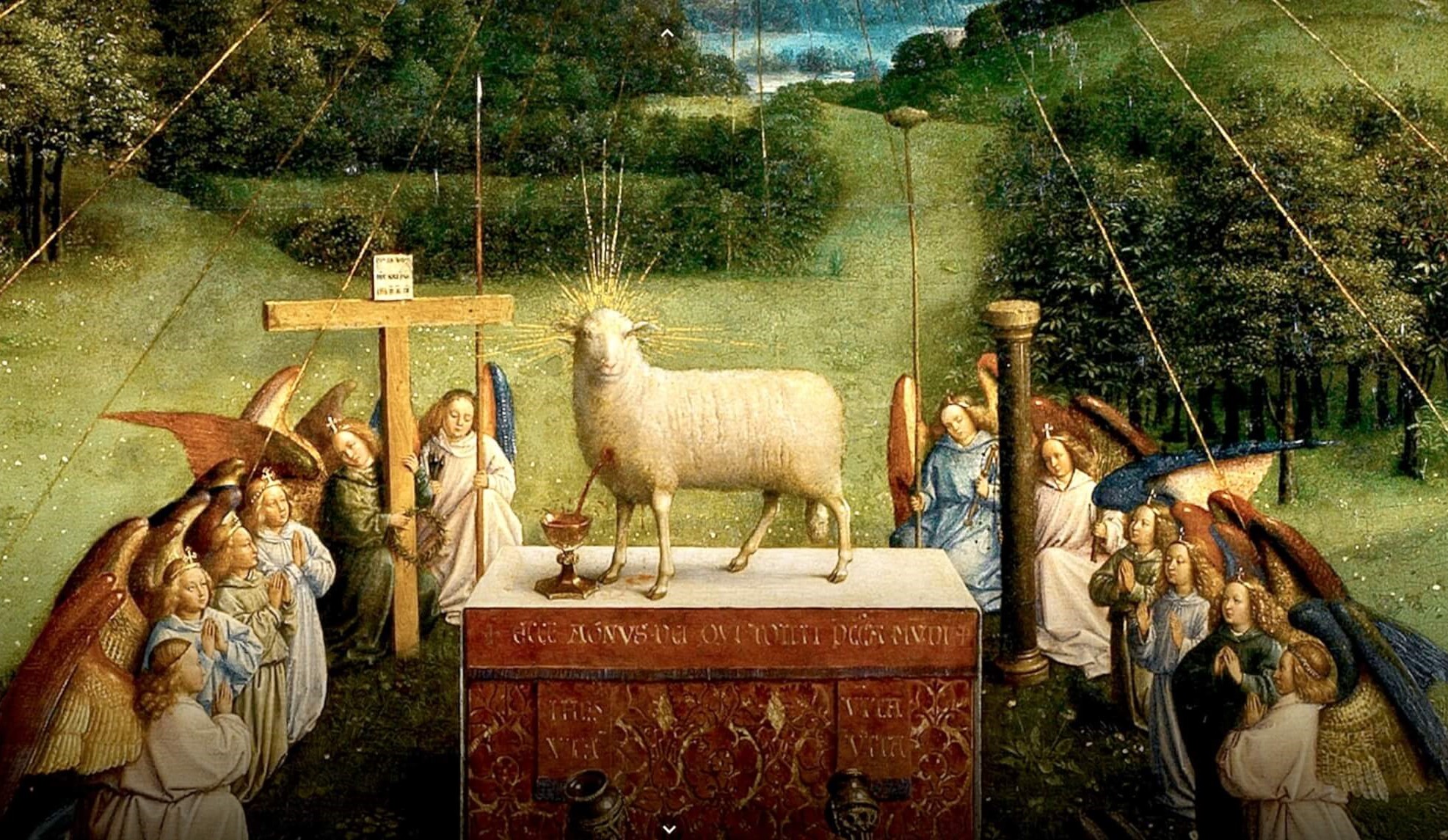
Lamb of God by Van Eyke
A monastic community formed around the ancient church at Glastonbury, known as Glastonbury Abbey. In the Middle Ages, Glastonbury Abbey was a center of learning and a shrine to which many made pilgrimages. The site of Glastonbury is thought to have been a center of Druidic worship as well. The Druids were the priest class of the ancient Celtic peoples and were responsible for the education of the young and the intellectual life of the community. They believed in and taught the immortality of the soul. According to Julius Caesar, the Druids in Gaul were organized into a brotherhood that extended across Celtic tribal divisions.
The book Man: His Origin, History and Destiny by Shroeder gives the following story compiled from ascended master dictations through the Bridge to Freedom. “One day, a message was received by Joseph of Arimathea, who had extensive business holdings on the British Isles. He had to leave for this destination, and extended an invitation to Mary and the disciples to accompany him. Jesus had told Mary previously that it would be necessary before her ascension to carry the “Cup” to the British Isles.
“It was felt that now the opportunity had presented itself to accomplish that purpose. In addition, it was learned that Pilate had been replaced by the Roman government, and the new governor was known to be less lenient toward the Christians than Pilate had been. Therefore, it was considered wise to have Mary leave Bethany for some time. Joseph of Arimathea had many slaves to man his boat. Mary reminded him that a mission involving the carrying of the sacred cup to Britain could not involve slave labor. Joseph agreed, and the boats were manned by volunteers from the Christian community. The boats had sails and oars. By volunteering and carrying out their mission as oarsmen, these men won the privilege of being the first knights of King Arthur's Court in a later embodiment.
“Among the people making the journey were Peter, James, Bartholomew, Nathaniel, Mary of Bethany, and Pilate's wife, who was returning to Rome. It was a small, but dedicated group of persons. Before leaving in the morning they all knelt in prayer. John gave the benediction, and the presence of Jesus was felt. After the boat anchored in Alexandria, Mary, Peter, James and a few others went to Luxor. Here Mary extended her gratitude to the Hierarch, Serapis Bey, for the assistance received in bringing about Jesus' victory.
“From Alexandria, the party decided to sail for Crete. Here the group magnetized the currents for the future visit by the Apostle Paul (now the Ascended Master Hilarion). Then the boat headed for Rome, to have the wife of Pilate disembark. However, Jesus appeared and warned them not to go to Rome because of the existing hostile sentiment against Christians in that city. So the boat sailed on toward the Straits of Gibraltar. At the southern tip of the Iberian Peninsula, Mary and others disembarked. Their journey would lead them through Portugal, Spain and France, and through the cities of Fatima, Lourdes and Orleans.
“Throughout the trip, Mary was in a constant state of listening grace. Sometimes she heard a delicate burst of music when crossing the aura of an individual whom she was to invite to accompany her party. In Portugal, she drew those who were later to be the children of Fatima, and from France she drew a small child who was later to become Bernadette. All of these joined the ever growing group of travelers.
“The currents anchored at Fatima, Lourdes and Orleans would be vitalized several hundred years later. During that later time when Mary appeared in her luminous presence at Fatima and Lourdes, many healings, visitations, and contacts with children were made possible by the previous anchoring of spiritual currents. The children who saw Mary accepted her Presence. Mary explained that the limited consciousness of the children made it impossible for her to explain more of the Law.
“Crossing the Pyrenees was difficult. It was done partially on foot and partially by donkey. When the group arrived in northern France, they re-united with Joseph of Arimathea, and together they crossed the channel. After their arrival in Great Britain, Mary carried the Cup ashore. Overcome by a feeling of gratitude, they knelt in the sands. As they were kneeling, Jesus manifested himself and gave the first benediction and ceremony of the “Holy Grail.”
“Into this etheric record King Arthur of the Round Table later tuned in. The Cup was left at Glastonbury. Here Mary and her group stayed for a while, making certain records for a future day. Mary and her group remained in England for some time. They enjoyed their stay here. Mary and her group, with the exception of three individuals who stayed in England, traveled north to Wales and Scotland. Then they sailed to Ireland. “Here Mary met a young boy, who in a later embodiment, as Saint Patrick, helped establish Christianity in Ire land. The boy became a member of Mary's party. Following their stay in Ireland, Mary's group started their return home. The rough seas off the shores of Spain tossed the boat around. It was also not easy to travel with the small children who were aboard on the return trip. There was little room on the boat. Yet, considering there were many comparative strangers on board, Mary and her group had a harmonious journey home, sailing again through the Mediterranean.”
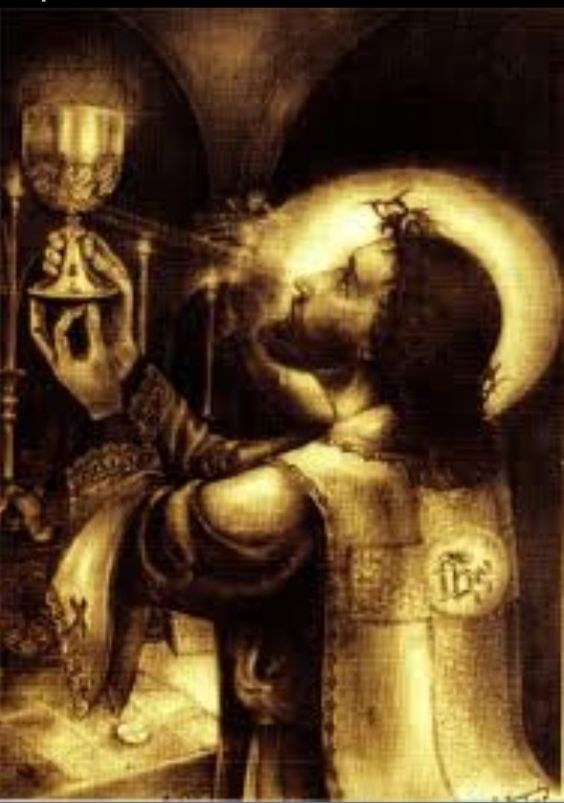
Jesus and the Holy Grail
In a dictation given through the Summit Lighthouse, Jesus said, “My own blessed Mother, the very heart of Glastonbury and Camelot of old—her heart, her light yet a beacon of hope in England—yet she, implanting her rod and the light of her Cosmic Christ conception, did magnetize the pilgrims of the Holy Spirit to the New World.”
I would like to conclude this chapter on the childhood of Jesus with words of Saint Thérèse of the Child Jesus who painted the picture, “Dream of the Child Jesus.” She says, “I painted this divine child to show what he represents for me. Indeed, he sleeps most of the time. But I know that if Jesus sleeps, his heart is alert and he keeps watch for us. He thinks of us without ceasing.”
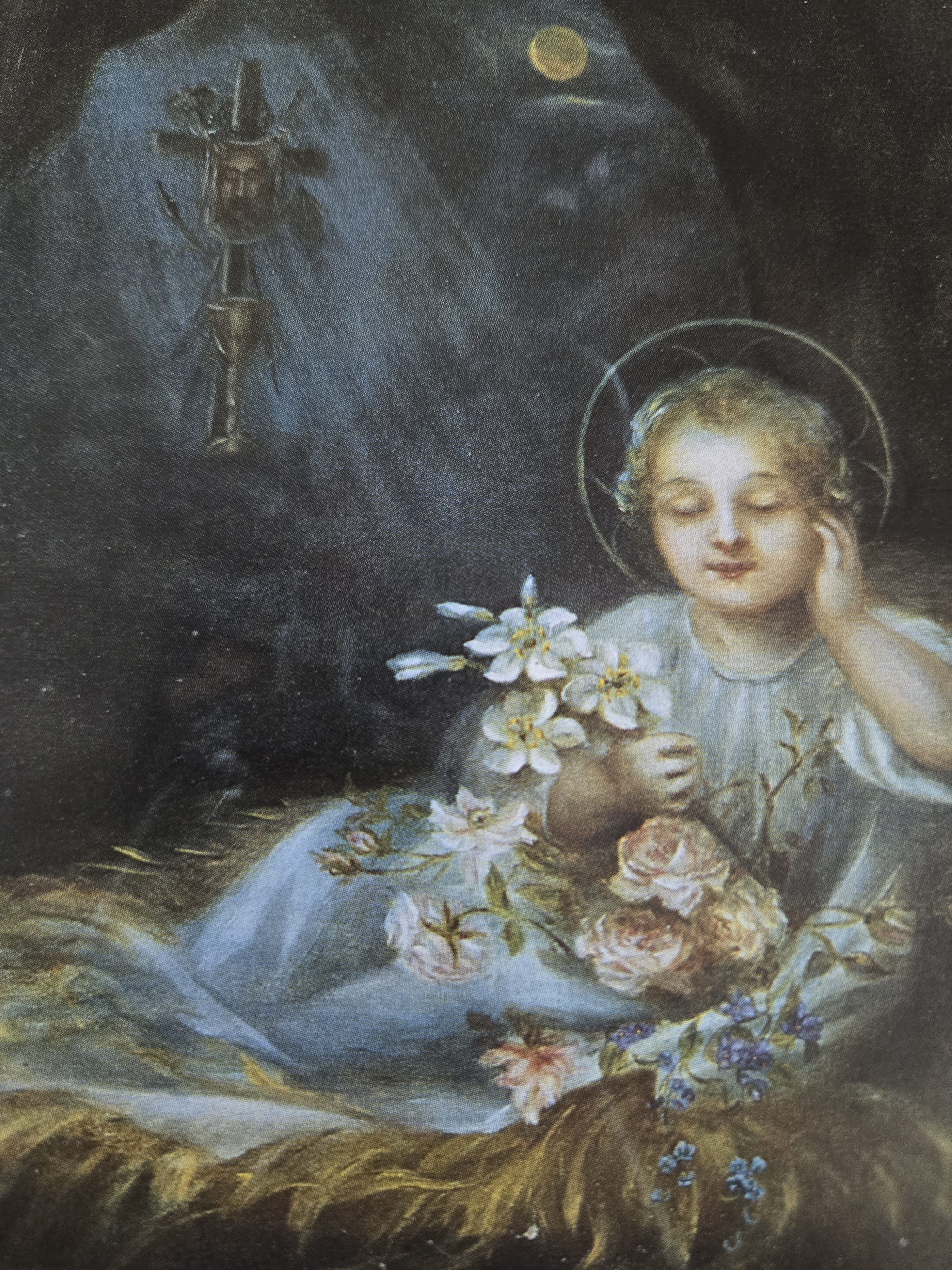
Dream of the Child Jesus by Saint Thérèse of Lisieux