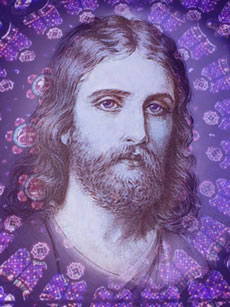
The Galilean Master
In fancy I stood by the shores one day
Of the beautiful murm'ring sea
I saw the great crowds as they thronged the way
Of the master of Galilee
I saw how the man who was blind from birth
In a moment was made to see
The lame were made whole by the matchless skill
Of the master of Galilee.
And I felt I could love him forever,
So gracious and tender was he
I claimed him that day as my savior,
Our Jesus of Galilee.
His look of compassion, his words of love
They shall never forgotten be
When sin-sick and helpless he saw me there
This master of Galilee
He showed me his hand and his riven side
And he whispered “It was for thee,”
My burden fell off at the pierced feet
Of the master of Galilee.
And I felt I could love him forever,
So gracious and tender was he
I claimed him that day as my savior,
Our Jesus of Galilee.
I heard him speak peace to the angry waves
Of that turbulent raging sea
And lo, at his word are the waters stilled
This Master of Galilee
A peaceful a quiet and holy calm
Now and ever abides with me
He holdeth my life in his mighty hands
This master of Galilee.
And I felt I could love him forever,
So gracious and tender was he
I claimed him that day as my savior,
Our Jesus of Galilee.
Come ye who are driven and tempest-tossed
And his blessed salvation see
He'll quiet life's storms with his, “Peace be still”
This master of Galilee
He bids me to go and he story tell
what he ever to you will be,
If only you let him with you abide,
This master of Galilee.
Oh my friend won't you love him forever,
So gracious and tender is he,
Accept him today as your savior,
This Jesus of Galilee.
Song from the book Watch
with Me Jesus Vigil of the Hours
Jesus is
Tempted
Following his baptism, Jesus went into the wilderness and fasted for forty days, where he was tempted by the devil. The fallen angel Satan appeared to him and gave him three tests. These tests are important to understand because the three temptations Jesus faced are similar to the temptations that people face in their daily lives. This is why Jesus taught his disciples to pray, “lead us not into temptation but deliver us from evil.”
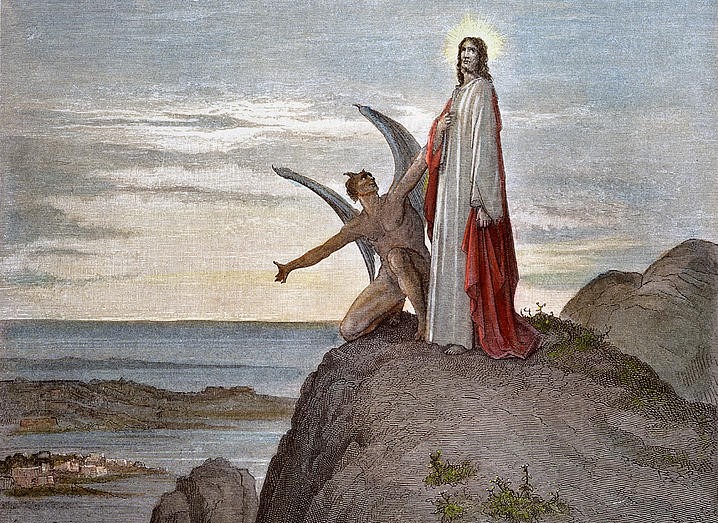
Temptation in the Wilderness by Gustave Dore
From the Gospel of Luke: Then Jesus was led by the Spirit into the wilderness to be tempted by the devil. After fasting forty days and forty nights, he was hungry. The tempter came to him and said, “If you are the Son of God, tell these stones to become bread.”Jesus answered, “It is written: ‘Man shall not live on bread alone, but on every word that comes from the mouth of God.’” This temptation is a test of power, that relates to our physical body and the blue plume of our heart's threefold flame. Here, Jesus is telling us to have faith in God for our sustenance, like the Israelites for manna in the desert, rather that to rely on human effort alone to provide for their sustenance.
“Then the devil took him to the holy city and had him stand on the highest point of the temple. “If you are the Son of God,” he said, “throw yourself down. For it is written: ‘He will command his angels concerning you, and they will lift you up in their hands,so that you will not strike your foot against a stone.’ Jesus answered him,“It is also written: ‘Do not put the Lord your God to the test.’”
Here the fallen one dares Jesus to take a gamble, to play Russian roulette with the Serpent philosophy that tempted Eve with the cunning challenge, “If you partake of the fruit of the knowledge of good and evil, you shall not surely die.” This is a test of mental fortitude that relates to the yellow plume of divine wisdom in our heart's threefold flame. Here, Jesus is exemplifying the humility of the spiritual path that defers back to God's wisdom and affirms, like Saint Margaret Mary, “Thou the all, I the nothing.”
“Again, the devil took him to a very high mountain and showed him all the kingdoms of the world and their splendor. “All this I will give you,” he said, “if you will bow down and worship me.”Jesus said to him,“Away from me, Satan! For it is written: ‘Worship the Lord your God, and serve him only.’Then the devil left him, and angels came and attended him.”
This last temptation is a test of divine love, that relates to the pink plume of our heart's threefold flame, and to our emotional body. Here, Jesus is showing that God's love for us must mean more to us than all of the riches and baubles and trinkets and seductions of the matter plane. This is true renunciation of the lower world for the higher world. As Jesus later said, “ If anyone desires to come after me, let him deny himself, and take up his cross, and follow me. For whoever desires to save his life will lose it, but whoever loses his life for my sake will find it. For what profit is it to a man if he gains the whole world, and loses his own soul? Or what will a man give in exchange for his soul? For the Son of Man will come in the glory of his Father with his angels, and then he will reward each according to his works.”
The three temptations also relate back to the three tests Eve faced in the Garden of Eden. Jesus had to pass the tests that Eve failed. Eve represents the fallen feminine nature of the soul of humanity, and her relationship with the Tree of Life, or I AM Presence. Elizabeth Clare Prophet explains these three tests that are recorded in the Book of Genesis, that the tree was good for food, that it was pleasant to the eyes and desired to make one wise.
Prophet explains that the tree “good for food” is a temptation of power. She says it is about using the sacred fire to evolve systems of economics outside of God, and to pursue the abundant life outside of the path of initiation, that is the edification of the soul in Christ. It relates to the test of “command these stones to be made bread.”
The tree “pleasant to the eyes” represents the pleasure cult of sensuality so prevalent in society. Using the sacred fire of the Christ to adorn the outer man instead of developing the inner man, Prophet says, becomes an exercise in vanity that is antithetical to God's love. This relates to the test of worshiping the “kingdoms of this world.” The tree “to be desired to make one wise” represents the wisdom of this world, with all of its political vying. These political systems, Prophet says, have replaced the government being upon the shoulder of Christ and his wisdom. This relates to the test given to Jesus: “throw thyself down and see if the angels will carry you.”
Jesus and
the Alchemy of the Marriage of Cana
Following the
temptations in the wilderness, the marriage of Cana marks the
beginning of Jesus' ministry in Galilee. This event is important
because it shows the spiritual collaboration between Jesus and
his mother, who presented to him the initiation that would begin
his public ministry.
The passage also reveals Jesus' reluctance to comply, because he knew the end from the beginning—that demonstrating his spiritual abilities to the world would lead to his persecution, and ultimately to his crucifixion. His response to his mother reminds me of a later statement in the Garden of Gethsemane where Jesus acknowledges the struggle between good intentions and human frailty: “The spirit is willing but the flesh is weak.” This, Saint Paul also referred to in his letter to the Romans as the “warring in our members.” He writes, “for the good that I would I do not: but the evil which I would not, that I do. ”
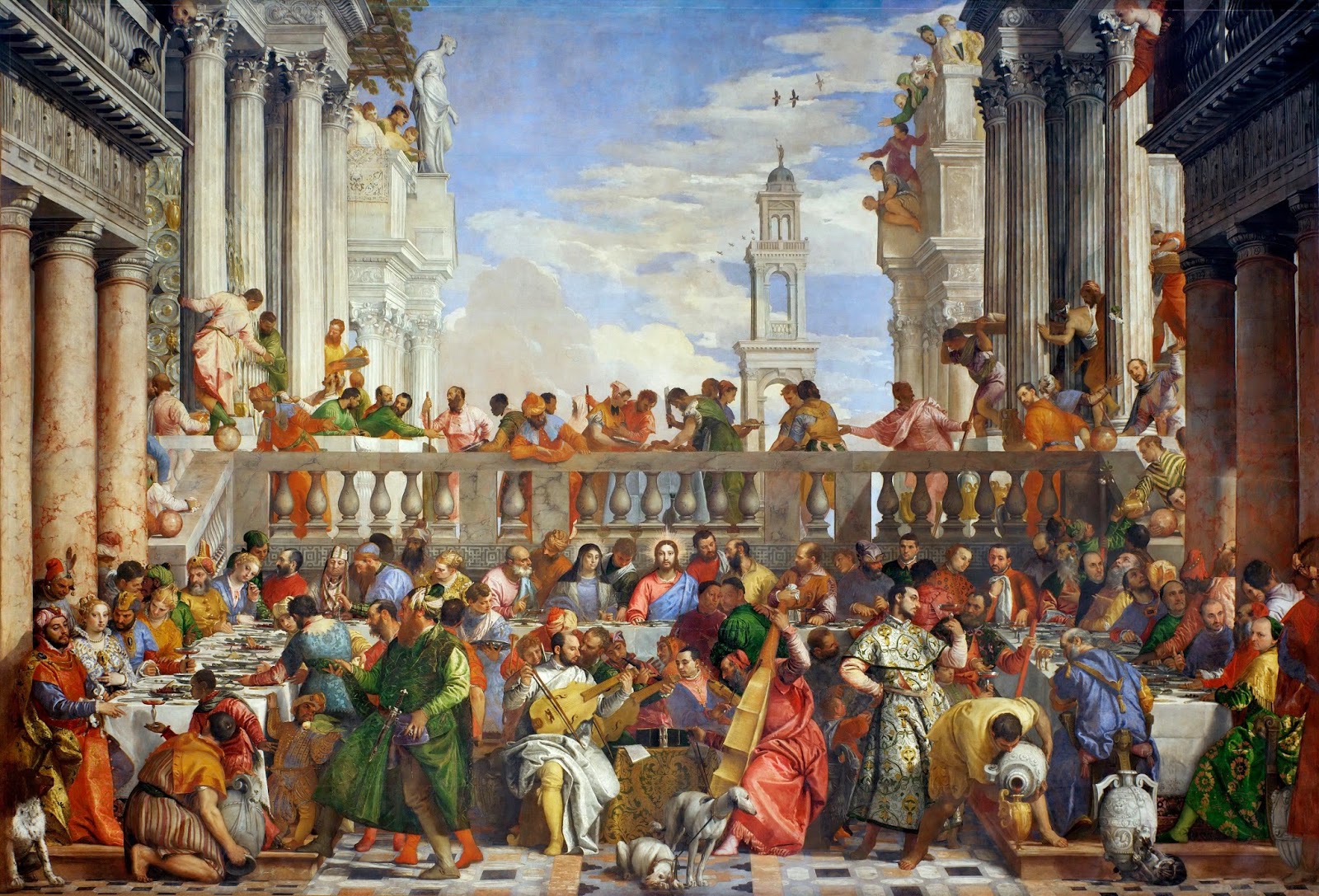
Marriage at Cana by Paolo Veronese
From the Gospel of John: “And the third day there was a marriage in Cana of Galilee; and the mother of Jesus was there: And both Jesus was called, and his disciples, to the marriage. And when they wanted wine, the mother of Jesus said unto him, They have no wine.
“Jesus said unto her, Woman, what have I to do with thee? Mine hour is not yet come. His mother said unto the servants, Whatsoever he said unto you, do it.... Jesus said unto them, Fill the waterpots with water. And they filled them up to the brim. And he said unto them, Draw out now, and bear unto the governor of the feast....
“When the ruler of the feast had tasted the water that was made wine, and knew not whence it was: (but the servants which drew the water knew;) the governor of the feast called the bridegroom, and said unto him, Every man at the beginning doth set forth good wine; and when men have well drunk, then that which is worse: but thou hast kept the good wine until now. This beginning of miracles did Jesus in Cana of Galilee, and manifested forth his glory; and his disciples believed on him.”
The ascended master Saint Germain speaks of this miracle as a feat of alchemy and transmutation. In dictations from the Summit Lighthouse, he explains, “Individuals who have lived upon earth have been able to practice transmutation, which is simply changing one form into another, such as water into wine; amplification and multiplication of the atomic and molecular substance, such as multiplying the loaves and fishes; and precipitation of the elements, such as calling down fire from heaven. Equally wondrous feats performed by masters unascended and ascended indicate a most exact science of control over Matter and energy.”
“And you know, for it has been said before, that the first public miracle wrought by Jesus Christ was the changing of the water into wine at the wedding feast in Cana of Galilee....that touch whereby the water of the human consciousness is changed into the wine of the Spirit....which is mercy, compassion, enlightenment and the just and true and righteous judgments of our God.”
“Indeed many stalwart souls pursued alchemy with the same reverence they would a quest for the Holy Grail, seeing it as a divine art and the origin of the Christian mysteries, as when Christ changed the water into wine at the marriage in Cana of Galilee.”
Jesus and
the Woman at the Well
The next miraculous event
in Jesus' life is his encounter with the woman at the well,
a woman who, by many standards, lived in sin, and became Jesus'
first evangelist. This encounter sets the tone for Jesus' ministry
and took place at Jacob's well. It is notable that Jesus was
also revisiting past life records of his life as Joseph when
the brothers—now disciples—had thrown him in the
well. Elizabeth Clare Prophet says, “Jesus came to the
very parcel of ground that Jacob, his father, had given to him
when he was embodied as his favorite son, Joseph. And he sat
on the well, signifying his dominion over the consciousness
of the twelve tribes which had issued forth from the Ancient
of Days through the seed of Abraham, Isaac, and Jacob.”
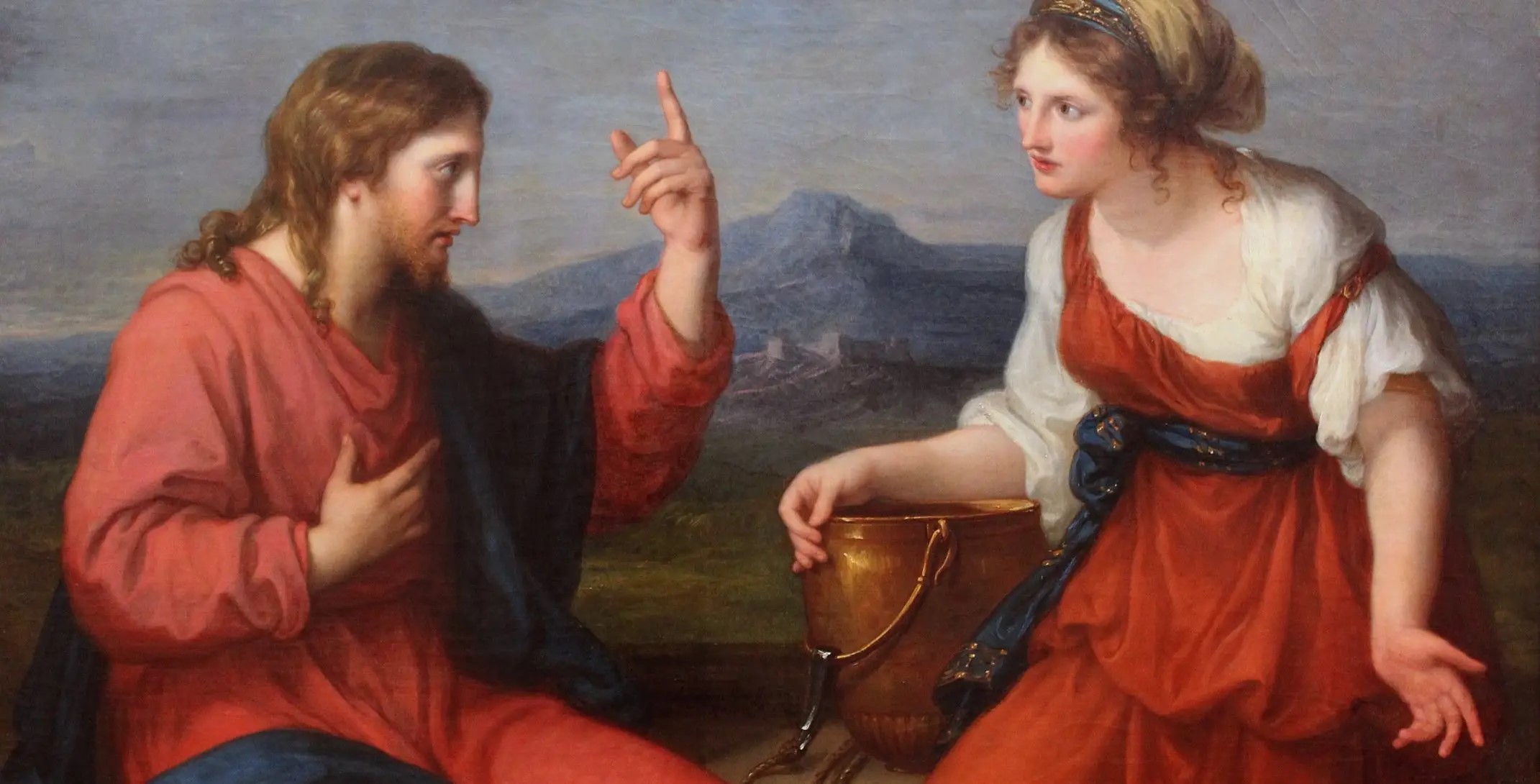
From the Gospel of John: Then came he to a city of Samaria,... near to the parcel of ground that Jacob gave to his son Joseph. Now Jacob's well was there. Jesus therefore, being wearied with his journey, sat thus on the well:...There came a woman of Samaria to draw water: Jesus said unto her, Give me to drink. Then said the woman of Samaria unto him, “How is it that thou, being a Jew, ask drink of me, which am a woman of Samaria?” for the Jews have no dealings with the Samaritans.
Jesus answered and said unto her, “If thou knew the gift of God, and who it is that said to thee, Give me to drink; thou would have asked of him, and he would have given thee living water.” The woman said unto him, “Sir, thou hast nothing to draw with, and the well is deep: from whence then hast thou that living water? Art thou greater than our father Jacob, which gave us the well, and drank thereof himself, and his children, and his cattle?”
Jesus answered and said unto her, “Whosoever drinks of this water shall thirst again: But whosoever drinks of the water that I shall give him shall never thirst; but the water that I shall give him shall be in him a well of water springing up into everlasting life.” The woman said unto him, “Sir, give me this water, that I thirst not, neither come hither to draw.”
Jesus said unto her, “Go, call thy husband, and come hither.” The woman answered and said, “I have no husband.” Jesus said unto her, “Thou hast well said, I have no husband: For thou hast had five husbands; and he whom thou now hast is not thy husband: in that said thou truly.”
Salvator Mundi by Leonardo de Vinci
The woman said unto him, “Sir, I perceive that thou art a prophet....I know that Messias cometh, which is called Christ: when he is come, he will tell us all things.” Jesus said unto her, “I that speak unto thee am he....”
The woman then left her waterpot, and went her way into the city, and said to the men, “Come, see a man, which told me all things that ever I did: is not this the Christ?”...And many of the Samaritans of that city believed on him for the saying of the woman, which testified, “He told me all that ever I did.” So when the Samaritans were come unto him, they besought him that he would tarry with them: and he abode there two days. And many more believed because of his own word; And said unto the woman, “Now we believe, not because of thy saying: for we have heard him ourselves, and know that this is indeed the Christ, the Savior of the world.”
Jesus
and the Miracles of Healing
Let us look now,
at some of the miracles that Jesus demonstrated, beginning with
miracles of healing. The gospels tell us Jesus went about all
Galilee, teaching in their synagogues, preaching the gospel
of the kingdom, and healing all kinds of sickness and disease
among the people. Then his fame went throughout all Syria; and
they brought to him all sick people who were afflicted with
various diseases and torments, and those who were demon-possessed,
epileptics, and paralytics; and he healed them. Great multitudes
followed him—from Galilee, and from Decapolis, Jerusalem,
Judea, and beyond the Jordan.
Some of the healings that are emphasized hold a lesson. A leper came and said, “Lord, if you are willing, you can make me clean.” Jesus put out his hand and touched him, saying,“I am willing; be cleansed.”Immediately his leprosy was cleansed. Then, Jesus sent him to offer a gift to the priest as a token of gratitude, and also to be examined. This was to satisfy the Mosaic tradition, whereby the priest could certify the lepers' healing and cleanliness, before reintegrating them into society and religious services.
When Jesus entered Capernaum, a Roman centurion came to him, pleading that he heal his paralyzed servant, saying, “Lord, my servant is lying at home paralyzed, dreadfully tormented.” When Jesus said he would go heal him, the centurion replied, “Lord, I am not worthy that you should come under my roof. But only speak a word, and my servant will be healed.”
This line of scripture was modified and inserted into the Catholic mass as a communion prayer, “Lord I am not worthy to receive you, but only say one word and I shall be healed.” Affirming this reinforces a spiritual unworthiness that is completely opposite to what Jesus demonstrated. “Behold, what manner of love the Father hath bestowed upon us, that we should be called the sons of God.” Instead we should affirm our worthiness in Christ, “O Lord, I AM worthy. Make me worthier still.” This is the faith Jesus praised in the centurion that he wants all of us to have: “Assuredly, I say to you, I have not found such great faith, not even in Israel!” Then Jesus said to the centurion, as he also says to us, “Go your way; and as you have believed,so let it be done for you.”And his servant was healed that same hour.
It is also recorded that when Jesus had come into Peter’s house, he saw Peter's mother-in-law lying sick with a great fever. Jesus stood over her and rebuked the fever. The fever immediately left her, and she arose and served them.
One day, people brought to Jesus a paralytic lying on a bed. When Jesus saw their faith, he said to the paralytic, “Son, be of good cheer; your sins are forgiven you.” And at once some of the scribes said within themselves, “This man blasphemes,” for saying he is able to forgive sins. But Jesus, knowing their thoughts, said, “Why do you think evil in your hearts? Know that the Son of Man has power on earth to forgive sins.” Then, Jesus said to the paralytic, “Arise, take up your bed, and walk.” And the paralytic arose and departed to his house. This healing illustrates Jesus' ability to transmute the karma behind the illness. This is why the sins—or karma—had to be forgiven before the healing could take place.
A woman who had a flow of blood for twelve years touched the hem of Jesus' garment. She had been to many physicians, and had spent all that she had, and nothing bettered. She said to herself, “If only I may touch his garment, I shall be made well.” When she touched Jesus' garment, the fountain of blood immediately dried up and she was healed. Jesus felt the light leave his being—that virtue had gone out of him—so he turned and asked, “Who touched my clothes?” His disciples answered, “Thou seest the multitude thronging thee, and sayest thou, Who touched me?” The woman fearing and trembling, knowing what was done in her, came and fell down before him, and told him the truth.. And he said unto her, “Daughter, be of good cheer. Thy faith hath made thee whole; go in peace”
When Jesus departed from there, two blind men followed him, crying out and saying, “Son of David, have mercy on us!” And Jesus said to them, “Do you believe that I am able to do this?” They said to him, “Yes, Lord.” So he touched their eyes, saying, “According to your faith let it be to you.” And their eyes were opened. Then Jesus sternly warned them,“See that no one knows it.” But when they had departed, they disobeyed and spread news about him in all that country.
A man was brought to Jesus, who was mute and demon-possessed. When the demon was cast out, the mute spoke, and the multitudes marveled, saying, “It was never seen like this in Israel!” Then, when Jesus reached the land of Gennesaret, the people brought to him all who were sick, and begged to touch the hem of his garment. All who touched it were made perfectly well.
Jesus departed from there, skirted the Sea of Galilee, and went up on the mountain and sat down. Then great multitudes came to him, having with them the lame, blind, mute, maimed, and many others; and they laid them down at Jesus’ feet, and he healed them. The multitude marveled when they saw the mute speaking, the maimed made whole, the lame walking, and the blind seeing. And they glorified the God of Israel.
When Jesus went out of Jericho, a great multitude followed him. Two blind men sitting by the road, heard that Jesus was passing by, and cried out, “Have mercy on us, O Lord, Son of David!” The multitude warned them to be quiet, but they cried out all the more, saying, “Have mercy on us, O Lord, Son of David!” So Jesus stood still and called them, and said, “What do you want me to do for you?” They said to him, “Lord, that our eyes may be opened.” So Jesus had compassion and touched their eyes. And immediately their eyes received sight, and they followed him.
Jesus went to Bethsaida; and a blind man was brought to him. Jesus took the blind man by the hand, and led him out of the town. He spit on his eyes, and put his hands upon him, and asked him what he saw. The man looked up, and said, “I see men as trees, walking.” This can be understood in a literal way, like stick people, but I believe Jesus first healed the man's spiritual sight in the etheric body, before healing his physical body. That is why the man was seeing the causal body over the people—their spiritual vine and fig tree. Then, Jesus put his hands upon the eyes again, and sealed his third eye, and he saw every man clearly.
Jesus entered a village in Samaria, and saw ten lepers standing afar off. They lifted their voices and said, “Jesus, Master, have mercy on us.” He said to them, “Go show yourselves to the priests” So as the lepers went, they were healed. One of them, who happened to be a Samaritan, turned back and falling on his face at Jesus' feet, gave thanks. Jesus said, “Were there not ten cleansed? but where are the nine?” Only one returned to give glory to God, save this stranger. And Jesus said to him, “Arise, go thy way: thy faith hath made thee whole.”
Now there is at Jerusalem by the sheep market a pool, which is called in the Hebrew tongue Bethesda, having five porches. In these lay a great multitude of impotent folk—blind, halt, withered—waiting for the moving of the water. For an angel would go into the pool and trouble the water, and whosoever would enter first after the troubling of the water was made whole. A man was there, who had an infirmity for thirty-eight years. Jesus saw him and said, “Wilt thou be made whole?
We witness, again and again, the importance of free will cooperation in the healing process. The impotent man answered Jesus, “Sir, I have no man, when the water is troubled, to put me into the pool: but while I am coming, another steps down before me.” Jesus said to him, “Rise, take up thy bed, and walk.” Immediately the man was made whole. When Jesus later found the man in the temple, he said unto him, “Behold, thou art made whole: sin no more, lest a worse thing come unto thee.” Jesus was admonishing him not to re-engage in old karmic sinful patterns that had brought on the sickness.
The Gospel
of Matthew gives an important teaching, that Jesus did
not heal those who lacked faith, or those whose karma prevented
it. “Now he did not do many mighty works there because
of their unbelief.” In the Gospel of Luke, Jesus
affirmed in the synagogue, quoting from the lives of Elijah
and Elisha: “Ye will surely say unto me this proverb,
'Physician, heal thyself: whatsoever we have heard done in Capernaum,
do also here in thy country.' But I tell you of a truth, many
widows were in Israel in the days of Elias, when the heaven
was shut up three years and six months, when great famine was
throughout all the land; But unto none of them was Elias sent,
save unto Sarepta, a city of Sidon, unto a woman that was a
widow. And many lepers were in Israel in the time of Eliseus
the prophet; and none of them was cleansed, saving Naaman the
Syrian.
Jesus
Raises the Dead
The scriptures also record that Jesus raised three people from the dead. When Jesus went into a city called Nain with his disciples, a dead man was being carried out by many people, who was the only son of his widowed mother. Jesus had compassion on her, and said, “Weep not.” He went and touched the bier, and said “Young man, I say unto thee, Arise.” He that was dead sat up, and began to speak and returned to his mother. It would make sense if the widow of Nain and her dead son that Jesus raised, were the same souls as the Shunammite widow and her dead son, that Elisha raised.
On another occasion, Jairus, who was a ruler of the synagogue, fell down at Jesus' feet and besought him to come to his house, where his only daughter, about twelve years of age, was dying. While he spoke to Jesus, another came to him, saying: “Thy daughter is dead; trouble not the Master.” Jesus answered, “Fear not: believe only, and she shall be made whole.” Peter, James and John entered the house with the girl's parents. Flute players and a number of people had gathered for the mourning, and everyone was weeping and bewailing her. Jesus said, “Weep not; she is not dead, but sleeps.” They laughed him to scorn, knowing that she was dead, but he put them all out and took her by the hand, saying, “Maid, arise.” Her spirit returned and she rose straightaway. Then Jesus commanded them to give her food.
Jesus also had a friend name Lazarus, who lived in Bethany, with his sisters, Mary and Martha. The sisters sent a message to Jesus: “Lord, behold, he whom you love is sick.” When Jesus heard that, he said, “This sickness is not unto death, but for the glory of God, that the Son of God might be glorified thereby.”
Jesus spent two more days where he was, and then told his disciples, “Our friend Lazarus sleeps but I go, that I may awake him out of sleep.” Then Jesus said to them plainly, “Lazarus is dead. And I am glad for your sake that I was not there, to the intent ye may believe.” Jesus was referring to the miracle about to take place, that he hoped would strengthen his disciples' faith in the resurrection of the dead, knowing this would also become his future. Thomas said to his fellow disciples, “Let us also go, that we may die with him.” I believe what Thomas meant by this was—so that Jesus can also awaken us from our density.
When Jesus arrived, Lazarus had been in the grave four days already. As soon as Martha heard that Jesus was coming, she went to meet him and said, “Lord, if thou hadst been here, my brother had not died. But I know, that even now, whatsoever thou wilt ask of God, God will give it thee.” Jesus said unto her, “Thy brother shall rise again.” Martha answered, “I know that he shall rise again in the resurrection at the last day.” So Jesus clarified, “I am the resurrection and the life: he that believeth in me, though he were dead, yet shall he live: And whosoever liveth and believeth in me shall never die. Believest thou this?”
And Martha replied, “Yea, Lord: I believe that thou art the Christ, the Son of God, which should come into the world.” Then Martha's sister Mary came to Jesus and fell down at his feet, weeping, “Lord, if thou had been here, my brother had not died.”
When Jesus saw everyone weeping, he groaned in the spirit and said, “Where have ye laid him?” They said unto him, “Lord, come and see.” Jesus also wept as he approached the grave. It was a cave, and a stone lay upon it. Jesus said, “Take away the stone.” Martha replied, “Lord, by this time he stinks: for he hath been dead almost four days. Jesus replied, “Said I not unto thee, that, if thou would believe, thou should see the glory of God?”
Then they took away the stone and Jesus lifted up his eyes and said, “Father, I thank thee that thou hast heard me. And I knew that thou hearest me always: but because of the people which stand by I said it, that they may believe that thou hast sent me.” Having thus spoken, Jesus cried with a loud voice, “Lazarus, come forth” And Lazarus stepped forth, bound hand and foot with grave clothes, and his face was bound about with a napkin. Jesus said unto them, “Loose him, and let him go.”
Jesus Performs Exorcisms
Jesus also performed exorcisms. Some of these experiences are highlighted in the gospels. According to the Gospel of Matthew, when Jesus went into the country of the Gergesenes, he met two demon-possessed men coming out of a cemetery who were exceedingly fierce, so that no one could pass that way. And when the men saw Jesus, they cried out, “What have we to do with you, Jesus, Son of God? Have you come here to torment us before the time?” It is interesting to note that the demons were perhaps the first to recognize Jesus' Christhood.
The Gospel of Mark tells the story a little differently. It says this took place in the country of the Gadarenes, where Jesus was met by a man with an unclean spirit. This man lived among the tombs, and no man could bind him with fetters and chains as he broke them all, and neither could any man tame him. Night and day, he was in the mountains and in the tombs, crying out and cutting himself with stones. Seeing Jesus, he said with a loud voice, “What have I to do with thee, Jesus, thou Son of the most high God? I adjure thee by God, that thou torment me not.
Jesus asked him, “What is thy name?” The demon answered, “My name is Legion: for we are many.” Now there was nigh unto the mountains a great herd of two thousand swine feeding. And all the devils besought him, saying, “Send us into the swine, that we may enter into them.” And forthwith Jesus gave them leave. And the unclean spirits went out, and entered into the swine: and the herd ran violently down a steep hill into the sea.
On another occasion, a woman of Canaan cried out to Jesus, “Have mercy on me, O Lord, Son of David! My daughter is severely demon-possessed.” Jesus answered not a word. The disciples urged, “Send her away, for she cries out after us.” So Jesus told her, “I was not sent except to the lost sheep of the house of Israel.” She did not relent. “Lord, help me!”she said. He answered, “It is not good to take the children’s bread and throw it to the little dogs.” (The Jews used a word for Gentiles translated into Greek as “kunarion—pet dog”) The woman persisted, “Yes, Lord, yet even the little dogs eat the crumbs which fall from their master's table.” Then Jesus said, “O woman, great is your faith! Let it be to you as you desire.” And her daughter was healed from that very hour.
Later, a man knelt before Jesus, saying, “Lord, have mercy on my son, for he is an epileptic and suffers severely; for he often falls into the fire and often into the water. He foams and gnashes his teeth. So I brought him to your disciples, but they could not cure him.”
They brought the son to Jesus, and when the boy saw him, he fell on the ground, and wallowed foaming. Jesus asked his father, “How long is it since this came unto him?” The man said, “Of a child. If thou canst do anything, have compassion on us, and help us.” Jesus answered, “If thou can believe, all things are possible to him that believes.”
The father said with tears, “Lord, I believe. Help thou mine unbelief.” This is a powerful statement we can also say. Jesus rebuked the foul spirit, “Thou dumb and deaf spirit, I charge thee, come out of him, and enter no more into him.” And the spirit cried, and rent him sore, and came out of him: and he was as one dead; insomuch that many said, “He is dead.” But Jesus took him by the hand, and lifted him up; and he arose. Then, the disciples asked him privately, “Why could not we cast him out?” And Jesus said, “This kind can come forth by nothing, but by prayer and fasting.”
Jesus also gave an important admonishment about exorcism. “When an unclean spirit goes out of a man, he goes through dry places, seeking rest, and finds none. Then he says, ‘I will return to my house from which I came.’ And when he comes, he finds it empty, swept, and put in order. Then he goes and takes with him seven other spirits more wicked than himself, and they enter and dwell there; and the last state of that man is worse than the first. So shall it also be with this wicked generation.”
What this means is that the cause of the possession must be addressed and healed, and not just the effect. The ascended masters teach that when we pray for healing, we must call for the cause, effect, record and memory of the condition to be taken. This requires the balancing or transmutation of the karma that brought on the condition. The most effective way to achieve this is by invoking the violet flame.
Jesus
and the Science of Precipitation
Jesus performed
many other miracles, including miracles of precipitation. Precipitation
is the science of manifestation. The master Saint Germain, in
dictations given through the Summit Lighthouse, defines it in
the following way: “Individuals who have lived upon earth
have been able to practice transmutation, which is simply changing
one form into another, such as water into wine; amplification
and multiplication of the atomic and molecular substance, such
as multiplying the loaves and fishes; and precipitation of the
elements, such as calling down fire from heaven. Equally wondrous
feats performed by masters unascended and ascended indicate
a most exact science of control over Matter and energy.”
Saint Germain teaches the basic elements of the science of precipitation. He says, “ First design a mental matrix of the desired object, then determine where you wish it to manifest. If you know the material substance of which it is composed, memorize its atomic pattern; if not, call to the Divine Intelligence within your Higher Mind to register the pattern for you from the Universal Intelligence and impress it upon your memory body and your mind.
“Recognize that light is an energy substance universally manifesting on earth, thanks to the sun center of being, the focal point of the Christ in this solar system. Call for light to take on the atomic pattern you are holding, to coalesce around that pattern, and then to “densify” into form. Call for the multiplication of this atomic structure until molecules of substance begin to fill the void occupying the space in which you desire the object to appear.
“When the total outline is filled with the vibratory action of the fourth-dimensional substance representing the desired manifestation, ask for the full lowering of the atomic density into three-dimensional form and substance within the pattern established by the matrix of your mind; and then await results.
“Do not be tense if your manifestation is not immediate or if after a reasonable length of time it appears that results are not forthcoming. Remember, blessed ones, despair destroys the very faith upon which your experiment is built. For faith is the substance of things hoped for, the evidence of things not seen, and you must hold your faith as you hold the gossamer veil composing the mental image.
“In most cases where direct precipitation does not occur, if the effort and the technique be pursued in full faith that the call compels the answer, an indirect precipitation will sooner or later be brought about whereby through one hand or another the desired manifestation does take place. Remember, this is divine artistry of the highest type. It is also co-creation with God and, as such, is best used by those whose purposes parallel the divine. Thus, when the will of man is aligned with the will of God, the light of God does not fail to precipitate that will in the fullness of time, space, and opportunity.”
Jesus fully exercised the science of precipitation when he turned the water into wine and when he fed the multitudes who were following him—not once but twice! He fed five thousand people with five loves of bread and two fishes, and then another four thousand with seven loaves of bread and a few little fish. Both times, Jesus gave thanks unto God before performing the miracles. Even the alchemy of holy communion becomes the precipitation of Jesus' spiritual light essence into the wafer and the wine. For me, one of the most important lesson we can take from the multiplication of the loaves and fishes is that like the loaves and fishes., so our prayers can be multiplied thousands, millions, even an infinitesimal amount over. The more quality of divine love and precision we put into our prayers, calls and decrees, the more effective they become—even world-changing—as we call for their spiritual multiplication. So once again, we see the importance of faith in the process of healings and miracles.
Jesus also precipitated a coin for Peter, just like he precipitated the innumerable fish that broke Peter's nets. “When they had come to Capernaum, those who received the temple tax came to Peter and said, “Does your Teacher not pay the temple tax?” Peter answered “Yes.”
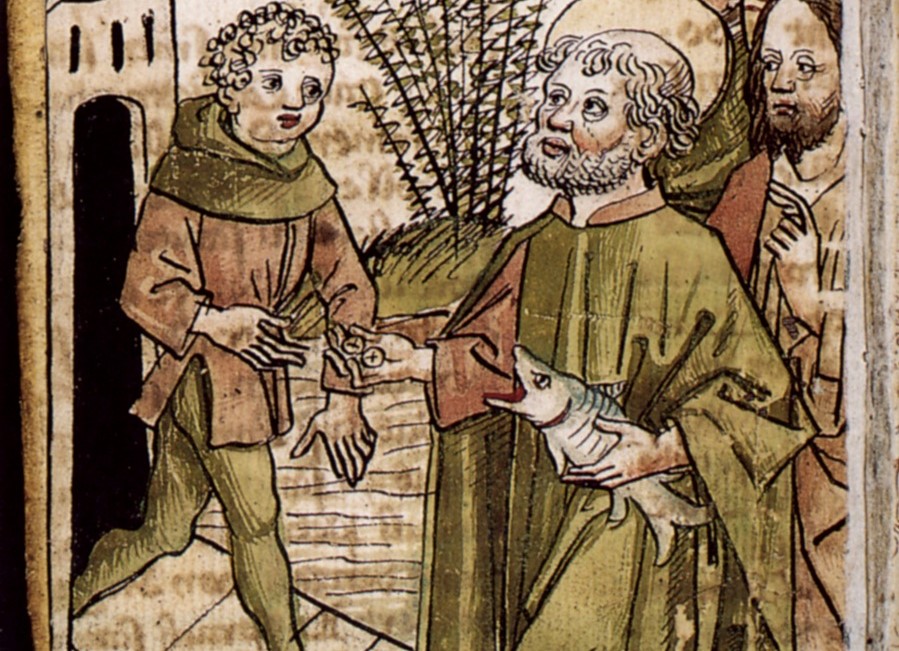
Jesus anticipated him, saying, “What do you think, Simon? From whom do the kings of the earth take customs or taxes, from their sons or from strangers?” Peter said to him, “From strangers.” Jesus said to him, “Then the sons are free. Nevertheless, lest we offend them, go to the sea, cast in a hook, and take the fish that comes up first. And when you have opened its mouth, you will find a piece of money; take that and give it to them for me and you.”
Jesus
Masters the Elements of Nature
Jesus also proved
his mastery over the elements of nature, like when he walked
on water. On another instance, he and his disciples got into
a boat, and suddenly a great tempest arose on the sea, so that
the boat was covered with waves. Jesus was asleep. His disciples
awoke him, saying, “Lord, save us! We are perishing!”
“Why are you fearful, O you of little faith?”he
replied. Then, he arose and rebuked the winds and the sea, and
there was a great calm.
Jesus
Could Disappear His Body
Jesus could also
accelerate the atomic structure of his body to where he could
disappear out of the midst of people. This happened several
times as the crowds sought to kill him, and makes his sacrifice
on the cross that much more touching, because he completely
allowed it to happen for the balancing of karma and the forgiveness
of sins, even though he had the mastery to dematerialize and
escape.
The gospels relate, “And all they in the synagogue, when they heard these things, were filled with wrath, and rose up, and thrust him out of the city, and led him unto the brow of the hill whereon their city was built, that they might cast him down headlong. But he, passing through the midst of them, went his way. On another occasion. Jesus was preaching, “Believe, that the Father is in me, and I in him.” Therefore they sought again to take him: but he escaped out of their hand. A further instance says, “Then the Jews took up stones again to stone him, but Jesus hid himself, and went out of the temple, going through the midst of them, and so passed by.” We also read that when the chief priests and Pharisees heard his parables, they perceived that he was speaking of them. But when they sought to lay hands on him, they feared the multitudes, because the multitudes took Jesus for a prophet.
Some people in
the synagogue were astonished by Jesus, and others were offended,
“Where did this man get this wisdom and these mighty works?
Is this not the carpenter’s son? Is not his mother called
Mary? And his brothers James, Joses, Simon, and Judas? And his
sisters, are they not all with us? Where then, did this man
get all these things?” And Jesus simply answered, “A
prophet is not without honor except in his own country and in
his own house.”
Jesus
Challenges the Spiritual Authorities of His Time
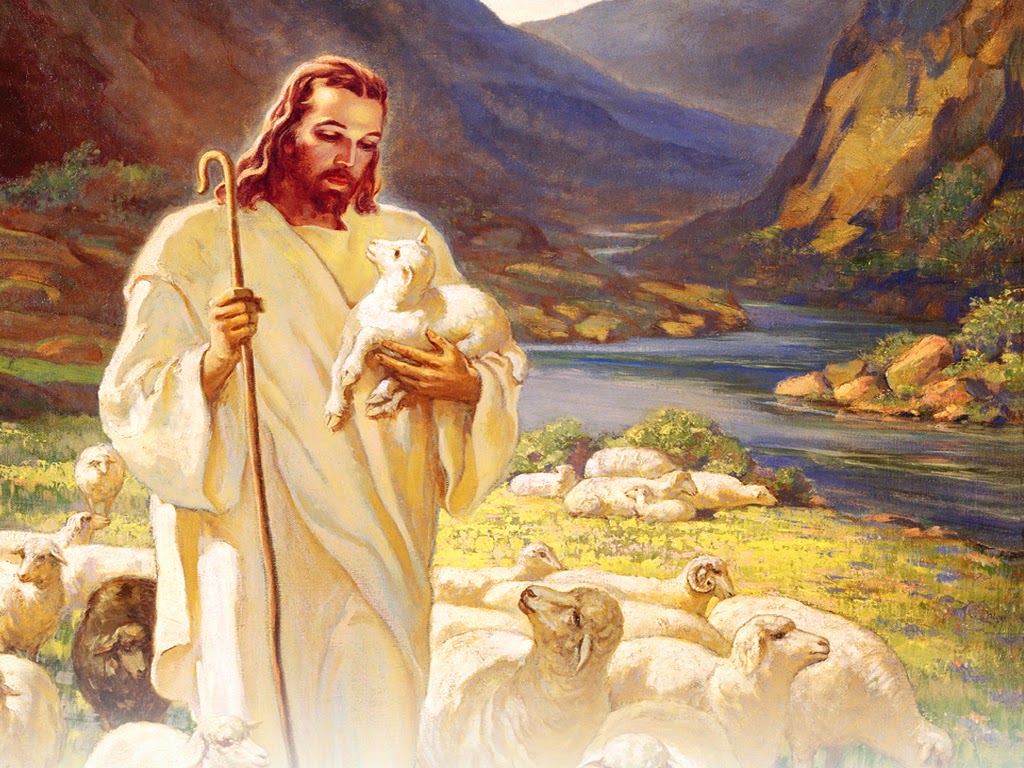
This bring us to the next topic—Jesus' relationship with the Pharisees, Sadducees and Herodians, who became his accusers. The gospels say, “Then Jesus went about all the cities and villages, teaching in their synagogues, preaching the gospel of the kingdom, and healing every sickness and every disease among the people. But when he saw the multitudes, he was moved with compassion for them, because they were weary and scattered, like sheep having no shepherd.” Jesus recognized that the spiritual authorities did not care for, or shepherd the people. They were only in it for themselves.
Jesus called himself the good shepherd and explained that these spiritual authorities were thieving the sheep—the souls of children of God—because they were trying to get into positions of spiritual authority by deviant ways, and not by the genuine authority of the Christ, who is the Way, the Truth and the Life. “Enter by the narrow gate; for wide is the gate and broad is the way that leads to destruction, and there are many who go in by it. Because narrow is the gate and difficult is the way which leads to life, and there are few who find it,” he said. He taught them as one having authority, and not as the scribes.
This also relates back to when Jesus rebuked the Pharisees for shutting the kingdom of heaven in men's faces. Jesus said, “You yourselves do not enter, nor will you let in those who wish to enter.”
Jesus said, “Verily, verily, I say unto you, he that enters not by the door into the sheepfold, but climbs up some other way, the same is a thief and a robber. But he that enters in by the door is the shepherd of the sheep.” The good shepherd leads the sheep to heaven's door. “To him the porter opens; and the sheep hear his voice: and he calls his own sheep by name, and leads them out.” Jesus explains, “I am the door of the sheep. All that ever came before me are thieves and robbers: The thief comes not, but for to steal, and to kill, and to destroy: I am come that they might have life, and that they might have it more abundantly.
Jesus tells the powers-that-be, “I am the good shepherd: the good shepherd gives his life for the sheep...And other sheep I have, which are not of this fold: them also I must bring, and they shall hear my voice; and there shall be one fold, and one shepherd. Ye believe not, because ye are not of my sheep, as I said unto you. My sheep hear my voice, and I know them, and they follow me: And I give unto them eternal life; and they shall never perish, neither shall any man pluck them out of my hand.”
The Pharisees questioned Jesus for eating with tax collectors and sinners. Jesus rebuked their self-righteousness. “I did not come to call the righteous, but sinners to repentance, “ he said. “Those who are well have no need of a physician, but those who are sick.” To this he added, “But go and learn what this means” he said. “‘I desire mercy and not sacrifice.’ ” Jesus was quoting what God told the Prophet Hosea: “For I desired mercy, and not sacrifice; and the knowledge of God more than burnt offerings.” He was reminding the Pharisees that God prefers a true change of heart to the ritualistic scapegoat.
Jesus expressed gratitude to God for hiding divine truth from those who see themselves wise and prudent, revealing it instead to those who have a childlike spirit. “I thank you, Father, Lord of heaven and earth, that you have hidden these things from the wise and prudent and have revealed them to babes.” The scriptures recount that the chief priests and scribes were indignant when Jesus healed the blind and the lame that came to him in the temple, while the children praised him, “Hosanna to the Son of David!”
“Do You hear what these are saying?” they said. “Yes.” Jesus answered, quoting the Psalms “Have you never read, ‘Out of the mouth of babes and nursing infants you have perfected praise’?”
Jesus further exposed the spiritual authorities by challenging the multitudes who gathered to listen to him: “Unless your righteousness exceeds the righteousness of the scribes and Pharisees, you will by no means enter the kingdom of heaven.” Jesus was talking about having our hearts in the right place.
The gospels say that when the Pharisees heard that he had silenced the Sadducees, who were their religious “higher ups,” they gathered together. Then a lawyer among them, asked Jesus a question to test him: “Teacher, which is the great commandment in the law?” Jesus said to him,“‘You shall love the Lord your God with all your heart, with all your soul, and with all your mind.’ This is the first and great commandment. And the second is like it: ‘You shall love your neighbor as yourself. On these two commandments hang all the Law and the Prophets.”
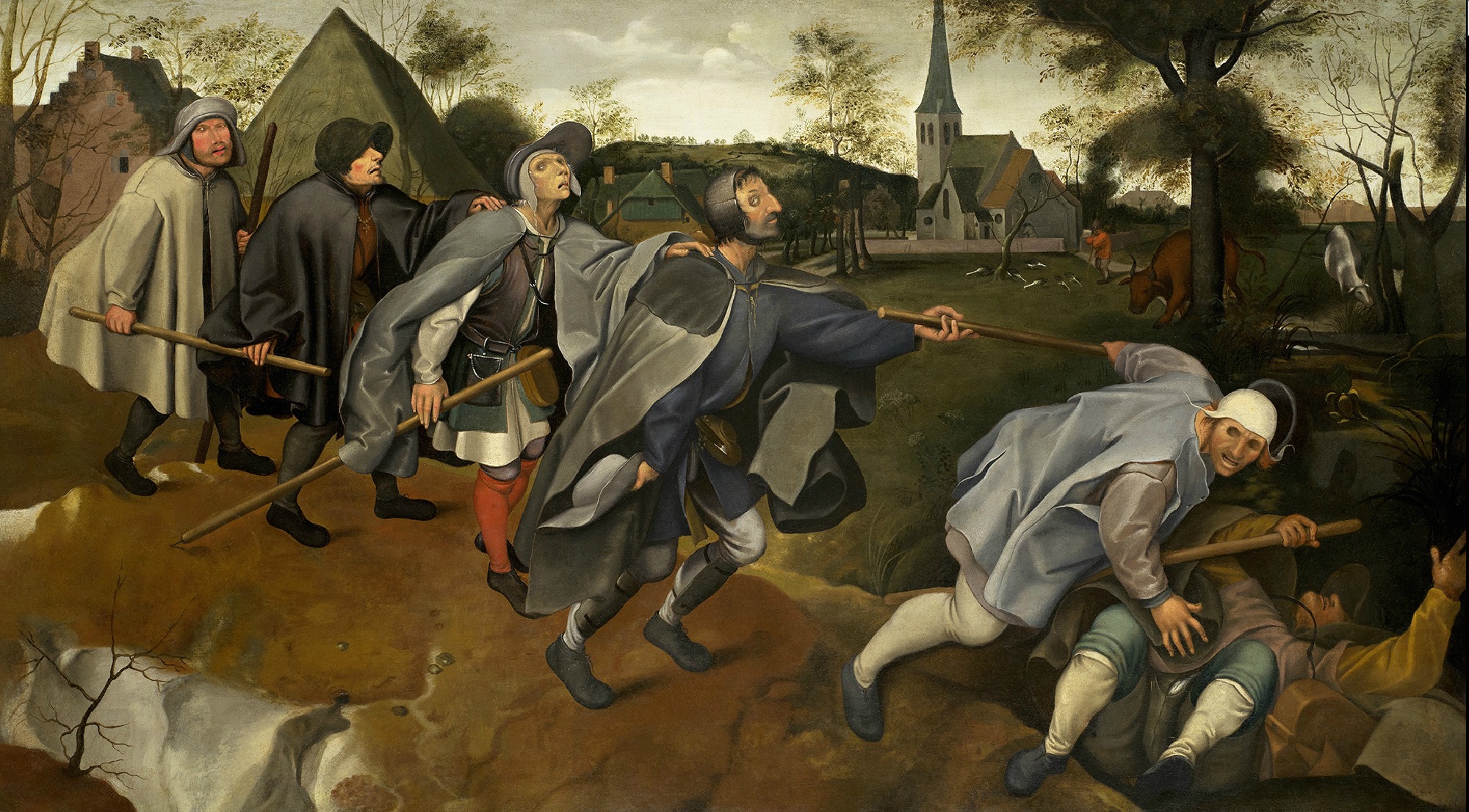
The Blind Leading the Blind by Pieter Brueghel
Jesus warned those who, out of hypocrisy, were training others to do likewise. He said, “Whoever therefore breaks one of the least of these commandments, and teaches men so, shall be called least in the kingdom of heaven; but whoever does and teaches them shall be called great in the kingdom of heaven.” Then, he said, “Do not think that I came to destroy the Law or the Prophets. I did not come to destroy but to fulfill. For assuredly, I say to you, till heaven and earth pass away, one jot or one tittle will by no means pass from the law till all is fulfilled.”
Jesus challenged the rote fulfillment of Mosaic law—and those who take refuge in the letter of the law—while bypassing the spirit of the law. The ascended master Saint Germain teaches that the letter of the law is the skeletal framework of cosmos on which the spirit of the law self-actuates. He tells us the letter of the law is the masculine aspect of God and the spirit of the law is the feminine aspect, that allows us to receive the grace of our Christ self. This echoes the Gospel of John, “For the law was given by Moses, but grace and truth came by Jesus Christ.” The letter of the law is like a music staff, and the spirit of the law are the notes of music that fill the air with creative genius. The Divine Mother who manifests as progressive revelation is always supported by the Divine Father's will and blueprint.
Jesus exposed the spiritual authorities, and their scribes and lawyers, as the blind leading the blind. “You blind guides!” he said. “You strain out a gnat but swallow a camel.” One time, the disciples told Jesus that the Pharisees were offended by his words. Jesus answered, “Every plant which my heavenly Father has not planted will be uprooted. Let them alone. They are blind leaders of the blind. And if the blind leads the blind, both will fall into a ditch.”
Jesus is saying that the Pharisees who do not approve of him are not children of God. He makes that observation even clearer when he tells them they are children of the devil. He says they strain out a gnat and swallow a camel, denouncing their misguided discernment and preferring dead ritual over the God's mandate of Love. One such example had to do with hand washing.
Jesus' hands, and the hands of his disciples, were used by God to bless and heal. The Pharisees, and certain scribes from Jerusalem, saw the disciples eat bread with unwashed hands and found fault. “Why walk not thy disciples according to the tradition of the elders, but eat bread with unwashed hands?” they asked.
A Pharisee who invited Jesus to dine with him was also surprised to see that Jesus did not first wash before the meal. Jesus answered, “You Pharisees clean the outside of the cup and dish, but inside you are full of greed and wickedness....Woe unto you, scribes and Pharisees, hypocrites! for ye are like whited sepulchers, which indeed appear beautiful outward, but are full of dead men's bones, and of all uncleanness.”
Jesus explained to them that self-givingness cleans both the inside and the outside of a person. He was speaking of vibration, even at the sub-atomic level. “But give as alms the things that are within you, and you will see that everything is clean for you.”
Jesus also took the opportunity to point out to the Pharisees where they were in breach of the law they so loved to quote. He denounced them for welcoming into the temple grown children estranged from their parents, so long as instead of supporting their aging parents, these children transferred that money to the temple.
Jesus said, “For God commanded, saying, ‘Honor your father and your mother’; and ‘He who curses father or mother, let him be put to death.’ But you say, ‘Whoever says to his father or mother, whatever profit you might have received from me is a gift to God—then he need not honor his father or mother.’ Thus you have made the commandment of God of no effect by your tradition.”
He denounced that their adherence to God's law was situational and self-serving, and reminded them of the words of Isaiah: “Well hath Esaias prophesied of you hypocrites, as it is written, This people honor me with their lips, but their heart is far from me. Howbeit in vain do they worship me, teaching for doctrines the commandments of men.” Then, Jesus explained to the multitudes, “Hear and understand: Not what goes into the mouth defiles a man; but what comes out of the mouth, this defiles a man.”
“Either make the tree good and its fruit good, or else make the tree bad and its fruit bad,” said Jesus, “for a tree is known by its fruit. Beware of false prophets, who come to you in sheep’s clothing, but inwardly they are ravenous wolves. You will know them by their fruits. Do men gather grapes from thornbushes or figs from thistles? Even so, every good tree bears good fruit, but a bad tree bears bad fruit. Every tree that does not bear good fruit is cut down and thrown into the fire. Therefore by their fruits you will know them.”
Like John the Baptist, Jesus exposed the fallen Serpent consciousness of the Pharisees. “Brood of vipers!” he said. “How can you, being evil, speak good things? For out of the abundance of the heart, the mouth speaks. A good man out of the good treasure of his heart brings forth good things, and an evil man out of the evil treasure brings forth evil things. But I say to you that for every idle word men may speak, they will give account of it in the day of judgment. For by your words you will be justified, and by your words you will be condemned.”
Peter asked Jesus to elaborate. Jesus answered by pointing out the difference between the digestive system and the misuse of the spoken word, through the extension of an impure heart. Mark and Elizabeth Clare Prophet explained to students that the spiritual science of decrees is sponsored by ascended masters all the way back to the Great Central Sun. This is why the Book of Job says, “Thou shalt also decree a thing and it shall be established unto thee.”They also warned that decrees will not work for people who exercise the science of the spoken word with hatred or resentment or discontent in their heart. God—through any one of the ascended masters— cannot answer a call that is given with a darkened disposition. Jesus told Peter the same: “Are you also still without understanding? Do you not yet understand that whatever enters the mouth goes into the stomach and is eliminated? But those things which proceed out of the mouth come from the heart, and they defile a man. For out of the heart proceed evil thoughts, murders, adulteries, fornications, thefts, false witness, blasphemies. These are the things which defile a man, but to eat with unwashed hands does not defile a man.”
Jesus was also questioned John the Baptist's disciples, which included Pharisees, why he did not exact fasting from his disciples. “Why do we and the Pharisees fast often but your disciples do not fast?”they asked. Jesus answered, “Can the friends of the bridegroom mourn as long as the bridegroom is with them? But the days will come when the bridegroom will be taken away from them, and then they will fast.” We can see from these teachings that Jesus is not fanatic, and that the light of Christ suffices to cleanse.
One day, Jesus went through the grain fields on the Sabbath, and his disciples were hungry, and began to pluck heads of grain to eat. The Pharisees badgered, “Look, your disciples are doing what is not lawful to do on the Sabbath!” The Pharisees liked to refer back to David, so Jesus pointed out that David, on occasion, also broke the laws of Moses. When David was hungry, he reminded them, David and his companions entered the house of God and ate the showbread, which was only lawful for the priests to eat. He also pointed out that while many priests profane the Sabbath without scruples, he and his disciples were guiltless because their temple is in the heart— and the temple in the heart where Christ abides is greater than David's temple. For this reason he said, “the Son of Man is Lord of the Sabbath.” Later, the Book of Hebrews affirmed Jesus as “a priest forever, after the Order of Melchezedek.” Jesus then told them he was the bread of life. I can just see the look on their faces...
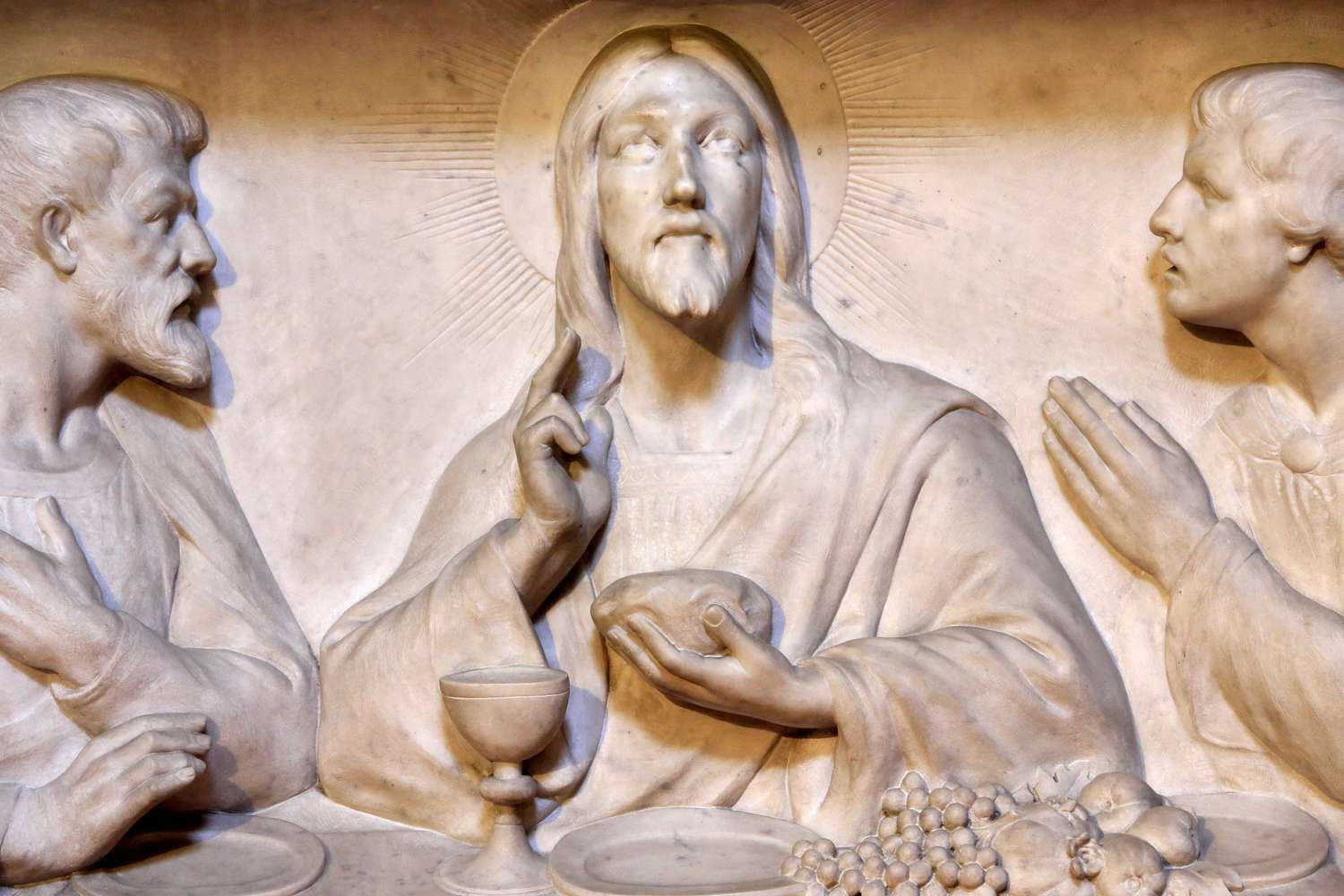
From the Gospel of John: “Very truly I tell you, it is not Moses who has given you the bread from heaven, but it is my Father who gives you the true bread from heaven. For the bread of God is the bread that comes down from heaven and gives life to the world.” This bread—like Jesus told Satan in the wilderness—is the Word of God, the power of creation itself. “Sir,” some replied, “always give us this bread.”
Then Jesus went a step further and declared that he was that Word and that bread: “I am the bread of life. Whoever comes to me will never go hungry, and whoever believes in me will never be thirsty.”
Jesus went on to say that those who believe in him are pre-chosen by the Father. They have the seed of Christ in them—the divine threefold flame—by which they respond to the Christ flame in Jesus. Those who do not have an active Christ flame do not believe and resist conversion through the Holy Spirit.
Jesus said to them, “But as I told you, you have seen me and still you do not believe. All those the Father gives me will come to me, and whoever comes to me I will never drive away. For I have come down from heaven not to do my will but to do the will of him who sent me. And this is the will of him who sent me, that I shall lose none of all those he has given me, but raise them up at the last day. For my Father’s will is that everyone who looks to the Son and believes in him shall have eternal life, and I will raise them up at the last day.”
The Pharisees began to grumble. “Is this not Jesus, the son of Joseph, whose father and mother we know? How can he now say, ‘I came down from heaven’?”
“Stop grumbling among yourselves,” Jesus told them. “No one can come to me unless the Father who sent me draws them, and I will raise them up at the last day. It is written in the prophets: ‘They will all be taught by God.’ Everyone who has heard the Father and learned from him comes to me. No one has seen the Father except the one who is from God.. Only he has seen the Father. Very truly I tell you, the one who believes has eternal life.
“I am the bread of life. Your ancestors ate the manna in the wilderness, yet they died. But here is the bread that comes down from heaven, which anyone may eat and not die. I am the living bread that came down from heaven. Whoever eats this bread will live forever. This bread is my flesh, which I will give for the life of the world.”
Then the Jews began to argue sharply among themselves, “How can this man give us his flesh to eat?” Jesus was speaking of the divine light present even in his cellular structure, that those attuned with God may assimilate and become. He said to them,“Very truly I tell you, unless you eat the flesh of the Son of Man and drink his blood, you have no life in you.”
Even his disciples became uncomfortable. “This is a hard teaching,” said some. “Who can accept it?” Jesus heard their grumbling. “Does this offend you? Then what if you see the Son of Man ascend to where he was before! The Spirit gives life. The flesh counts for nothing. The words I have spoken to you—they are full of the Spirit and life. Yet there are some of you who do not believe. This is why I told you that no one can come to me unless the Father has enabled them.”
Many turned back and no longer followed Jesus. “You do not want to leave too, do you?”Jesus asked the twelve. Peter answered,“Lord, to whom shall we go? You have the words of eternal life. We have come to believe and to know that you are the Holy One of God.”
The Pharisees also tried to smear Jesus's ability to exorcise evil spirits by saying that he used the power of Beelzebub, “prince of demons,” to do so. This was a bold and outrageous lie, because only God's light can drive out evil.
Jesus healed a demon-possessed man, who was also blind and mute, so that he could speak and see. When the Pharisees heard of this healing, they said among themselves, “This fellow does not cast out demons except by Beelzebub, the ruler of the demons.”
Jesus knew their thoughts and exposed their relationship with Beelzebub: “Every kingdom divided against itself is brought to desolation, and every city or house divided against itself will not stand. If Satan casts out Satan, he is divided against himself. How then will his kingdom stand? And if I cast out demons by Beelzebub, by whom do your sons cast them out? Therefore they shall be your judges. But if I cast out demons by the Spirit of God, surely the kingdom of God has come upon you.”
Jesus explains the process of exorcism. “How can one enter a strong man’s house and plunder his goods, unless he first binds the strong man?” says Jesus, referring to the demon as the strong man and the goods as the soul. “He who is not with me is against me, and he who does not gather with me scatters abroad,”—meaning scatters the souls that Jesus came to gather.
The common people marveled and said, “Could this be the Son of David?” The Jews believed the Messiah would come from the lineage of David to restore Israel and usher in an era of peace. In the Old Testament that the Jews followed, God made a covenant with David, promising his throne would be established forever. The Jews did not understand that Jesus was the soul of David reincarnated, and that God's promise would herald a heavenly kingdom “not of this world.”
Jesus challenged their understanding of Christ being a physical son of David. Quoting Psalms, he proved that Christ was also David’s Lord, and that He is now Lord because Christ is fully manifest within Him.
While the Pharisees were gathered together, Jesus asked them, “What do you think about the Christ? Whose son is he?” “The son of David,” they replied. Jesus said, “How then, does David in the Spirit call this son Lord, saying: The Lord said to my Lord, Sit at my right hand, till I make your enemies your footstool? If David then calls him Lord, how is he his son?”
The gospels say that following this, no one was able to answer him a word, nor from that day on did anyone dare question him anymore.
Still, the Pharisees and other synagogue leaders tried to entrap Jesus, that they might accuse him. They particularly reproached his healing on the Sabbath. When a man with a withered hand, came into their midst, Jesus said to them, “What man is there among you who has one sheep, and if it falls into a pit on the Sabbath, will not lay hold of it and lift it out? Of how much more value then, is a man than a sheep? Therefore it is lawful to do good on the Sabbath.” Jesus said to the man,“Stretch out your hand.”And he stretched it out, and it was restored as whole as the other. The Pharisees then went out and plotted how they might destroy him.
On another Sabbath day, Jesus was teaching in one of the synagogues and an infirm woman was there. She had been bowed together for eighteen years and could not lift herself up. Jesus saw her and said, “Woman, thou art loosed from thine infirmity.” Then he laid his hands on her and she was immediately made straight, and glorified God. The ruler of the synagogue was indignant, because Jesus had healed on the day of rest. Jesus told him, “You hypocrite, does not each one of you on the Sabbath loose his ox or his ass from the stall, and lead him away to watering? Ought not this woman, being a daughter of Abraham whom Satan hath bound these eighteen years, be loosed from this bond on the Sabbath day?” Having said this, Jesus' adversaries were ashamed and all the people rejoiced.
The man born blind was also healed on the Sabbath, and so was the man at the pool of Bethesda. There were so many healings on the Sabbath that it leads to believe this was not coincidental. The Sabbath, which is the seventh day, focuses the Seventh Ray of God—the violet flame energy of forgiveness, freedom, and transmutation of karma. When the blind man's sight was restored, the Pharisees interrogated him. He told them a prophet healed him. Then, some of the Pharisees accused Jesus again. “This man is not of God, because he keeps not the sabbath day.” Not all Pharisees were against Jesus. Some, like Nicodemus, who visited Jesus at night, defended the Master. “How can a man that is a sinner do such miracles?” they said.
The divided Pharisees interrogated the blind man's parents, but the parents would have none of this harassment. “He is of age. Ask him,” they answered. So the Pharisees went back to the healed blind man and tried to denounce Jesus. “Give God the praise,” they said. “We know that this man is a sinner.” The blind man answered them bluntly, “Whether he be a sinner or not, I know not. One thing I know—that, whereas I was blind, now I see.”
They could not let it go, so they questioned the blind man again. “What did he to thee? How opened he thine eyes?” The man answered in jest, and even more bluntly. “I have told you already, and you did not hear. Wherefore would you hear it again? Will you also be his disciples?”
Then the Pharisees reviled him, “You are his disciple; but we are Moses' disciples. We know that God spoke unto Moses. As for this fellow, we know not from whence he is.” The man challenged them again with childlike simplicity. “Why herein is a marvelous thing,” he said, “That ye know not from whence he is, and yet he has opened mine eyes. Now we know that God hears not sinners. But if any man be a worshiper of God, and does his will, him he hears. Since the world began, it was not heard that any man opened the eyes of one born blind. If this man were not of God, he could do nothing.” We can see from this man's words that his soul had volunteered to endure blindness, so that Jesus would demonstrate through him the glory of God by healing him of a condition that preceded birth. The haughty Pharisees wanted none of it, and blamed his past life karma: “You were altogether born in sin,” they said, “and you want to teach us? “ Then, they cast him out.
When Jesus heard that they had cast him out, he went to find him. “Do you believe on the Son of God?”Jesus asked. The man answered sincerely, “Who is he, Lord, that I might believe on him? And Jesus said to him, “You have both seen him,”—meaning his eyes—“and it is he that talks with thee.” The man replied, “Lord, I believe,” and he worshiped Christ in Jesus. Then Jesus explained to him, “For judgment I am come into this world, that they which see not might see. And that they which see might be made blind.”
Some of the Pharisees heard these words, and were offended: “Are we blind also?” they asked. Jesus said unto them, “If ye were blind, ye should have no sin: but now ye say, we see. Therefore your sin remains.” Jesus meant that unlike the blind man, their karma was not transmuted.
The Pharisees derided Jesus, so Jesus said, “Ye are they which justify yourselves before men; but God knows your hearts: for that which is highly esteemed among men is abomination in the sight of God.” Jesus further denounced them with the following parable:
Two men went up into the temple to pray; the one a Pharisee, and the other a publican. The Pharisee stood and prayed thus with himself: “God, I thank thee, that I am not as other men are, extortioners, unjust, adulterers, or even as this publican. I fast twice in the week, I give tithes of all that I possess.” And the publican, standing afar off, would not lift up so much as his eyes unto heaven, but smote upon his breast, saying, “God be merciful to me a sinner.”
“I tell you,” said Jesus, “this man went down to his house justified rather than the other: for every one that exalts himself shall be abased; and he that humbles himself shall be exalted.”
Jesus taught, “And when you pray, you shall not be like the hypocrites. For they love to pray standing in the synagogues and on the corners of the streets, that they may be seen by men. Assuredly, I say to you, they have their reward,” meaning the reward they get is the approval of men, instead of the approval of God. The benefit to the ego forfeits the accrual of good karma to the soul.
“But when you pray,” Jesus said, “go into your room, and when you have shut your door, pray to your Father who is in the secret place; and your Father who sees in secret will reward you openly. And when you fast, wash your face, so that you do not appear to men to be fasting, and your Father who sees in secret will reward you openly.”
Jesus also warns about vain repetitions. “And when you pray, do not use vain repetitions as the heathen do. For they think that they will be heard for their many words.” The keyword here is “vain.” Many monastic and Eastern traditions use repetitions of holy prayers and mantras to more deeply anchor a spiritual result. This is the true Science of the Spoken Word that Elizabeth Clare Prophet teaches: “You see, this is not vain repetition but prayer with a purpose: the re-creation of ourselves and our world in the image and likeness of God. Because the decree is expressing our will to confirm God’s will “on earth as it is in heaven,” the qualification of our energy and consciousness continues after the decree is given—so long as we hold the desire, the harmony, and the free will to have it so in our lives.
“Now, you can hear the decree accelerate. You can hear it become fiery and intense because a decree is a command. And God said to us, Command ye me—Ask me of things to come concerning my sons, and concerning the work of my hands command ye me.”
We find a story in the gospels about the leaven of the Pharisees. Jesus gave a parable about leaven. He said, “The Kingdom of Heaven is like the yeast a woman used in making bread. Even though she put only a little yeast in three measures of flour, it permeated every part of the dough.” I believe that the leaven in three measures of flour is a metaphor for the divine threefold flame in the heart. This is a divine energy field, and the very presence of God individualized for each one, what the Hindus call the Atman.
The threefold flame has also been called the Holy Christ Flame, because it is the seed of Christ in us. The ascended masters tell us that in most people, this flame is only a quarter of an inch in height. As we develop our Christ mastery, the flame expands and transforms us. We move from being children of God into becoming responsible Sons and Daughters of God, and then ultimately Christed beings.
The ascended masters tell us that Jesus' threefold flame enveloped his entire body—meaning he fully walked and lived within the flame—which afforded him extraordinary divine power, wisdom and love, from which healings and miracles sprung forth. This is the flame Moses attuned with when he said, “Our God is a consuming fire.” This is the “kingdom within” that Jesus directed us to find. As the flame increases, God permeates our entire consciousness, being and world.

Jesus Enveloped in the Threefold Flame, www.tsl.org
In contrast, Jesus told his disciples to “Take heed and beware of the leaven of the Pharisees and the Sadducees.” When he said this, the disciples understood he was speaking of their doctrine. Jesus defined it as the hypocrisy found within church and state. “For there is nothing covered, that shall not be revealed; neither hid, that shall not be known. Therefore whatsoever ye have spoken in darkness shall be heard in the light; and that which ye have spoken in the ear in closets shall be proclaimed upon the housetops.”
I believe Jesus gave another metaphor for the threefold flame, so small to begin with, but that can grow to become the full repository of our tree of life. “The Kingdom of Heaven is like a grain of mustard seed which a man took, and sowed in his field, which indeed is smaller than all seeds. But when it is grown, it is greater than the herbs and becomes a tree, so that the birds of the air come and lodge in its branches.”
Jesus also urged his disciples to have faith as a mustard seed, meaning to draw upon the strength of the divine presence in their heart. “If ye have faith as a grain of mustard seed, ye shall say unto this mountain, Remove hence to yonder place; and it shall remove; and nothing shall be impossible unto you. If ye had faith as a grain of mustard seed, ye might say unto this sycamine tree, Be thou plucked up by the root, and be thou planted in the sea; and it should obey you.”
The gospels record that among the chief rulers, many believed on Jesus, but because of the Pharisees they did not confess their belief, lest they should be put out of the synagogue: For they loved the praise of men more than the praise of God. This is also why Jesus said, “But woe unto you that are rich! For ye have received your consolation. Woe unto you that are full! For ye shall hunger. Woe unto you that laugh now! For ye shall mourn and weep. Woe unto you, when all men shall speak well of you! For so did their fathers to the false prophets. Beware of the scribes, which love to go in long clothing, and love salutations in the marketplaces, and the chief seats in the synagogues, and the uppermost rooms at feasts, which devour widows' houses, and for a pretense make long prayers. These shall receive greater damnation.”
What Jesus
is saying here is that spiritual leaders who parasitize on their
followers, and use the Word of God to finance themselves, to
prop up their ego, to receive commendation, to amass power and
influence, shall be judged even more severely.
Jesus
and Money
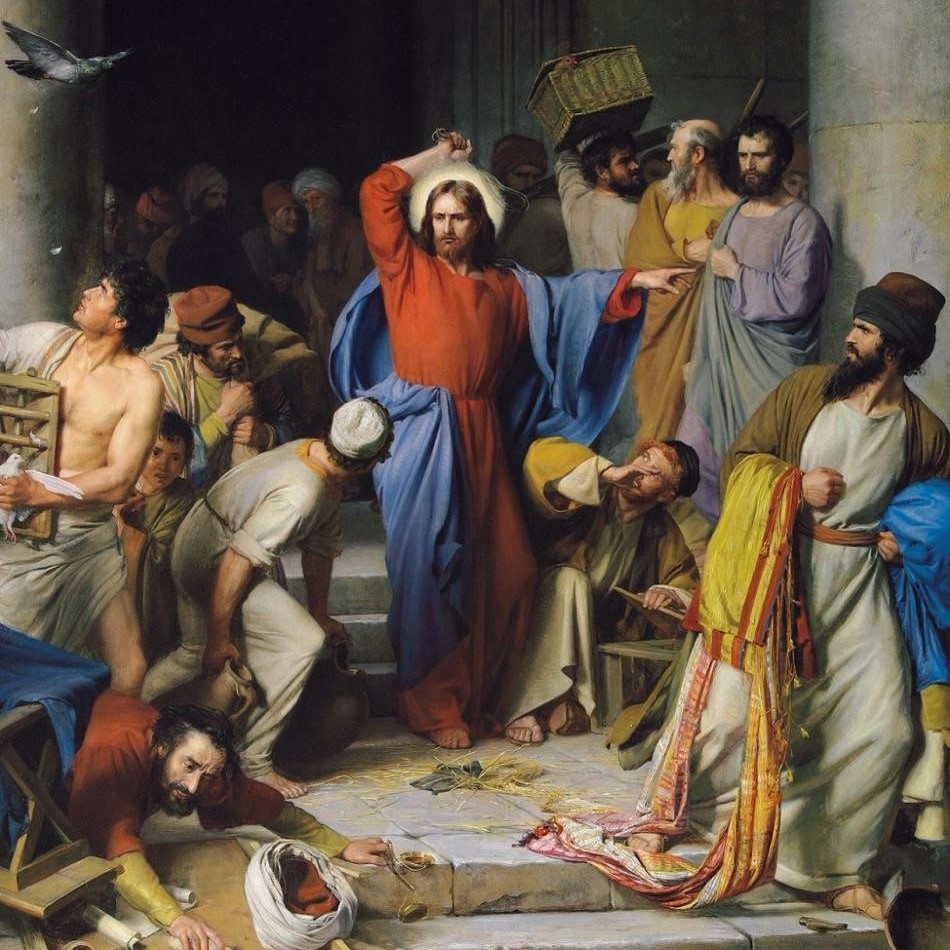
Jesus had many interactions with the Pharisees on the subject of money. He repeatedly challenged their cupidity, greed and avarice. Perhaps the most significant example is when Jesus went into the temple of God and drove out all those who bought and sold in the temple. He overturned the tables of the money changers and the seats of those who sold doves, saying to them,“It is written,‘My house shall be called a house of prayer,’ but you have made it a ‘den of thieves.’” This is especially significant because the temple in Jerusalem was the temple David built, and so Jesus, as the soul of David, wanted it used for what it was intended. For David, the temple was an outside building. For Jesus, the temple was his body. One was exoteric and the other esoteric.
In the Gospel of John, we read: When the Jewish Passover was near, Jesus went up to Jerusalem. In the temple courts, he found men selling cattle, sheep, and doves, and money changers seated at their tables. So he made a whip out of cords and drove all from the temple courts, both sheep and cattle. He poured out the coins of the money changers and overturned their tables. To those selling doves he said, “Get these out of here! How dare you turn my Father’s house into a den of thieves!”
Jesus spoke of this incident in two dictations published by the Summit Lighthouse. “I must in protest come again to overturn the money changers in the temple. These are they who conspire with world movements of totalitarianism, who enter into compromise, and challenge and deny the true path of individual soul freedom and the rightful inheritance of every son of God to walk and talk with me and to commune with me as I walked and talked with my disciples.”
He also said, “I AM come that you might have life and that more abundantly manifest in the here and now! I AM come to remove the moneychangers from the temple of our God and from the temple of the people! I AM come for the thrusting of the energy of the Great Central Sun whereby all must give accounting this day in the Law of the One! Let them stand, then, before the judgment hall as I stood and as you stand, for none are spared in the hour of the judgment! And unto the souls of light is the judgment, the manifestation of that love whereby they are sealed in the eye of God.
“Let the judgment, then, be for the separation to the right and to the left of mankind’s uses and misuses of the sacred energies of life. And let those who have been sown as the tares among the good wheat, let the seed of the wicked also know that the hour of redemption is come and the hour of choosing to bend the knee and bow to the inner light of the Christ is also come. He that receiveth you receiveth me, and he that receiveth me receiveth the Christ of his own Self-–the Supreme One, the Mediator, the very God from the heart of the Great Central Sun.”
Jesus' disciples remembered that it is written: “The zeal for your house will consume me.” On account of this, the Jews demanded, “What sign can you show us to prove your authority to do these things?” Jesus answered, “Destroy this temple, and in three days I will raise it up again.”
“This temple took forty-six years to build,” the Jews replied, “and you are going to raise it up in three days?” But Jesus was speaking about the temple of his body. And after he was raised from the dead, his disciples remembered that he had said this. Then they believed the scripture and the word that Jesus had spoken.
Jesus' life began with a financial transaction—the taxation of his parents that drove them to Bethlehem. It also ended with a financial transaction—Judas betraying Jesus for thirty pieces of silver. Jesus was well aware of the financial requirements of the physical plane, but he wanted his disciples to learn of him, trust in God and forsake money-making schemes, especially when it came to religion and the Kingdom of God.
We read in the Gnostic texts that Jesus and his disciples were provided for by the holy women and by other benefactors, like Joseph of Arimathea. Jesus could also precipitate what was needed from the ethers, like when he fed the multitudes and told Peter to go find a coin in the mouth of a fish. He also depended on the kindness and hospitality of strangers, for meals, accommodations and even a donkey, and he taught his disciples to do likewise. When Jesus spoke to the woman at the well, his disciples were getting meat, and offered some food to Jesus but he refused, saying, “I have meat you know not of. My meat is to do the will of him that sent me, and to finish his work.” What Jesus meant was that his sustenance was divine light descending from his Mighty I AM Presence, over his crystal cord.
Jesus brought this up this divine source again when the disciples questioned him about bread. “O you of little faith, why do you reason among yourselves because you have brought no bread? Do you not yet understand, or remember the five loaves of the five thousand and how many baskets you took up? Nor the seven loaves of the four thousand and how many large baskets you took up?”
Regarding clothing, Jesus spoke about the lilies in the field being arrayed with greater glory than Solomon. “And why take ye thought for raiment? Consider the lilies of the field, how they grow; they toil not, neither do they spin: And yet I say unto you, that even Solomon in all his glory was not arrayed like one of these.”
Jesus told his disciples not to worry, and then sent them to preach without purse. Upon their return, he questioned them: “When I sent you without purse, bag or sandals, did you lack anything?” “Nothing,” they answered. “Therefore I say to you, do not worry about your life, what you will eat or what you will drink; nor about your body, what you will put on. Is not life more than food and the body more than clothing? Look at the birds of the air, for they neither sow nor reap nor gather into barns; yet your heavenly Father feeds them. Are you not of more value than they? Which of you by worrying can add one cubit to his stature?”
“Now if God so clothes the grass of the field, which today is, and tomorrow is thrown into the oven, will he not much more clothe you, O ye of little faith? Therefore do not worry, saying, ‘What shall we eat?’ or ‘What shall we drink?’ or ‘What shall we wear?’ For after all these things the Gentiles seek. Your heavenly Father knows that you need all these things. But seek first the kingdom of God and his righteousness, and all these things shall be added unto you. Therefore do not worry about tomorrow, for tomorrow will worry about its own things. Sufficient for the day is the evil; thereof,” meaning each day brings forth its own allotment of karma to balance.
“Do not lay up for yourselves treasures on earth, where moth and rust destroy and where thieves break in and steal,” says Jesus. But lay up for yourselves treasures in heaven, where neither moth nor rust destroys and where thieves do not break in and steal.”
Jesus is speaking here of the color band rings of our causal bodies, that contain the spiritual record of all of the good our soul has ever done. “For where your treasure is, there your heart will be also. No one can serve two masters; for either he will hate the one and love the other, or else he will be loyal to the one and despise the other. You cannot serve God and mammon,” said Jesus, meaning the purposes of your divinity and the values of the world.
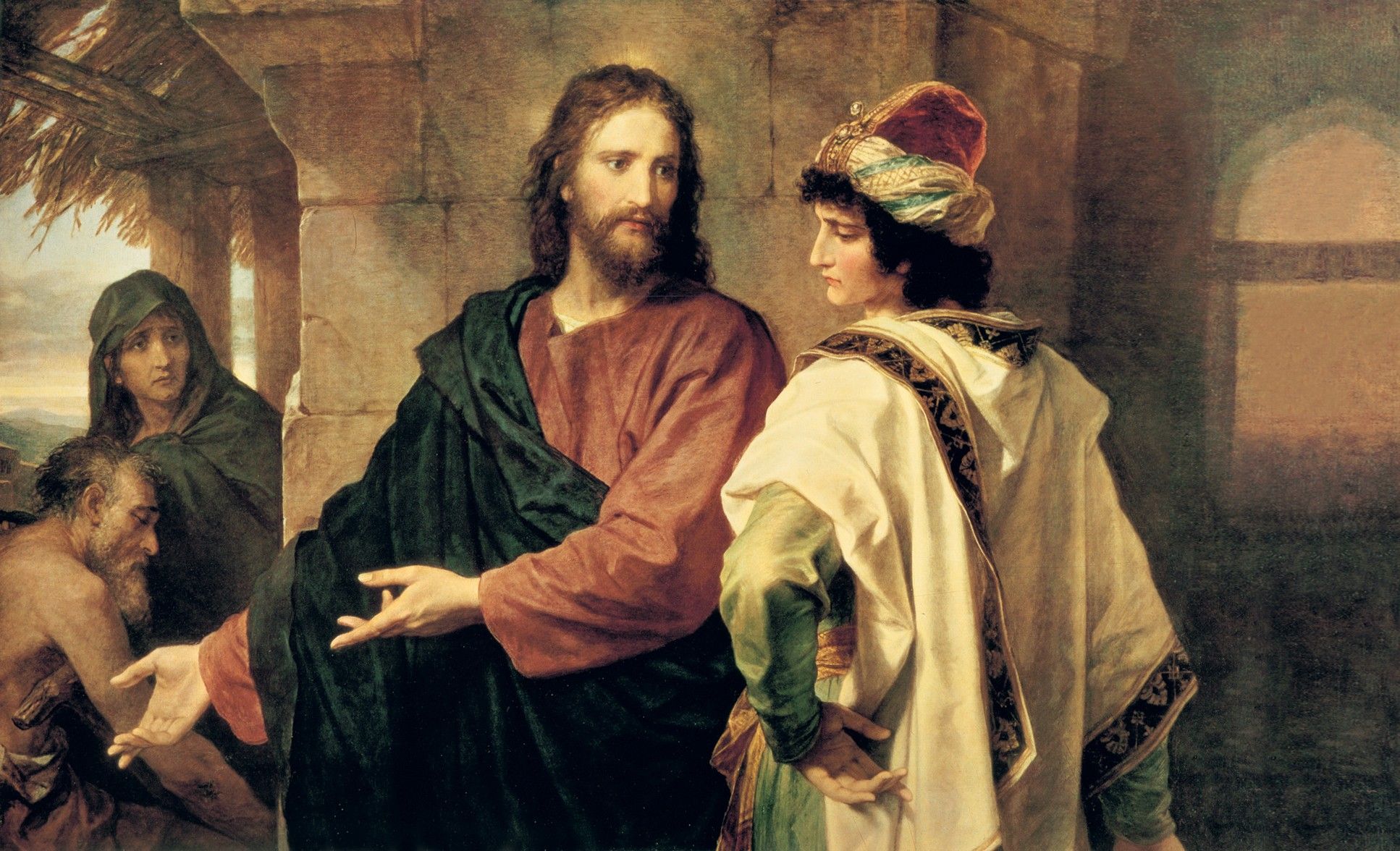
Christ and the Rich Man by Heinrich Hoffman
Jesus was adamant about not marketing the spiritual teachings of God for self-enrichment. He admonished his disciples to give the teachings for free. We find a similar warning from Jesus in the Apocryphon of John, which reminds me of the story of Elisha and Gehazi. “The Savior entrusted all of this to be written and preserved by him. He cautioned: Anyone who trades it for a present, or for sustenance, or for drink, or for clothing, or for any form of that nature, shall be cursed.”
Jesus also told his disciples that it was difficult for a rich man to give up his riches for the spiritual path, because of attachment to wealth and earthly accoutrements. He said it was easier for a camel to go through the eye of the needle, which was a very small gate in the Jerusalem wall, than for a rich man to enter the kingdom of heaven.
One day in the synagogue, Jesus sat over against the treasury, and beheld how the people cast money into the treasury. He noticed that many that were rich cast in much. Then came a poor widow, and she threw in two mites, which make a farthing. Jesus called his disciples, and said: “Verily I say unto you, that this poor widow has cast more in than all they which have cast into the treasury: for all they did cast in of their abundance; but she of her want did cast in all that she had, even all her living.”
Then Jesus said, “Take heed that you do not do your charitable deeds before men, to be seen by them. Otherwise you have no reward from your Father in heaven. When you do a charitable deed, do not sound a trumpet before you as the hypocrites do in the synagogues and in the streets, that they may have glory from men. Assuredly, I say to you, they have their reward. But when you do a charitable deed, do not let your left hand know what your right hand is doing, that your charitable deed may be in secret; and your Father who sees in secret will himself reward you openly.” Jesus' teaching clearly defies the longstanding tradition found in many churches, that monitors and credits people for their offerings, and rewards the offering with a public commendation, or a name on the bulletin, the brick or the building.

Jesus
and Good Stewardship
Notwithstanding, Jesus taught that we must be good stewards of the gifts and opportunities that God has given us in life, and not take them for granted or waste them. He explained that by being faithful in our worldly responsibilities, we gain God's trust with gifts of the Spirit. “He that is faithful in that which is least is faithful also in much: and he that is unjust in the least is also unjust in much. If therefore you have not been faithful in the unrighteous mammon, who will commit to you trust the true riches? And if you have not been faithful in that which is another man's, who shall give you that which is your own?
Jesus gave the following parable about good stewardship, which has a surprising twist. Instead of making profit on others, Jesus taught that being a good steward meant relieving people of their debts.
There was a certain rich man, which had a steward. Someone told the rich man that his steward had wasted his goods. He called his steward and said, “How is it that I hear this of thee? Give an account of thy stewardship, for thou may no longer be steward.” The steward said to himself, What shall I do?
So he called every one of his lord's debtors and said unto the first, “How much do you owe unto my lord?” “A hundred measures of oil.” “Take thy bill, and sit down quickly, and write fifty.” Then he said to another, “And how much do you owe?” “A hundred measures of wheat.” “Take thy bill, and write fourscore.”
Then the rich man commended the unjust steward, because he had been wise to mercifully help the debtors get out of their debt. The lesson here is to use worldly resources to benefit others and make friends, so that when your possessions are gone, the ones you helped will welcome you to an eternal home. “For the children of this world,” said Jesus, “are in their generation wiser than the children of light.”
The ascended master El Morya explains how the children of the world are smarter than the children of the light. In a Summit Lighthouse dictation, he said: “The forces of darkness work day and night for their ends. They spawn the lie, and you must unspawn it. Where they sow the seeds of darkness, you must dig up those seeds and plant the seeds of light! You must outsmart the fallen ones. If you do not study the Law, how can you be expected to outsmart the fallen ones, who come with all of their many schemes and temptations to take from you the abundance of the Divine Mother?”
Jesus
is Challenged by the Spiritual Authorities
On another occasion,
the Pharisees and the Herodians were plotting how to entangle
Jesus in his talk. They approached him with flattery as wolves
in sheep's clothing: “Teacher, we know that you are true,
and teach the way of God in truth; nor do you care about anyone,
for you do not regard the person of men.” They were referring
to the fact that Jesus had no idolatry or socialization subservience
to the ruling class. “Tell us, therefore, what do you
think? Is it lawful to pay taxes to Caesar, or not?”
Jesus perceived their wickedness, and said, “Why do you test me, you hypocrites? Show me the tax money.” So they brought him a denarius. He looked at the coin and said to them, “Whose image and inscription is this?” They said to him, “Caesar’s.” Then he said to them, “Render therefore to Caesar the things that are Caesar’s, and to God the things that are God’s.” And when they had heard these words, they marveled, and left him and went their way.
What Jesus was teaching here is that we must work within the confines of the planetary karma, and that we cannot shirk our human responsibilities while serving God. Even though friendship with God helps us navigate through the challenges of this world, it cannot spare us the challenge.
Another teaching on tax collectors and prostitutes entering heaven before the Pharisees also inflamed them. “But what do you think?” said Jesus. “A man had two sons, and he came to the first and said, Son, go work today in my vineyard.” The first son represents those whose lifestyle is incongruent with a professed path of holiness, but who end up doing what is right by God, because they have a good heart.
“The son answered and said, ‘I will not,’ but afterward he regretted it and went. Then he came to the second and said likewise.” The second son represents those who take up a path of priesthood and temple life, like the Pharisees and Sadducees, but then forsake God's way of humility for hypocrisy and human acclaim. This son said, ‘I go ’ but he did not go.
“Which of the two did the will of his father?” Jesus asked. “The first,” answered the pharisees. And Jesus said to them, “Assuredly, I say to you that tax collectors and harlots enter the kingdom of God before you. For John the Baptist came to you in the way of righteousness, and you did not believe him; but tax collectors and harlots believed him; and when you saw it, you did not afterward relent and believe him.”
Now when Jesus came into the temple, the chief priests and the elders of the people confronted him as he was teaching, and said, “By what authority are you doing these things? And who gave you this authority?” Jesus answered and said to them, “I also will ask you one thing, which if you tell me, I likewise will tell you by what authority I do these things: The baptism of John—where was it from? From heaven or from men?”
They reasoned among themselves, saying, “If we say, ‘From heaven,’ he will say to us, ‘Why then did you not believe him?’ But if we say, ‘From men,’ we fear the multitude, for all count John as a prophet.” So they answered Jesus, “We do not know.” And Jesus said to them,“Neither will I tell you by what authority I do these things.”
Every saint and true follower of Christ has been questioned throughout the ages by those who represent the fallen consciousness and impersonate the sinister force. It is always the same statement, “By what authority do you speak?”
The only answer to give is the fruit of one's efforts, and the vibration of one's being. This is what Jesus meant when he said, “By their fruits shall ye know them.” The authority of God working through us will speak for itself and does not have to be promoted or defended. It comes for judgment, to separate the tares from the wheat, in our own consciousness first, and then in the world around us.
The Sadducees came to Jesus with a preposterous statement about the resurrection of the dead.. The Sadducees did not believe in the resurrection, so they asked him: “Moses said that if a man dies, having no children, his brother shall marry his wife and raise up offspring for his brother. Now there were with us seven brothers. The first died after he had married, and having no offspring, left his wife to his brother Likewise the second also, and the third, even to the seventh. Last of all the woman died also. Therefore, in the resurrection, whose wife of the seven will she be? For they all had her.”
Jesus brought their question to a whole new level. “You are mistaken,” he told them, “not knowing the scriptures nor the power of God. For in the resurrection, they neither marry nor are given in marriage, but are like angels of God in heaven.” Jesus was speaking about the celibacy of the angels. “But concerning the resurrection of the dead, have you not read what was spoken to you by God, saying, ‘I am the God of Abraham, the God of Isaac, and the God of Jacob’? God is not the God of the dead, but of the living.” What Jesus meant by this was that Abraham, Isaac and Jacob were very much alive in the kingdom of heaven, and that even the term “resurrection of the dead” is a misnomer. For only those who are alive in God can be in heaven.
That is why Jesus also said, “Let the dead bury the dead,” in response to a disciple who wanted to spend more time with his family, before committing himself to the path. Jesus said, “Follow me.” But the man replied, “Lord, first let me go and bury my father.” Jesus said to him, “Let the dead bury their own dead, but you go and proclaim the kingdom of God.” Instead of focusing on death, we must focus on life. In the words of Moses, “Choose life not death.” And Jesus said, “I am the way, the truth and the life. No one comes to the Father except through me.”
Then spake Jesus again unto them, saying, “I am the light of the world: he that follows me shall not walk in darkness, but shall have the light of life.” The Pharisees and Sadducees said unto him, “ You bear record of yourself but your record is not true.” Jesus answered, “ Though I bear record of myself, my record is true, for I know whence I came, and whither I go. But you cannot tell whence I come, and whither I go. You judge after the flesh. I judge no man, and yet if I judge, my judgment is true, for I am not alone, but I and the Father that sent me. It is also written in your law, that the testimony of two men is true. I am one that bears witness of myself, and the Father that sent me bears witness of me.”
Then they asked, “Where is thy Father?” Jesus answered, “You neither know me, nor my Father: if you had known me, you should have known my Father also.” Then Jesus said to those who believed on him, “If you continue in my word, then you are my disciples indeed; and you shall know the truth, and the truth shall make you free.”
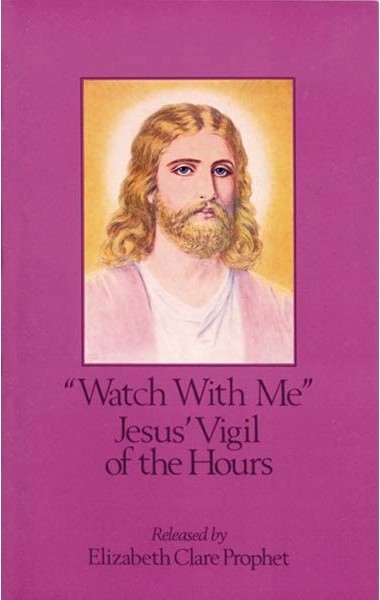
In the Watch With Me Jesus Vigil of the Hours, Jesus gives a beautiful list of statements called the “End of Banalities, to help us enter the consciousness and the kingdom of God. ”
Our Father, Thy Kingdom Come!
They shall not prevail who scatter seeds of discord and unrest among the brethren.
They shall not prevail who seek to be held in repute by mankind.
They shall not prevail who seek earthly honor and pay not homage unto divine opportunity.
They shall not prevail who give not freedom to mankind to accept the progressive revelation of God.
They shall not prevail who hearken unto the spirits that are not just and that are not perfected in God.
They shall not prevail who abuse their bodies and minds by taking impure substance knowingly.
They shall not prevail who seek by the action of violent drugs to raise their consciousness to a more exalted state.
They shall not prevail who give not God the glory fore each accomplishment.
They shall not prevail who carry water upon both shoulders, thinking to serve both God and mammon.
They shall not prevail who senselessly waste the hours God hath given them in the continuous seeking of pleasure.
They shall not prevail who shall not gird up their minds and hearts and fortify themselves for the victory.
They shall not prevail who shall lean upon the arm of flesh and shun the support of the Lord God.
They shall not prevail who shall run with the masses and desire the support of visible numbers in affirming their right action and conduct.
When Jesus was speaking of soul freedom, the spiritual authorities questioned what he meant. “We be Abraham's seed, and were never in bondage to any man. How can you say, Ye shall be made free?”
Jesus answered that sin keeps us from having soul freedom. “Verily, verily, I say unto you, Whosoever commits sin is the servant of sin.” He also taught that the fullness of freedom comes from Christ—the son of God within. “The servant abides not in the house forever,” Jesus said. “But the Son abides ever. If the Son therefore shall make you free, you shall be free indeed.” Then Jesus asserted once more that he is that Christ and Son of God, who has the power to free those who abide in his Word. “I know that you are Abraham's seed,” he said, “but you seek to kill me, because my word has no place in you. I speak what I have seen with my Father, and you do that which you have seen with your father.”
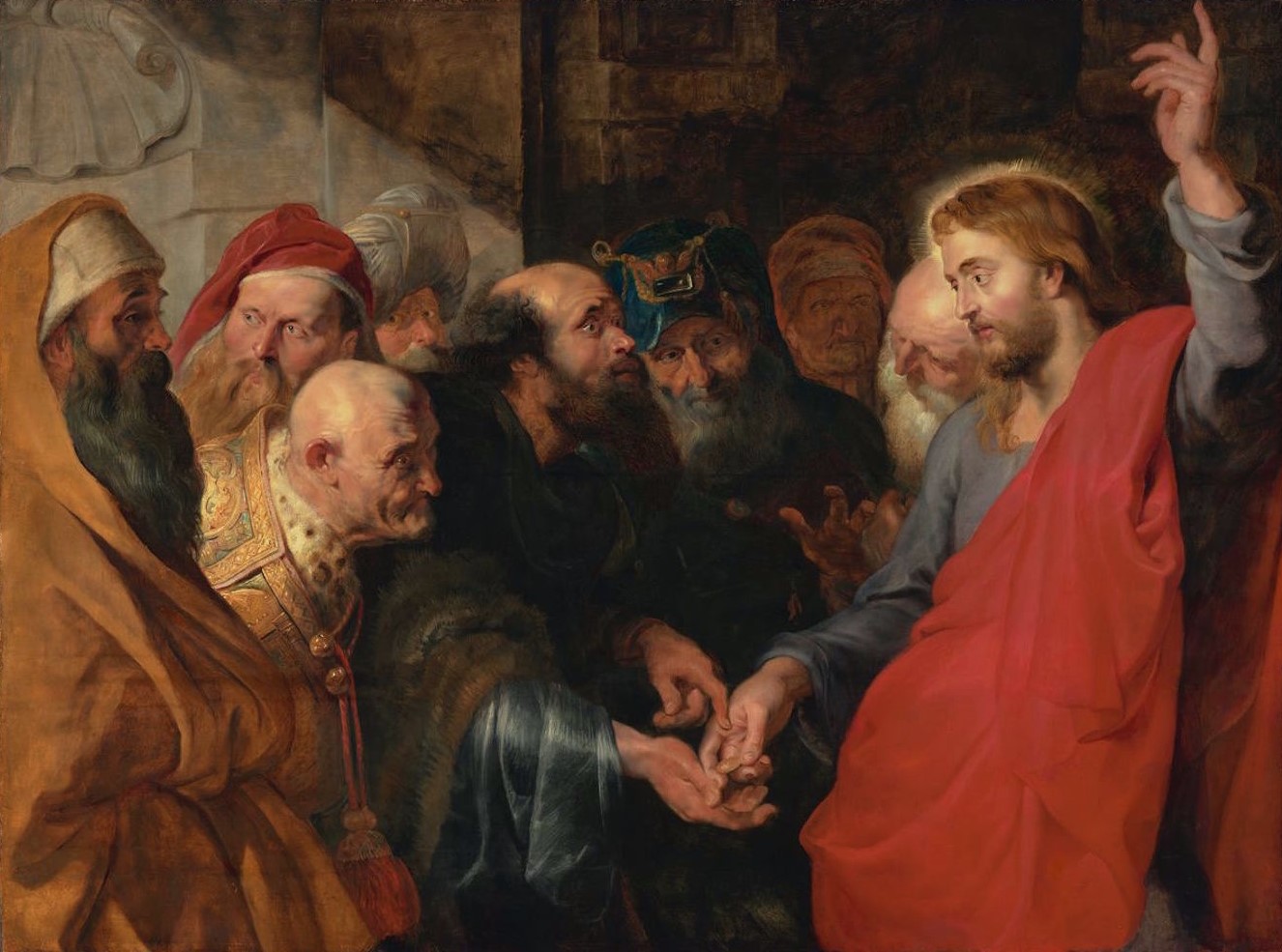
Jesus and the Money and the Pharisees by Peter Paul Rubens
Now Jesus is describing the fallen ones not only by their fruit, but by their point of origin. These swore allegiance in the fall of the angels to the devil, or “deified energy veil” as Mark Prophet defined. When the Pharisees and Sadducees said to Jesus, “Abraham is our father,” Jesus replied: “If you were Abraham's children, you would do the works of Abraham. But now you seek to kill me—a man who has told you the truth which I have heard of God. This Abraham did not! You do the deeds of your father.”
“We are not born of fornication,” they answered, defending their purity. “We have one Father, even God.” Jesus said, “ If God were your Father, you would love me, for I proceeded forth and came from God. You are of your father the devil, and the lusts of your father you will do. He was a murderer from the beginning, and abode not in the truth, because there is no truth in him. And because I tell you the truth, you believe me not. He that is of God hears God's words. You therefore, hear them not, because you are not of God.”
Upon hearing these words, the Jews who hated the Samaritans said to Jesus, “Say we not well that you are a Samaritan, and have a devil?” Jesus answered, “I have not a devil but I honor my Father, and ye do dishonor me. And I seek not mine own glory: There is one that seeks and judges. Verily, verily, I say unto you, If a man keep my saying, he shall never see death.”
Then the Pharisees and Sadducees accused Jesus of being possessed. They had not internalized anything Jesus said previously about life in the heaven-world. and continually referred back to the death of the physical body.
This conversation, essentially captures the existential divide between believers and atheists, that Saint Thomas Aquinas defined: “To one who has faith, no explanation is necessary. To one without faith, no explanation is possible.” Or “For those who believe in God no explanation is necessary. For those who do not believe in God no explanation is possible.”
The Jewish authorities continued: “Now we know that you have a devil. Abraham is dead, and the prophets, and you say, If a man keep my saying, he shall never taste of death. Are you greater than our father Abraham, who is dead? And the prophets are dead, whom you make of yourself.” Jesus answered, “If I honor myself, my honor is nothing. It is my Father that honors me, of whom you say that he is your God. Yet you have not known him, but I know him and keep his saying.”
Jesus then spoke of his birth, which was attended by the three kings—including Melchior, who, according to ascended master teachings, was the reincarnation of Abraham. Jesus said, “ Your father Abraham rejoiced to see my day, and he saw it, and was glad.” The Pharisees and Sadducees answered, “You are not yet fifty years old, and you have seen Abraham?” They were referring to the “earth earthy,” but Jesus was referring to the preexistence of the soul, and to the Mighty I AM Presence functioning beyond time and space: “Verily, verily, I say unto you, Before Abraham was, I AM.”
Then the Jews took up stones again to stone him and Jesus said, “Many good works have I shown you from my Father. For which of those works do you stone me?” The Jews answered, “For a good work we stone you not, but for blasphemy. And because thou, being a man, make yourself God.” Jesus said, “Is it not written in your law, I said, Ye are gods?” Jesus was referring to what God said to Moses, “See today, I have made thee a god over pharaoh,” and also to the warning of the psalmist. “I said ye are gods, and all of you are sons of the Most High.’ But you shall die like men, and fall like one of the princes.”
Jesus continued, “If he called them gods, unto whom the word of God came—and the scripture cannot be broken; Say ye of him, whom the Father has sanctified and sent into the world, You blaspheme because I said, I am the Son of God?”
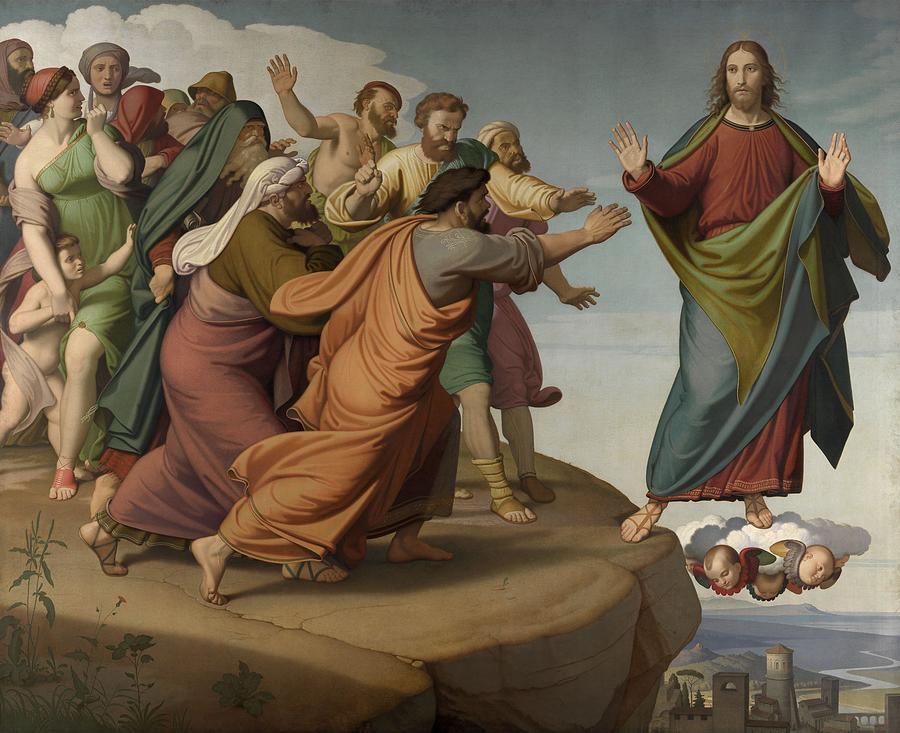
Jesus escapes the Pharisees by Johann Friedrich Overbeck
Jesus and
the Hatred of Christ
It is important to remember, as we read these words, that the hatred of the Christ is found in all religions, not just in Judaism. From the Gospel of John: “For God so loved the world, that he gave his only begotten Son, that whosoever believes in him should not perish, but have everlasting life. For God sent not his Son into the world to condemn the world; but that the world through him might be saved. He that believes on him is not condemned, but he that believes not is condemned already—because he has not believed in the name of the only begotten Son of God. And this is the condemnation, that light is come into the world, and men loved darkness rather than light, because their deeds were evil. For every one that does evil hates the light, neither comes to the light, lest his deeds should be reproved. But he that does truth comes to the light, that his deeds may be made manifest, that they are wrought in God.”
“Hear another parable: There was a certain landowner who planted a vineyard. And he leased it to vinedressers and went into a far country. Now when vintage-time drew near, he sent his servants that they might receive its fruit. And the vinedressers took his servants, beat one, killed one, and stoned another. Again he sent other servants, more than the first, and they did likewise to them. Then last of all he sent his son to them, saying, ‘They will respect my son.’ But when the vinedressers saw the son, they said among themselves, ‘This is the heir. Come, let us kill him and seize his inheritance.’ So they took him and cast him out of the vineyard and killed him.” The vinedressers are those who have the Pharisee consciousness, who envy the light of Christ, kill the prophets and do not produce fruit—or keep it for themselves.
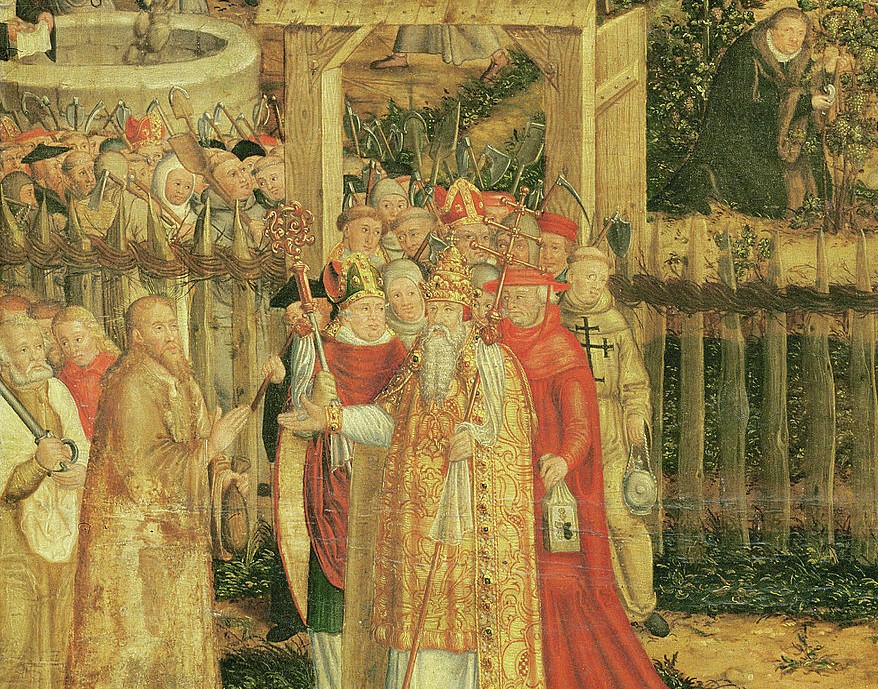
The Lord of the Vineyard by Lucas Cranach
“Therefore, when the owner of the vineyard comes, what will he do to those vinedressers?” asked Jesus. The disciples answered, “He will destroy those wicked men miserably, and lease his vineyard to other vinedressers who will render to him the fruits in their seasons.”
Then, Jesus said,“Have you never read in the scriptures, ‘The stone which the builders rejected has become the chief cornerstone. This was the Lord’s doing, and it is marvelous in our eyes. Therefore I say to you, the kingdom of God will be taken from you and given to a nation bearing the fruits of it. And whoever falls on this stone will be broken. But on whomever it falls, it will grind him to powder.
“These things have I spoken unto you,” said Jesus, “that you should not be offended. They shall put you out of the synagogues. Yea, the time cometh, that whosoever killeth you will think that he doeth God service. And these things will they do unto you, because they have not known the Father, nor me.”
Now when the chief priests and Pharisees heard this parable, they perceived that Jesus was speaking of them. They sought to lay hands on him, but feared the multitudes, who believed Jesus was a prophet. When the Pharisees and chief priests heard the people murmur such things about Jesus, they sent officers to take him. Then Jesus said to them, “Yet a little while am I with you, and then I go unto him that sent me. You shall seek me and shall not find me. And where I am thither you cannot come.” Then the Jews said among themselves, “Where will he go, that we shall not find him? Will he go among the Gentiles, and teach them?”
The Pharisees and Sadducees also asked Jesus to show them a sign from heaven. Jesus answered, “When it is evening you say, ‘It will be fair weather, for the sky is red ’and in the morning, ‘It will be foul weather today, for the sky is red and threatening.’ Hypocrites! You know how to discern the face of the sky, but you cannot discern the signs of the times. A wicked and adulterous generation seeks after a sign, and no sign shall be given to it except the sign of the prophet Jonah. For as Jonah was three days and three nights in the belly of the great fish, so will the Son of Man be three days and three nights in the heart of the earth. The men of Nineveh will rise up in the judgment with this generation and condemn it, because they repented at the preaching of Jonah. And indeed, one greater than Jonah is here. The queen of the South (the Queen of Sheba) will rise up in the judgment with this generation and condemn it, for she came from the ends of the earth to hear the wisdom of Solomon. And indeed, one greater than Solomon is here.”
The chief priests consulted to put Lazarus to death because by reason of him, so many Jews were believing on Jesus. Officers were also summoned by the chief priests and Pharisees to arrest Jesus, but they did not follow through. When they asked the officers, “Why have you not brought him?” The officers replied, “Never a man has spoken like this man.” This only made matters worse.
“Are you also deceived?” asked the Pharisees. “These people who know not the law are cursed.” Nicodemus spoke up to defend Jesus. “Does our law judge any man,” he told the others, “before it hear him, and know what he does?” T he Pharisees could not go against due process, so they reprimanded Nicodemus: “Are you also of Galilee? Search the scriptures and look, for out of Galilee arises no prophet.” Then every man went to his own house. They all had to retract because Jesus' time had not yet come, but the storm to put him to death was brewing.
The Pharisees
could not stand any progressive revelation outside Mosaic Law,
so Jesus explained the concept with a short parable: “Every
scribe who has been made a disciple in the Kingdom of Heaven
is like a man who is a householder, who brings out of his treasure
new and old things. No man puts a piece of new cloth upon an
old garment, or the new cloth will make a rent, and agrees not
with the old. And no man puts new wine into old bottles, else
the new wine will burst the old bottles, and be spilled. New
wine must be put into new bottles, and no man having drunk old
wine straightway desires new wine, for he says, The old is better.”
Nevertheless, Jesus was bringing new wine to the people—the
wine of progressive revelation.
Jesus,
the End Times and the Kingdom of Heaven
When the disciples asked Jesus why he spoke to people in parables, he answered: “To you it has been given to know the secrets of the kingdom of heaven, but to them it has not been given.”
“For the Kingdom of Heaven is like a man who was the master of a household, who went out early in the morning to hire laborers for his vineyard. When he had agreed with the laborers for a denarius a day, he sent them into his vineyard. He went out about the third hour, and saw others standing idle in the marketplace. He said to them, ‘You also go into the vineyard, and whatever is right I will give you.’ So they went their way. Again he went out about the sixth and the ninth hour, and did likewise. About the eleventh hour he went out and found others standing idle. He said to them, ‘Why do you stand here all day idle?’ They said to him, ‘Because no one has hired us.’ He said to them, ‘You also go into the vineyard, and you will receive whatever is right.’
“When evening had come, the lord of the vineyard said to his manager, ‘Call the laborers and pay them their wages, beginning from the last to the first.’ When those who were hired at about the eleventh hour came, they each received a denarius. When the first came, they supposed that they would receive more, but they likewise received a denarius. Then, they murmured against the master of the household, saying, ‘These last have spent one hour, and you have made them equal to us who have borne the burden of the day and the scorching heat!’ So he answered one of them, ‘Friend, I am doing you no wrong. Didn’t you agree with me for a denarius? Take that which is yours, and go your way. It is my desire to give to this last just as much as to you. Isn’t it lawful for me to do what I want to with what I own? Or is your eye evil with envy, because I am good?’ So the last will be first, and the first will be last. For many are called, but few are chosen.”
The ascended master Jesus Christ explained in a dictation through the Summit Lighthouse what this meant. “There are many magnificent individuals on the planet who have offered themselves to God in service who do not yet understand that all of their substance, all of their supply, all of the abundance that they enjoy was bestowed upon them by God as stewards of cosmic grace. I remind you of my parable concerning the workers in the vineyard. Some who were hired at the eleventh hour received one penny for their labor even as they who came in at the first hour and toiled all day received one penny. The grumbling of those who came in at the first hour was answered by the lord of the vineyard, 'Did you not bargain for so much?' And they said, 'Yea.' And he said, 'You have received it. Take what is there and go thy way: I will give unto this last, even as unto thee, for it is lawful for me to do what I will with mine own.
“If those who have a smattering of spiritual knowledge and dogma and a touch of devotion wish to abstain from the heart’s love of their own divinity, to deny opportunity to others, and to speak disparagingly of universal harmony between peoples, we will indeed go out into the highways and byways and bring in the multitudes and the last shall be first.
“There are many people in the world today who have had little exposure to faith in God. They have had little contact with religious doctrine, and they have had little experience with the things of the Spirit. Yet their hearts are anhungered and they, too, are sheep of the Father’s pasture. We turn, then, not in desperation but in deeper love, to those who have long lived in error and in the stain of moral sin. We turn to those who have been enmeshed in the gambling marts of the world, in prostitution, in crime, in narcotics traffic, and to those who dwell under the shadow of the wings of darkness.
“Here the mercy of heaven holds in abeyance the overpowering karmic record which some do write—a karma which is more than most of them could bear. Therefore, the Lords of Karma mete out to them in succeeding embodiments that karma which requires balance, that which they have unjustly created. And this action is taken not in order to punish a wayward generation, but solely for the purpose of learning and instruction that through trial and error they may yet come to the full opportunity of cosmic sonship which God offers to all. Then will they cease their struggle to intensify the spirit of vain competition, and they will understand that man can compete only with himself for the overcoming of his imperfections. Then will they understand that cosmic law, the law of unity, of harmony, of the golden age and the golden rule must prevail and that by its prevalence abundant life will come to all.”
Jesus spoke about the end times as he sat on the Mount of Olives. The disciples asked him privately, “Tell us, when will these things be? And what will be the sign of your coming, and of the end of the age?” Jesus answered:“Take heed that no one deceives you. For many will come in my name, saying, ‘I am the Christ,’ and will deceive many. And you will hear of wars and rumors of wars. See that you are not troubled; for all these things must come to pass. For nation will rise against nation, and kingdom against kingdom. And there will be famines, pestilences, and earthquakes in various places. All these are the beginning of sorrows. Then they will deliver you up to tribulation and kill you, and you will be hated by all nations for my name’s sake. And then many will be offended, will betray one another, and will hate one another. Then many false prophets will rise up and deceive many. And because lawlessness will abound, the love of many will grow cold. But he who endures to the end shall be saved. And this gospel of the kingdom will be preached in all the world as a witness to all the nations, and then the end will come.”
Jesus further described the end of to come through another parable: “The Kingdom of Heaven is like a dragnet that was cast into the sea and gathered some fish of every kind, which, when it was filled, fishermen drew up on the beach. They sat down and gathered the good into containers, but the bad they threw away. So it will be in the end of the world. The angels will come and separate the wicked from among the righteous, and will cast them into the furnace of fire. There will be weeping and gnashing of teeth.”
Jesus gave more parables to explain the kingdom of God, for what will a man give in exchange for his soul? “The Kingdom of Heaven is like treasure hidden in the field, which a man found and hid. In his joy, he goes and sells all that he has and buys that field. Again, the Kingdom of Heaven is like a man who is a merchant seeking fine pearls, who having found one pearl of great price, went and sold all that he had and bought it.” Jesus said, “For what profit is it to a man if he gains the whole world, and loses his own soul? Do not give what is holy to the dogs, nor cast your pearls before swine, lest they trample them under their feet, and turn and tear you in pieces.”
In 1924, El Morya spoke of the Pearl of Great Price in Leaves of Morya's Garden:
The temple is glowing and Our Path is fixed.
And each morning brings us closer to the sun.
And happy are they who minded not the day and
who seized the pearl of the spirit from the stars.
This pearl loses not its luster; and you, poor ones,
where will you find a treasure more enduring?
But if you carry with you a precious stone or rarest pearl—
would you forget it?No, you would guard it carefully.
You would search your pockets and fasten the clasps,
because you carry a true treasure of earth.What care!
You will ask, “How amidst the stress of life
can one remember the Treasure of the World?”
I shall smile and say that it is simple—
Select at the seashore a pebble smoothed by the waves and
carry it with you, remembering the Treasure of the World.
And when they press around you
and cover your garments with dust,
Then take in your hand the chosen stone,
And remind yourself of the Treasure of the World
which I commanded you to take to its destination.
Remember, remember, remember.
They will ask you how to traverse life.
Answer: Like crossing an abyss upon a taut string—
Beautifully, carefully, and fleetly.

I would like to share with you the words of a song that I wrote, Pearl of Great Price. It is published as Songs of Divine Love, www.songsofdivinelove.com
Floating on the seas of life
Trade winds blowing balmy spice
Turquoise waters of the deep
Crystal clear in restful sleep
I gaze into the deep
I gaze into the deep
Something shimmers in the sand
'Neath the waves in mermaid land
Looking for that long-lost star
That guided sailors from afar
I wander restlessly
I wander restlessly
And so I dive beneath the waves
To look for treasure buried safe
Under the sandy burrows fair
I find a pearl extraordinaire
Truly a pearl of great, great price
Truly a pearl of great, great price
Who could have left her lying there
Beneath the sands devoid of care
I ponder as I hold my breath
Then pick her up with tenderness
Securely bring her to the air
Securely bring her to the air
The azure skies are filled with joy
Their sweet perfume banish the toil
And popcorn clouds traversing there
Remind me of an ancient prayer
I smile with happiness
I smile with happiness
My soul the pearl of greatest price
Plunged to the depths restored to life
My soul, my pearl, you won't be sold
But given to the king foretold
But given to the king foretold
But given to the king foretold
Child of the isles you are now free
You will obtain your victory
That which was lost is now redeemed
Your soul now wed to fiery ring
And now my child you are that king
And now my child you are that king
El Morya also speaks of the “Pearl of Great Price” in The Chela and the Path. “To souls adrift upon the sea of life we send out a line. It is a lifeline that must be seized with trust.” Speaking of the dictations, El Morya says, “In this age the Ascended Masters have cast the pearl of their identity sealed in God into the great sea of humanity in order that humanity might find their own individuality and their soul similarly consigned to God. I AM the pearl waiting for the diver. Come and find me.”
Jesus continued
to reach out to the Pharisees and preach to those who had embraced
the fallen consciousness. “Ask, and it will be given to
you. Seek, and you will find. Knock, and it will be opened to
you. For everyone who asks receives, and he who seeks finds,
and to him who knocks it will be opened. Or what man is there
among you who, if his son asks for bread, will give him a stone?
Or if he asks for a fish, will he give him a serpent? If you
then, being evil, know how to give good gifts to your children,
how much more will your Father who is in heaven give good things
to those who ask Him!”
Jesus
and Perpetual Prayer
He recommended to them perpetually prayer. “There was in a city a judge who feared not God, neither cared about people. There was also a widow in that city, who kept saying, “Avenge me of my adversary.” He would not for a while, but afterward, said to himself, “Though I fear not God, nor regard man, yet because this widow troubles me, I will avenge her, lest she weary me.” Jesus said, “Hear what the unjust judge said. Shall not God avenge his own elect, which cry day and night to him, though he bear long with them? I tell you that he will avenge them speedily.” Nevertheless when the Son of man comes, shall he find faith on the earth?
Jesus offered another parable to illustrate the value of persistence. He said unto them, “Which of you shall have a friend, and shall go unto him at midnight, and say to him, 'Friend, lend me three loaves; For a friend of mine in his journey is come to me, and I have nothing to set before him?' And he, from within, shall answer and say, 'Trouble me not. The door is now shut, and my children are with me in bed. I cannot rise and give thee.' I say unto you, though he will not rise and give him, because he is his friend, yet because of his persistence, he will rise and give him as many as he needs.”
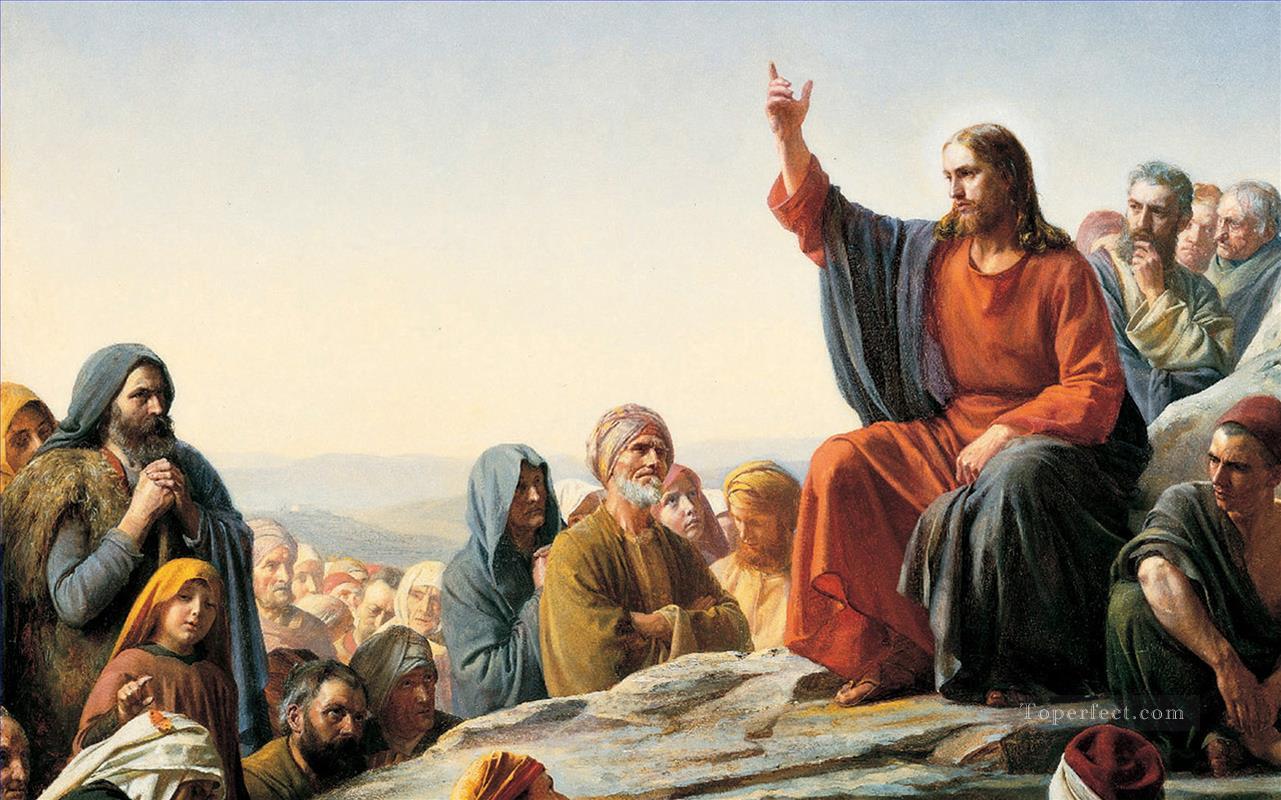
Sermon on the Mount by Carl Bloch
And seeing the multitudes, Jesus went up on a mountain, and when he was seated his disciples came to him. Then he opened his mouth, saying:
The Beatitudes
“Blessed are the poor in spirit,
For theirs is the kingdom of heaven.
Blessed are those who mourn,
For they shall be comforted.
Blessed are the meek,
For they shall inherit the earth.
Blessed those who hunger and thirst for righteousness,
For they shall be filled.
Blessed the merciful,
For they shall obtain mercy.
Blessed the pure in heart,
For they shall see God.
Blessed are the peacemakers,
For they shall be called sons of God.
Blessed are those who are persecuted for righteousness’ sake,
For theirs is the kingdom of heaven.
Blessed are you
when they revile and persecute you, and say all kinds of evil
against you falsely for my sake. Rejoice and be exceedingly
glad, for great is your reward
in heaven, for so they persecuted the prophets who were before
you.”
Jesus and
Personal Accountability
Jesus then taught
a whole new level of accountability, that encompasses not only
our physical actions, but also our thoughts and feelings. As
Saint Germain once said, “Thoughts are things.”
Jesus explained: “You have heard that it was said of old,
‘You shall not murder, and whoever murders will be in
danger of the judgment.’ But I say to you that whoever
is angry with his brother without a cause shall be in danger
of the judgment. And whoever says to his brother, ‘Raca!’
(meaning empty-headed) shall be in danger of the council (the
Karmic Board.) Whoever says, ‘You fool!’ shall be
in danger of hellfire. Therefore if you bring your gift to the
altar, and remember that your brother has something against
you, leave your gift before the altar, and go your way. First
be reconciled to your brother, and then come and offer your
gift.”
Jesus also said, “Agree with your adversary quickly, while you are on the way with him, lest your adversary deliver you to the judge, the judge hand you over to the officer, and you be thrown into prison. Assuredly, I say to you, you will by no means get out of there till you have paid the last penny.”
Regarding this statement, the master El Morya told us to practice the Buddhic quality of non-resistance, and to count every point of oppression—and blow of hell—as a sign of our coming sainthood. I believe Jesus goes even further here, admonishing us not to rush where angels fear to tread. Even as God administers our karma to balance each day, when we bait the powers of this world, we may come to find that they do not function from the divine principle that mercy tempers judgment.
Then, Jesus taught about being faithful in our relationships. “You have heard that it was said to those of old, ‘You shall not commit adultery.’ But I say to you that whoever looks at a woman to lust for her has already committed adultery with her in his heart.” He tells us how fierce we must be to save our soul. “If your right eye causes you to sin, pluck it out and cast it from you.. For it is more profitable for you that one of your members perish, than for your whole body to be cast into hell. And if your right hand causes you to sin, cut it off and cast it from you. For it is more profitable for you that one of your members perish, than for your whole body to be cast into hell.”
Jesus also taught about marriage, celibacy and divorce. “Because of the hardness of your hearts, he said, “Moses permitted you to divorce your wives, but from the beginning it was not so. And I say to you, whoever divorces his wife, except for sexual immorality and marries another, commits adultery; and whoever marries her who is divorced, commits adultery.”
Jesus mentioned those who cannot procreate because of past-life karma, and those who can no longer procreate because of interventions. The disciples then asked him, “If such is the case of the man with his wife, it is better not to marry?” Jesus replied, “All cannot accept this saying, but only those to whom it has been given. For there are eunuchs who were born thus from their mother’s womb, and there are eunuchs who were made eunuchs by men, and there are eunuchs who have made themselves eunuchs for the kingdom of heaven.”
As an alternative to marriage, Jesus recommended the celibate path, which is honored in many religious traditions and holy orders, East and West. In this instance, men and woman can choose to dedicate their procreative energies to the raising up of the Mother-light—the Kundalini energies—on their spinal altar. Instead of being exchanged in sex, which is what the word sex stands for—sacred energies exchanged—God's creative energies flow up through the chakras, from the base-of-the-spine up to the crown, which is the Buddhic top-knot that radiates out as the halo of the saints. Even Napoleon Hill, the proponent of “Positive Mental Attitude,” and author of Think and Grow Rich, explained that redirecting one's sexual energies is key to achieving greatness in life. He also observed that for most people, creative genius truly flourishes after mid-life, when people are typically not as sexually active.
We live in a time where life has accelerated far more than the early Piscean age. For this reason, our God Self may bring to us a number of significant relationships in one given lifetime, in order to balance more karma with more individuals. Marriage is a sacred vow and should never be entered into lightly, and every divorce is like a death. The ascended masters have taught that if two people end up creating more negative karma by staying together, then it is better for them to go their separate ways.
The ascended master Godfre, who was embodied as George Washington and Guy Ballard, the Messenger for the I AM Movement, said in a dictation through the Summit Lighthouse: “We do not advocate divorce in this day and age, but we recognize that two thousand years later there is a different situation on earth. That situation is the acceleration of the balance of karma. With the acceleration of these cycles, therefore, it sometimes becomes necessary for individuals to change partners, as you say, for a higher purpose, for a higher calling and for the working out of that manifestation of light within them, especially in the case of lightbearers, where past associations do not lead to the victory of the soul or to the path of initiation.”
Jesus continues: “Again you have heard that it was said to those of old, ‘You shall not swear falsely, but shall perform your oaths to the Lord.’ But I say to you, do not swear at all: neither by heaven, for it is God’s throne; nor by the earth, for it is His footstool; nor by Jerusalem, for it is the city of the great King. Nor shall you swear by your head, because you cannot make one hair white or black. But let your ‘Yea’ be ‘Yea,’ and your ‘Nay’ be ‘Nay.’ For whatever is more than these is from the evil one.”
Mark Prophet
explained this teaching in the book, My Soul Doth Magnify
the Lord. He writes, “The grandfather and grandmother
of our Lord were humble and pious before God. They lived in
obedience to the code of conduct taught in the retreats of the
hierarchy and set forth by Jesus to meet the needs of the disciples
in every age who desire to learn the law of the conservation
of Christic energies for the glory of the Law: ‘Let your
communication be, Yea, yea; Nay, nay: for whatsoever is more
than these cometh of evil.’
“Jesus explained to us that when the disciple is on the homeward path, he encounters hourly and momentarily the cycles of his past uses and misuses of energy. If the effects of causes set in motion are good, then he must reaffirm that goodness and expand it for God and man; but if the effects of past actions be harmful, or out of harmony with cosmic law, then he must be quick to deny and denounce their energy coils and to divest them of all the negative influence, through the transmutative fires of the Holy Spirit. John the Beloved commented on this teaching in a recent dictation, saying that Jesus had in this manner counseled the disciples as they served their novitiate under him. John explained that Jesus taught them to say ‘Yes’ the Light, affirming all good, and ‘No’ to the darkness, denying all evil, and then ‘Peace, be still.’ For then, he said, all energy flows from God to man, from man to God, and you begin your ascension process right now.”
We read in the Old Testament, that God swore to Abraham. “I swear by myself, declares the Lord, that because you have done this and have not withheld your son, your only son, I will surely bless you and make your descendants as numerous as the stars in the sky and as the sand on the seashore. Your descendants will take possession of the cities of their enemies, and through your offspring all nations on earth will be blessed, because you have obeyed me.”
What we can understand
from this is that in the Old Testament dispensation, which was
the Age of Aries, God asked the patriarch Abraham to offer up
Isaac as an externalization of sacrificing the Son of God. Then
in the New Testament, which ushers in the Age of Pisces, Jesus
offers himself on the cross, after becoming the full internalization
of the Son of God. Abraham was part of the order of Melchizedek
and tithed to him. Even though it is not directly mentioned
in the Bible, Melchizedek made his ascension because Jesus,
in the Book of Hebrews, has become a high priest forever
after the order of Melchizedek. Melchizedek and the priests
of the Old Testament entered the Holy of Holies in the temple
behind a physical curtain. Jesus' death rends the temple curtain
in twain. This is a strong visualization for the inner sanctuary
of our hearts where Jesus enters, and where the veil that separates
us from Christ is removed.
From the
Book of Hebrews: “When God made his promise to Abraham,
since he had no one greater to swear by, he swore by himself,
saying, I will surely bless you and multiply your descendants.
And so Abraham, after waiting patiently, obtained the promise.
We have this hope as an anchor for the soul, firm and secure.
It enters the inner sanctuary behind the curtain, where Jesus
our forerunner has entered on our behalf.” Even though
the Book of Hebrew advocates that is is permissible for men
to swear ‘by someone greater than themselves, and their
oath serves as a confirmation to end all argument,’ nevertheless,
we must be very careful, based on what Jesus taught. Our word
is our bond, and by our words, our karma returns.
Jesus' next statement is a formula to help us balance karma more quickly than with an ‘eye for an eye,’ and also to let go of our attachments to possessions in the physical plane. “You have heard that it was said, ‘An eye for an eye and a tooth for a tooth.’ But I tell you not to resist an evil person. Whoever slaps you on your right cheek, turn the other to him also. If anyone wants to sue you and take away your tunic, let him have your cloak also. And whoever compels you to go one mile, go with him two. Give to him who asks you, and from him who wants to borrow from you do not turn away.”
Jesus illustrated this principle with a parable, when someone came to ask him, “Master, speak to my brother, that he divide the inheritance with me.” Jesus did not want to get involved in their karma. He answered, “Man, who made me a judge or a divider over you? Take heed, and beware of covetousness: for a man's life consists not in the abundance of the things which he possesses. The ground of a certain rich man brought forth plentifully, and he thought ‘What shall I do, because I have no room where to bestow my fruits?’ And he said, ‘This will I do. I will pull down my barns, and build greater. There will I bestow all my fruits and my goods. And I will say to my soul, Soul, thou hast much goods laid up for many years. Take thine ease, eat, drink, and be merry.’ But God said unto him, ‘Thou fool, this night thy soul shall be required of thee: then for whom shall those things be, which thou hast provided?’ So is he that lays up treasure for himself, and is not rich toward God.”
Jesus then challenged and compelled us to even deeper love. “You have heard that it was said, ‘You shall love your neighbor and hate your enemy.’ But I say to you, love your enemies, bless those who curse you, do good to those who hate you, and pray for those who spitefully use you and persecute you, that you may be sons of your Father in heaven. For he makes his sun rise on the evil and on the good, and sends rain on the just and on the unjust. For if you love those who love you, what reward have you? Do not even the tax collectors do the same? And if you greet your brethren only, what do you do more than others? Do not even the tax collectors do so? For if ye love them which love you, and if ye do good to them which do good to you, what thank have ye? For sinners also love those that love them. And if ye lend to them of whom ye hope to receive, what thank have ye? For sinners also lend to sinners, to receive as much again. But love your enemies, and do good, and lend, hoping for nothing again, and your reward shall be great, and you shall be the children of the Highest.”
In this manner, therefore, pray:
The Lord's Prayer
Our Father in heaven,
Hallowed be thy name.
Thy kingdom come.
Thy will be done
On earth as it is in heaven.
Give us this day our daily bread.
And forgive us our debts,
As we forgive our debtors.
And lead us not into temptation,
But deliver us from the evil one.
For thine is the kingdom and the power and the glory forever.
Amen.
Jesus and the Law of
Forgiveness
Jesus teaches that the law of forgiveness is perhaps the most important element of the Law. “Be ye therefore merciful, as your Father also is merciful. For if you forgive men their trespasses, your heavenly Father will also forgive you. But if you do not forgive men their trespasses, neither will your Father forgive your trespasses.”
Then Peter said, “Lord, how often shall my brother sin against me, and I forgive him? Up to seven times?” Jesus said to him, “I do not say to you, up to seven times, but up to seventy times seven.” Then he gave a parable. “Therefore the kingdom of heaven is like a certain king who wanted to settle accounts with his servants. And when he had begun to settle accounts, one was brought to him who owed him ten thousand talents. But as he was not able to pay, his master commanded that he be sold, with his wife and children and all that he had, and that payment be made. The servant therefore fell down before him, saying, ‘Master, have patience with me, and I will pay you all.’ Then the master of that servant was moved with compassion, released him, and forgave him the debt.
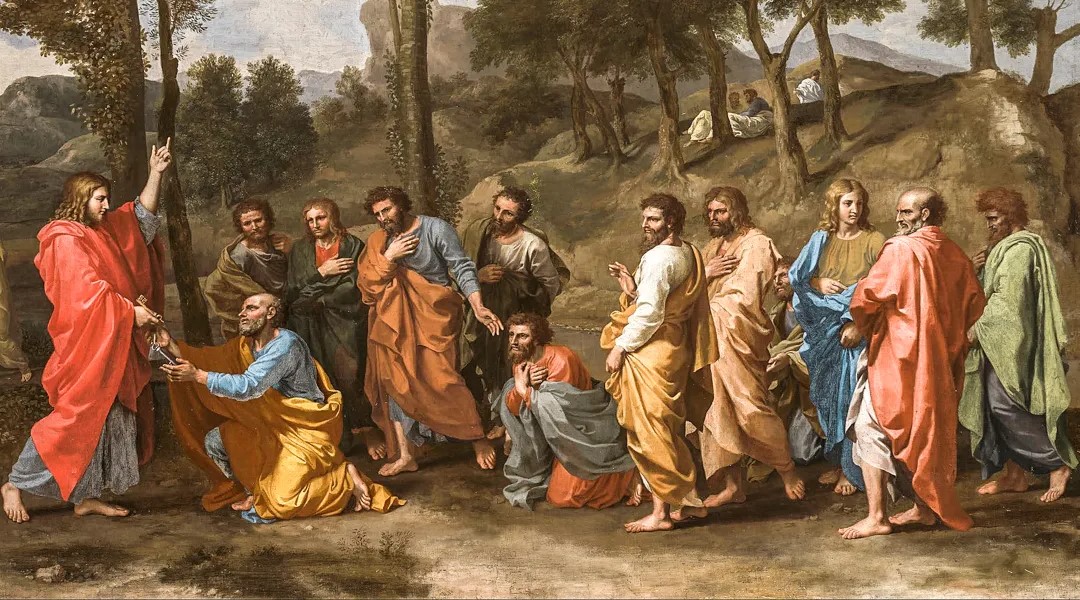
“But that servant went out and found one of his fellow servants who owed him a hundred denarii; and he laid hands on him and took him by the throat, saying, ‘Pay me what you owe!’ So his fellow servant fell down at his feet and begged him, saying, ‘Have patience with me, and I will pay you all.’ And he would not, but went and threw him into prison till he should pay the debt.
So when his fellow servants saw what had been done, they were very grieved, and came and told their master all that had been done. Then his master, after he had called him, said to him, ‘You wicked servant! I forgave you all that debt because you begged me. Should you not also have had compassion on your fellow servant, just as I had pity on you?’And his master was angry, and delivered him to the torturers until he should pay all that was due to him.
“So my heavenly Father also will do to you if each of you, from his heart, does not forgive his brother his trespasses.” Jesus added, “Judge not, that you be not judged. For with what judgment you judge, you will be judged; and with the measure you use, it will be measured back to you. And why do you look at the speck in your brother’s eye, but do not consider the plank in your own eye? Or how can you say to your brother, ‘Let me remove the speck from your eye’; and look, a plank is in your own eye? Hypocrite! First remove the plank from your own eye, and then you will see clearly to remove the speck from your brother’s eye.”
The ascended master Saint Germain spoke about forgiveness in a dictation through the Summit Lighthouse. He said, “The timeless message ‘Forgive them, Father, for they know not what they do’ and ‘Forgive them even seventy times seven’ is plainly uttered, and yet much understanding is needed on the matter.
“The best way to forgive others is first to forgive oneself for all errors and then to expand this forgiveness infinitely to all. Be sure to cover every circumstance, make no exceptions. If God be a flaming fire and all of his offspring divine sparks, why should not one spark forgive another, no matter how much the sacred fire may have been misused?
“Beloved ones, your ascension is your goal! It is that simple. If all the energy you have ever misqualified by misusing Life’s precious substance is requalified and transmuted by the violet fire of freedom’s love and by forgiveness in action, what then can prevent your ascension or the attainment of your goal? Yet your own Presence alone knows the day and the hour when it shall occur.”
Forgiveness does not preclude resolution. Jesus also said, “Moreover if your brother sins against you, go and tell him his fault between you and him alone. If he hears you, you have gained your brother. But if he will not hear, take with you one or two more, that ‘by the mouth of two or three witnesses every word may be established.’And if he refuses to hear them, tell it to the church. But if he refuses even to hear the church, let him be to you like a heathen and a tax collector.” Jesus here is speaking about trying to find resolution, and if no resolution is possible, then to go separate ways.
Jesus encouraged
people to agree together in life and in prayer. “Again
I say to you that if two of you agree on earth concerning anything
that they ask, it will be done for them by my Father in heaven.
For where two or three are gathered together in my name, there
I am in the midst of them.”
Jesus
and Divine Justice
One morning, the disciples saw the barren fig tree Jesus had cursed dried up from the roots. This fig tree represents the fallen ones who are accursed because God allows them to spend all of the light remaining in their causal body before the final judgment. This is the reason why the evil ones, and those who flaunt an ungodly life in society, often have so much more ease and wealth than those who follow a path of righteousness and personal Christhood.
The epicureans who profess, lifetime after lifetime, “Let us eat and be merry for tomorrow we die” are the ones Jesus spoke of when he said, “Take heed to yourselves, lest at any time your hearts be overcharged with surfeiting, and drunkenness, and the cares of this life, so that day come upon you unaware. For as a snare, it shall come on all them that dwell on the face of the whole earth. Watch therefore, and pray always, that you may be accounted worthy to escape all these things that shall come to pass, and to stand before the Son of Man. For the Son of Man will come in the glory of his Father with his angels, and then he will reward each according to his works.”
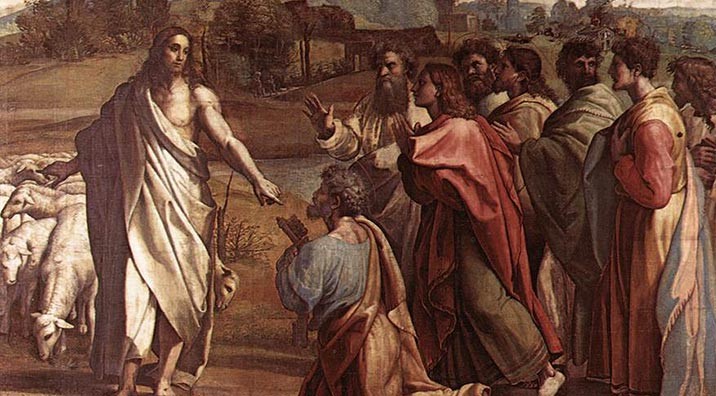
Jesus added, “Not everyone who says to me, ‘Lord, Lord,’ shall enter the kingdom of heaven, but he who does the will of my Father in heaven. Many will say to me in that day, ‘Lord, Lord, have we not prophesied in your name, cast out demons in your name, and done many wonders in your name?’ And then I will declare to them, ‘I never knew you; depart from me, you who practice lawlessness!’
“Master,” said Peter, “behold the fig tree which thou cursed is withered away.”And Jesus said, “Have faith in God. For whosoever shall say unto this mountain, be thou removed and cast into the sea, and not doubt in his heart, shall have whatsoever he saith. Therefore whatsoever ye desire, when ye pray, believe that ye receive them and ye shall have them. And when ye stand praying, forgive, if ye have ought against any: that your Father also which is in heaven may forgive you your trespasses.”
We can discern and offer our discernment to God for adjudication and righteous judgment—Justice is mine, I shall repay, sayeth the Lord—but we must refrain from judging ourselves or others.
Discernment comes through the gift of divine vision which is anchored in the third eye. For this reason, Jesus said: “The lamp of the body is the eye. If therefore your eye is good, your whole body will be full of light. But if your eye is bad, your whole body will be full of darkness. If therefore the light that is in you is darkness, how great is that darkness!” meaning the momentum of light is flipped into a momentum of darkness. The higher the height, the faster the fall.
“Therefore, whatever you want men to do to you, do also to them,” said Jesus, “for this is the Law and the Prophets.” Jesus gave a poignant forewarning: “Then the King will say to those on his right hand, ‘Come, you blessed of my Father, inherit the kingdom prepared for you from the foundation of the world: for I was hungry and you gave me food; I was thirsty and you gave me drink; I was a stranger and you took me in; I was naked and you clothed me; I was sick and you visited me; I was in prison and you came to me.’
“Then the righteous will answer him, saying, ‘Lord, when did we see you hungry and feed you, or thirsty and give you drink? When did we see you a stranger and take you in, or naked and clothe you? Or when did we see you sick, or in prison, and come to you?’ And the King will answer and say to them, ‘Assuredly, I say to you, inasmuch as you did it to one of the least of these my brethren, you did it to me.’
“Then he will also say to those on the left hand,‘Depart from me, you cursed, into the everlasting fire prepared for the devil and his angels: for I was hungry and you gave me no food; I was thirsty and you gave me no drink; I was a stranger and you did not take me in, naked and you did not clothe me, sick and in prison and you did not visit me.’
“Then they also will answer him, saying, ‘Lord, when did we see you hungry or thirsty or a stranger or naked or sick or in prison, and did not minister to you?’Then he will answer them, saying, ‘Assuredly, I say to you, inasmuch as you did not do it to one of the least of these, you did not do it to me.’And these will go away into everlasting punishment, but the righteous into eternal life.”
Jesus exhorted students in a Summit Lighthouse dictation, “Take the next six months to cry out to Almighty God for Divine Justice that the Lords of Karma might implement the edicts of the Twenty-four Elders to establish equal justice for the rich and the poor.
“Acts records that when Herod imprisoned Peter, the church prayed to God for him “without ceasing.”Peter was sleeping between two soldiers, bound with two chains. And the keepers before the door kept the prison. And, behold, the angel of the Lord came upon him, and a light shined in the prison: and he smote Peter on the side and raised him up, saying, “Arise up quickly.” And his chains fell off from his hands.
“And the angel said unto him, “Gird thyself and bind on thy sandals.” And so he did. And he saith unto him, “Cast thy garment about thee and follow me.”And he went out and followed him and wist not that it was true which was done by the angel but thought he saw a vision.
“When they were past the first and the second ward, they came unto the iron gate that leadeth unto the city, which opened to them of its own accord. And they went out and passed on through one street, and forthwith the angel departed from him.
“And when Peter was come to himself, he said, “Now I know of a surety that the Lord hath sent his angel and hath delivered me out of the hand of Herod.” And so, Peter escaped by the hand of the angel.
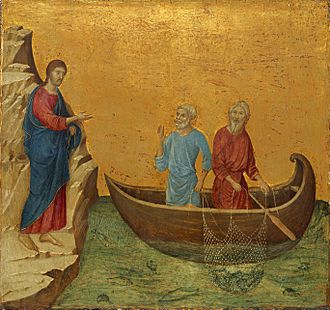
“As the early church prayed for Peter, so you must not fail to pray to the mighty angels of God to bring Divine Justice to those who are deserving of that justice. Pray that the angel of God open the prison doors and let out those who are there through no fault of their own but because the “system” favors the powerful and ignores the lowly. This must be your call!”
As Jesus passed through Jericho, a rich man named Zacchaeus, who was the chief publican, sought to see Jesus in the crowd but could not, because he was not tall. So he ran before Jesus and climbed into a sycamore tree to see him. When Jesus walked by the tree, he looked up and said, “Zacchaeus, make haste, and come down; for today I must abide at thy house. So Zacchaeus came down and received him joyfully. The people murmured, “He has gone to be guest with a sinner! Then Zacchaeus said, “Behold, Lord, I give half of my goods to the poor; and if I have taken anything from any man by false accusation, I restore him fourfold.” And Jesus replied, “This day has salvation come to this house, for he also is a son of Abraham, and the Son of Man is come to seek and to save that which was lost.”
“What do you think?” said Jesus, whose soul had once been the shepherd boy David. “If a man has a hundred sheep, and one of them goes astray, does he not leave the ninety-nine and go to the mountains to seek the one that is straying? And if he should find it, assuredly, I say to you, he rejoices more over that sheep than over the ninety-nine that did not go astray.”
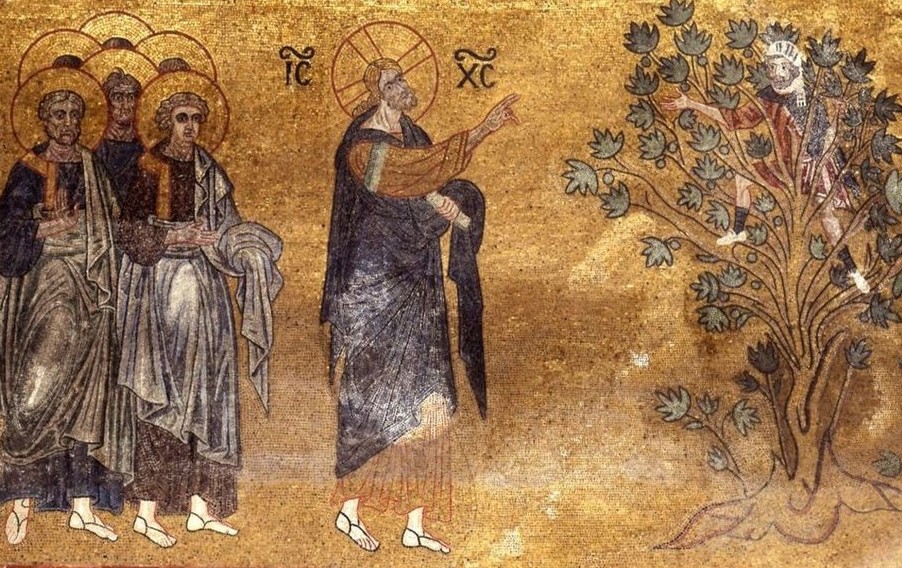
Jesus calls Zacchaeus
Veneto-Byzantine mosaic from Saint Mark's Basilica
Jesus
and the Children
The disciples came to Jesus, saying, “Who then is greatest in the kingdom of heaven?” Jesus called a little child to him, and set him in the midst of them: “Assuredly, I say to you unless you are converted and become as little children, you will by no means enter the kingdom of heaven. Therefore whoever humbles himself as this little child is the greatest in the kingdom of heaven. And whoever receives one little child like this in my name receives me.” The Gospel of Judas, in fact, says that Jesus occasionally shrouded his true identity from the disciples, though he would be found among them in the guise of a child.
Then, little children were brought to him that he might put his hands on them and pray. The disciples rebuked them, but Jesus said, “Let the little children come to me, and do not forbid them; for of such is the kingdom of heaven.” The Gospel of Truth tells us that Jesus assumed the role of a gentle and composed guide. Subsequently, even the young children—those possessing the Father's knowledge—approached him.
As they matured, they were instructed in the different aspects of the Father's essence. They gained knowledge and recognition, and in turn, they bestowed honor and praise. Within the hearts of the little children, the living book of the living was revealed. This book has been inscribed in the thoughts and minds of the Father and existed in that unfathomable aspect of Him, even before the beginning of all things.”
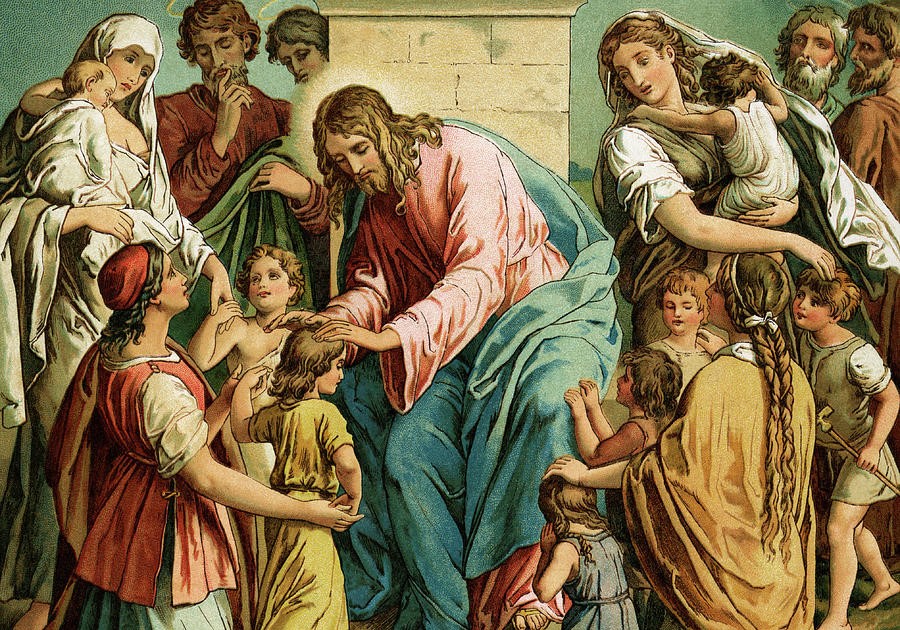
Jesus also warned, “But whoever causes one of these little ones who believe in me to sin, it would be better for him if a millstone were hung around his neck, and he were drowned in the depth of the sea. Woe to the world because of offenses! For offenses must come, but woe to that man by whom the offense comes!
“Take
heed that you do not despise one of these little ones, for I
say to you that in heaven their angels always see the face of
my Father who is in heaven. Even so it is not the will of your
Father who is in heaven that one of these little ones should
perish.”
Jesus
and Returning Karma
“Therefore whoever hears these sayings of mine, and does them, I will liken him to a wise man who built his house on the rock: and the rain descended, the floods came, and the winds blew and beat on that house; and it did not fall, for it was founded on the rock. But everyone who hears these sayings of mine, and does not do them, will be like a foolish man who built his house on the sand: and the rain descended, the floods came, and the winds blew and beat on that house; and it fell. And great was its fall.”
Jesus was speaking of returning karma, from which no one is immune, safe through contrition and transmutation, which is the forgiveness of sins. Some reported to Jesus about Galileans whom Pilate had killed by mingling their blood with their sacrifices. Jesus replied, “Do you suppose that these Galilaeans were sinners above all the Galilaeans, because they suffered such things? I tell you, Nay. Except ye repent, ye shall all likewise perish. Or those eighteen, upon whom the tower in Siloam fell, and slew them, do you think that they were sinners above all men that dwelt in Jerusalem? I tell you, Nay: but, except ye repent, ye shall all likewise perish.”
Jesus also spoke about family karmas and denounced family mesmerism—when a person forsakes the path of the ascension to please relatives. “Do not think that I came to bring peace on earth. I did not come to bring peace but a sword. For I have come to ‘set a man against his father, a daughter against her mother, and a daughter-in-law against her mother-in-law’; and ‘a man’s enemies will be those of his own household.’ He who loves father or mother more than me is not worthy of me. And he who loves son or daughter more than me is not worthy of me. And he who does not take his cross and follow after me is not worthy of me He who finds his life will lose it, and he who loses his life for my sake will find it.”
Jesus reminded students in a Summit Lighthouse dictation that the path of the ascension has a cost. “I have spoken of this before, and I have commanded you to claim the mantle of your Christhood. And ye know so well in your hearts that the day must come when your Christhood should appear, for are ye not the light of the world? A city that is set on a hill that cannot be hid. And ye also know well that men do not “light a candle and put it under a bushel but on a candlestick, and it giveth light unto all that are in the house.”
“In the same manner, may you allow your Christhood to shine brightly, ready to dispense love. For thereby you shall not be moved from your Christ-centeredness but you will make fervent calls to me for the violet-flame transmutation of persecution and of the hate crimes that have been committed against our Community.”
Jesus told his disciples, “Whatever I tell you in the dark, speak in the light; and what you hear in the ear, preach on the housetops. And do not fear those who kill the body but cannot kill the soul. But rather fear him who is able to destroy both soul and body in hell. Are not two sparrows sold for a copper coin? And not one of them falls to the ground apart from your Father’s will. But the very hairs of your head are all numbered. Do not fear therefore; you are of more value than many sparrows.”
And he gave us this consolation. “Come to me, all ye who labor and are heavy laden, and I will give you rest. Take my yoke upon you and learn from me, for I am gentle and lowly in heart, and you will find rest for your souls. For my yoke is easy and my burden is light. ”
“Also I say unto you, whosoever shall confess me before men, him shall the Son of Man also confess before the angels of God. But he that denies me before men shall be denied before the angels of God. And when they bring you unto the synagogues, and unto magistrates, and powers, take ye no thought how or what thing ye shall answer, or what ye shall say: For the Holy Ghost shall teach you in the same hour what ye ought to say.
“Therefore I say to you, every sin and blasphemy will be forgiven men, but the blasphemy against the Spirit will not be forgiven men. Anyone who speaks a word against the Son of Man will be forgiven. But whoever speaks against the Holy Spirit will not be forgiven, either in this age or in the age to come.”
The ascended master Lanello, who was last embodied as Mark Prophet, explained what this: “In every age, the Lord God has sent forth his representatives to show forth the effulgence of the Logos in Christed beings–“male and female created he them.” If those among mankind for whom the example is given fail to acknowledge that Christ as the Mediator in the avatar that is sent, then their own opportunity for the realization of the Christ is cut off. This is the law, and it cannot be broken. Therefore, it is not the man or the outer person that we worship, for this would be idolatry. But to fail to acknowledge the Christ incarnate as the avatar of the age–this is indeed blasphemy and the sin against the Holy Spirit which cannot be forgiven until it is forsaken.
Elizabeth Clare Prophet provides more understanding. “Our God is the consuming fire. The flaming Presence of God is the Divine Monad, above all as the I AM Presence, through all as the all-pervasive essence of the Holy Spirit, in you all as the threefold flame in your heart. It cannot be denied. It cannot be taken from you except you yourself deny it, and denial of that flame is the sin against the Holy Spirit which cannot be forgiven until it is forsaken. For when you deny your divinity by free will, it is taken from you. And therefore you suffer from the law of sin that is of your own creating.
.jpg)
Easter by Therese
Emmanuel
Jesus
Calls Us to Be Disciples
“When we occupy the position of an apostle of the Church, let us remember that those who come after us will suffer from our weaknesses and will be borne up by our strengths. And so we want to overcome our weaknesses and build up our strengths. Our teacher Jesus wants us to excel and to accelerate the God flame and the crystallization of that God flame.
“I bid you, then, concern yourself with apostleship. Concern yourself with being worthy to be apostles for Christ. Accelerate your path of initiation. Get God where you are and throw out everything that impedes your getting of God. Accelerate going into the fiery core of you own Christ consciousness. Put your house in order. Bring yourself into alignment with the sacred Word. Be God where you are. Speak with authority as Jesus did and not as the scribes. We don’t want to be scribes and Pharisees. We want to be apostles for Christ. We, each one, are called to this mission.”
Isaiah witnessed, “Then I heard the voice of the Lord saying, “Whom shall I send? And who will go for us?”
And I said, “Here am I. Send me!”
These are the words of all those who sincerely become Sons and Daughters of God, following in the footsteps of Jesus—our elder brother—who said, “All things have been delivered to me by my Father, and no one knows the Son except the Father. Nor does anyone know the Father except the Son, and the one to whom the Son wills to reveal him.”
In the dictation, “I Desire to Be Remembered by You,” Jesus said: “Thanks to the Messengers, you have a far greater knowledge of what transpired in my life beyond the thirty-three years that the scriptures record than most others have. Beloved, because you know that I, Jesus, your Lord, have taught the laws of karma and reincarnation to the people, so you also must teach these laws to the people.
“You must not withhold the truth of God’s laws! And you must not let your carnal mind be the judge of who is ready to ponder these laws of God and who is not. The hour is late. Break the bread of life and let all partake of it.
“Better to be persecuted by those who reject you and who, in rejecting you, reject me than to not offer them the prize of the high calling of their Christhood through the Word of God. You must offer them the Teachings of the Ascended Masters, including the laws of karma and reincarnation, for I require this of all my disciples.
“Every soul evolving on planet earth must receive the offering and then must choose to the right or to the left. As you are my disciples, I ask you to be my instruments in the performing of this service to life in my name.
“Blessed ones, strengthen yourselves in my Sacred Heart that you might meet all circumstances at the level of your Christhood. Go forth, for the hour is come! And this gospel of the kingdom shall be preached in all the world for a witness unto all nations, and then shall the end of world darkness come.”